
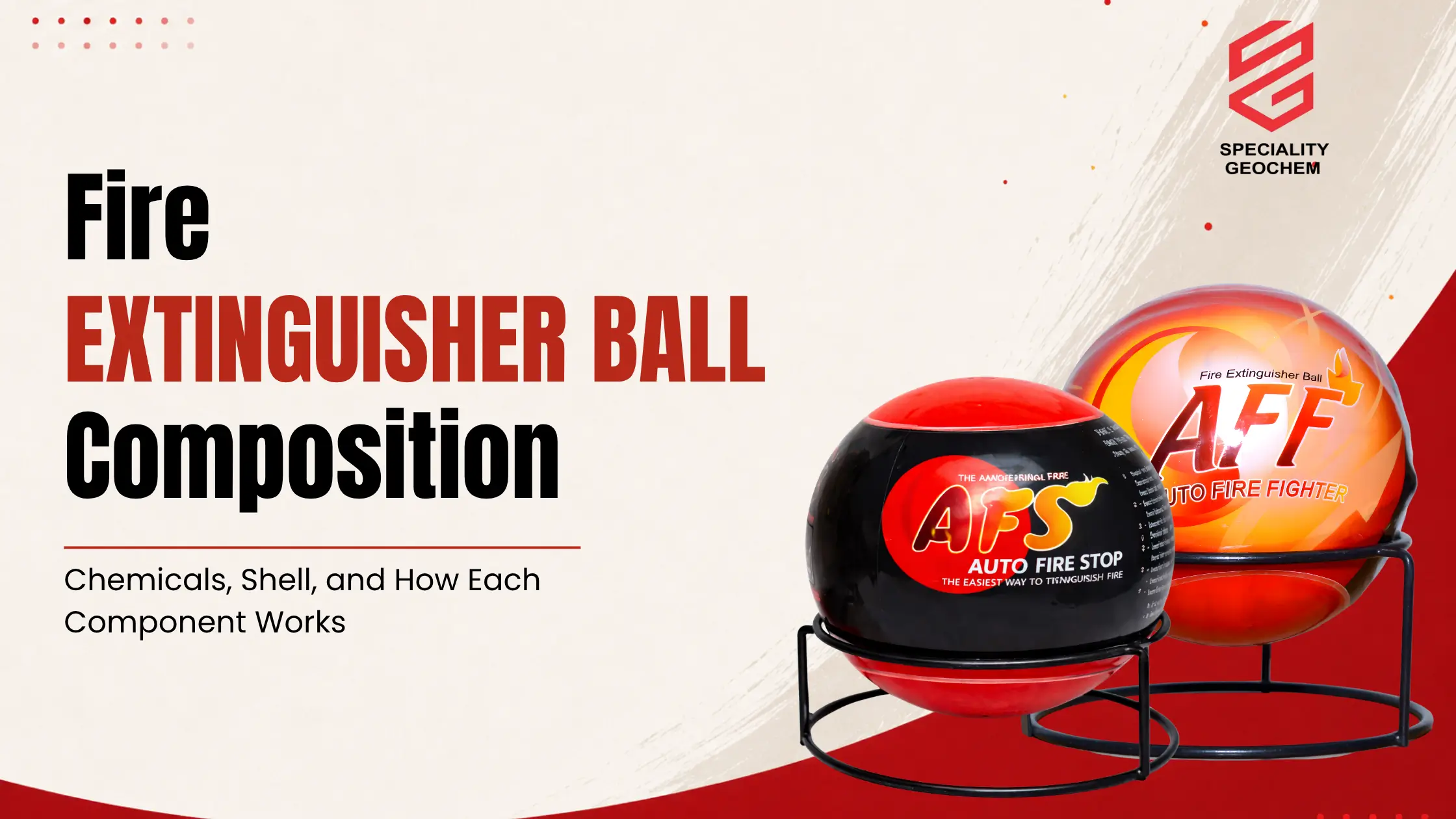
The fire extinguisher ball composition uses monoammonium phosphate (MAP) as its primary dry chemical agent for suppressing Class A, B, and C fires. Along with MAP, the ball contains ammonium sulfate, silicone-based anti-caking additives, and a heat-sensitive polymer shell engineered for rapid activation. Each component supports a specific function, from preventing powder clumping to enabling automatic 360° fire suppression within seconds of flame contact.
What Is the Chemical Composition of a Fire Extinguisher Ball?
The fire extinguisher ball composition consists mainly of monoammonium phosphate, ammonium sulfate, flow-control additives, and a heat-sensitive outer shell designed for automatic powder dispersal.
The primary extinguishing agent inside most fire suppression ball systems is monoammonium phosphate (MAP), chemical formula NH₄H₂PO₄, CAS number 7778-77-0. MAP forms the active base of modern ABC powder composition systems because it suppresses Class A fire, B, and C fires through thermal decomposition and oxygen isolation.
Manufacturers combine monoammonium phosphate with ammonium sulfate to improve powder consistency, storage stability, and discharge reliability. Standard formulations generally contain 40 to 60 percent MAP with 40 to 60 percent ammonium sulfate. Higher-grade industrial formulations may increase MAP concentration to nearly 90 percent for stronger extinguishing performance.
The composition also includes silicon dioxide and magnesium carbonate in small percentages. These additives prevent moisture absorption and reduce powder clumping during long-term storage. Without anti-caking agents, the powder may harden and fail to disperse correctly after activation.
Most fire extinguisher ball chemical composition systems also use siliconization technology. During this process, powder particles between 10 and 100 microns receive a silicone coating that improves free-flow discharge performance and moisture resistance.
| Component | Role | Typical % |
|---|---|---|
| Monoammonium phosphate (MAP) | Primary fire suppressant | 40–90% |
| Ammonium sulfate | Filler + anti-caking | 10–60% |
| Silicon dioxide | Flow agent, prevents clumping | <5% |
| Silicone coating | Particle treatment for discharge | <2% |
| Magnesium carbonate | Anti-moisture, anti-caking | <3% |
This combination of chemical agents explains what is inside a fire extinguisher ball and why the powder disperses rapidly after shell rupture.
Why Monoammonium Phosphate — and Not Other Chemicals?
Monoammonium phosphate is used because it suppresses Class A, Class B Fire, and C fires simultaneously while remaining non-conductive, stable, and relatively safe for occupied spaces.
Earlier BC powder systems relied mainly on sodium bicarbonate. Although sodium bicarbonate performed well on Class B and C fires, it failed to suppress deep-seated Class A combustible fires involving wood, paper, cloth, and plastics. MAP solved that limitation by forming a molten coating over burning surfaces.
CO₂ systems leave no residue, but they provide limited discharge coverage and require directional application through pressurized cylinders. A fire suppression ball needs a dry chemical capable of automatic radial dispersal without external pressure equipment.
Halon systems once offered excellent suppression efficiency, but global environmental restrictions under the Montreal Protocol phased them out because of ozone depletion risks. Monoammonium phosphate became the preferred replacement because it combines multi-class suppression capability with lower environmental impact.
The chemistry behind MAP powder fire safety depends on thermal decomposition. When exposed to flame temperatures, monoammonium phosphate breaks down according to the following reaction:
NH_4H_2PO_4 \rightarrow NH_3 + H_3PO_4 \rightarrow HPO_3
The resulting metaphosphoric acid forms a glass-like coating over fuel surfaces. This coating blocks oxygen access and slows heat transfer, which rapidly weakens combustion.
Unlike water-based extinguishing systems, MAP powder does not conduct electricity. That characteristic allows the composition to suppress energized electrical fires more safely than liquid agents.
Which Fire Classes Does the Composition Cover?
The monoammonium phosphate fire extinguisher ball composition suppresses multiple class of fire such as Class A, B, and C fires but does not safely handle Class D metal fires or Class K cooking oil fires.
Class A Fires
Class A fires involve ordinary combustible materials such as wood, cloth, paper, rubber, and plastics. Monoammonium phosphate melts at approximately 150°C and forms a metaphosphoric acid coating over the fuel surface. This layer blocks oxygen and slows the combustion cycle.
Class B Fires
Class B fires involve flammable liquids and gases such as petrol, diesel, solvents, paint, LPG, and industrial chemicals. MAP interrupts the free radical chain reaction responsible for sustaining liquid fuel combustion. The powder cloud reduces flame intensity within seconds after discharge.
Class C Fires
Class C fires involve energized electrical equipment including switchboards, motors, wiring systems, and electrical panels. MAP remains electrically non-conductive, allowing safer suppression around live systems within manufacturer voltage ratings.
Class D Fires
Class D fires involve combustible metals such as magnesium, sodium, titanium, and lithium. Standard ABC powder composition systems cannot safely suppress reactive metal combustion because these fires require specialized dry powder agents.
Class K Fires
Class K fires involve cooking oil and deep-fat frying systems. Monoammonium phosphate cannot create the saponification reaction needed to cool and stabilize burning oil surfaces. Wet chemical extinguishers remain the correct solution for commercial kitchens.
| Fire Class | Fuel Type | MAP Effective? | Why |
|---|---|---|---|
| Class A | Wood, paper, fabric | Yes | Forms coating that cuts oxygen |
| Class B | Flammable liquids, gases | Yes | Interrupts chain reaction |
| Class C | Electrical equipment | Yes | Non-conductive agent |
| Class D | Reactive metals | No | Not formulated for metal fires |
| Class K | Cooking oil/grease | No | Requires wet chemical agent |
The ability to suppress multiple fire classes with a single powder blend is the main reason fire extinguisher ball composition systems use monoammonium phosphate instead of older BC-only agents.
Shell Composition — What Makes the Ball Burst on Contact
The shell composition uses heat-sensitive polymer materials designed to rupture within 3 to 5 seconds of flame contact.
Most fire suppression ball shells use high-density polyethylene (HDPE) or polystyrene because these materials remain durable during handling but fracture quickly under sustained heat exposure. The shell normally ruptures at surface temperatures between 70°C and 80°C.
Inside the shell, the powder remains compact until activation occurs. Once the trigger area reaches activation temperature, internal gas pressure rises rapidly and forces the shell to burst outward.
Unlike traditional extinguishers that release powder through a nozzle, the ball disperses powder in a full 360° radius. A single unit typically covers approximately 9 square meters depending on placement height and airflow conditions.
The activation sound generally ranges between 120 and 140 dB because of sudden gas expansion and shell fragmentation. This loud discharge also acts as an emergency warning signal inside homes, warehouses, electrical rooms, and factories.
Most units weigh between 1.3 and 1.5 kg including shell structure and powder fill. That relatively low weight allows installation above electrical panels, inside vehicles, or near kitchen zones without complex mounting hardware.
This shell design is what makes the fire extinguisher ball composition function as an automatic system you don’t need to know the Pass Fire Extinguisher method as the fire ball is automatically activated unlike traditional extinguisher.
Is the Fire Extinguisher Ball Composition Safe for Homes?
Yes. Monoammonium phosphate is considered non-toxic under standard fire safety classifications, although it creates nuisance dust during discharge.
The powder inside most fire suppression ball ingredients is not classified as highly hazardous. During activation, airborne particles may temporarily irritate the nose, throat, or lungs, especially in enclosed spaces. Moving to fresh air normally resolves mild exposure symptoms quickly.
Skin or eye contact generally requires only water rinsing because the residue is non-corrosive. Unlike foam agents, MAP residue does not create slippery liquid contamination across floors and walkways.
Post-discharge cleanup usually involves vacuuming loose powder followed by wiping surfaces with water. The residue remains water-soluble and relatively easy to remove from walls, flooring, and machinery surfaces.
Monoammonium phosphate also appears in agricultural fertilizer applications because phosphate compounds biodegrade naturally over time. That gives the composition relatively low long-term environmental persistence compared to halogenated suppression chemicals.
The composition is suitable for homes, vehicles, offices, factories, warehouses, kitchens, and electrical panel zones. However, environments containing sensitive electronics such as data centres, telecom rooms, or laboratory equipment generally prefer clean-agent suppression systems because ABC powder residue can contaminate delicate circuitry.
Speciality Geochem’s Fire Extinguisher Ball: Composition and Standards
Speciality Geochem manufactures ISI-grade fire suppression balls using tested-grade monoammonium phosphate formulations engineered for Indian operating conditions and humidity levels. The powder blend is designed for stable storage, rapid activation, and reliable discharge performance across Class A, B, and C fire risks.
As a fire extinguisher ball manufacturer, the company focuses on certified suppression performance and controlled powder formulation standards. Readers who want a deeper technical explanation can also review monoammonium phosphate activation explained.
Frequently Asked Questions About Fire Extinguisher Ball Composition
Q1: What is the main chemical in a fire extinguisher ball?
The primary chemical in a fire extinguisher ball is monoammonium phosphate (MAP), with the formula NH₄H₂PO₄. Most balls contain a blend of 40–90% MAP combined with ammonium sulfate as a secondary agent. Together they suppress Class A, B, and C fires by decomposing under heat to form a coating that cuts oxygen supply to the flame.
Q2: Is the chemical composition of a fire extinguisher ball toxic or dangerous?
Monoammonium phosphate is not classified as toxic. On discharge it produces fine nuisance dust — move to fresh air and rinse skin or eyes with water if exposed. The residue is water-soluble and easy to clean. It is safe for use in homes, vehicles, and offices.
Q3: Can a fire extinguisher ball’s chemical composition handle electrical fires?
Yes. Monoammonium phosphate is non-conductive, making it safe for Class C electrical fires. The ball can be installed inside electrical panels, near switchboards, or in server rooms where human response may be delayed — though clean agent systems are preferred where residue contamination is a concern.
Q4: What is the difference between ABC powder and fire extinguisher ball composition?
The chemical agent is the same — monoammonium phosphate. The difference is delivery. A traditional ABC extinguisher requires a person to aim and discharge it manually. The fire extinguisher ball activates automatically on flame contact, dispersing the same MAP-based composition in 360° without any human operation.
Q5: How long does the chemical composition in a fire extinguisher ball remain effective?
The standard shelf life is 5 years from manufacture date. Humidity and moisture degrade MAP powder over time, so balls stored in damp environments may lose effectiveness earlier. Store in a dry location and check the expiry label annually.