
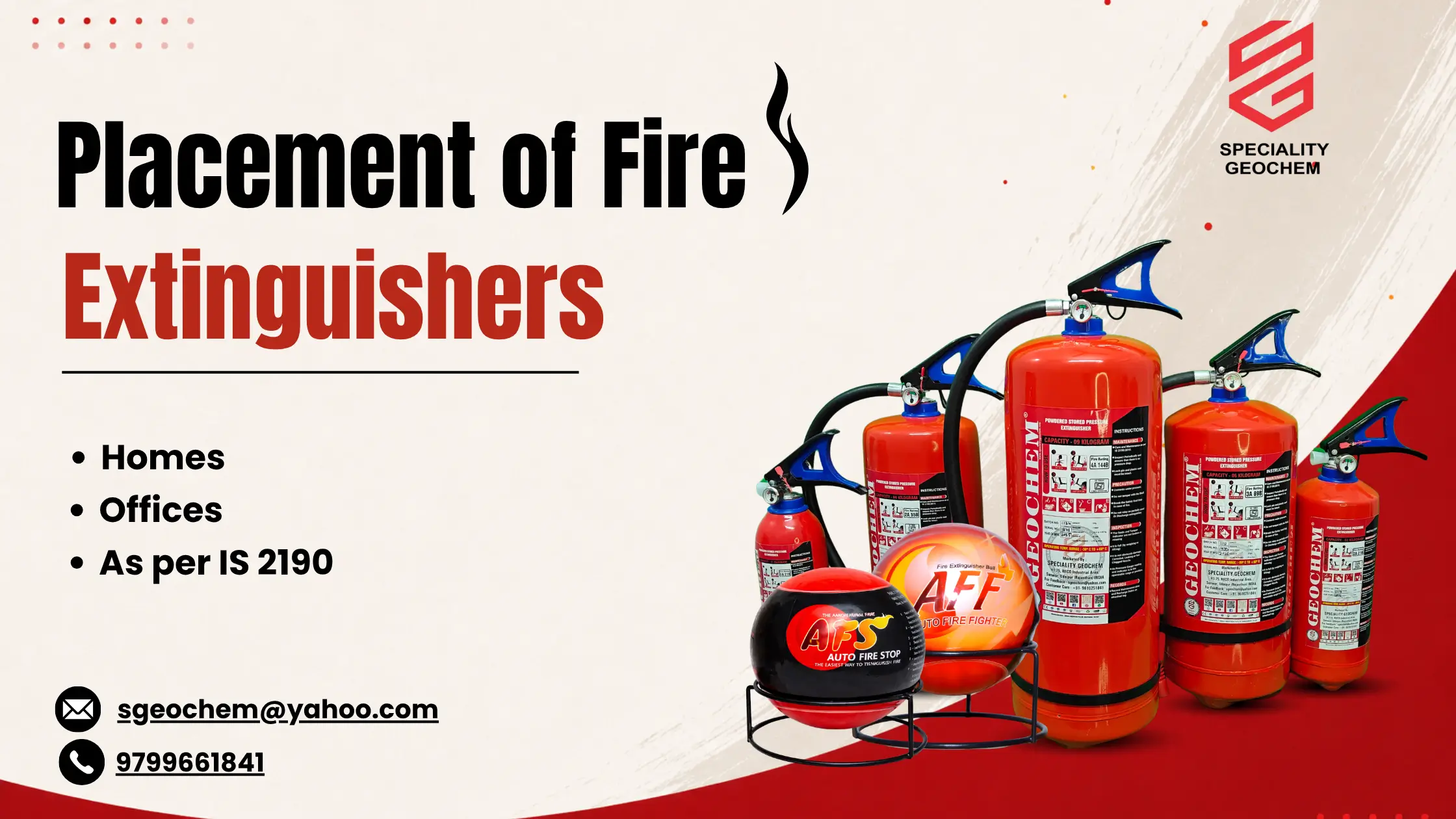
Placement of Fire Extinguishers: Room by Room Guide as per IS 2190

Placement of Fire Extinguishers: Room by Room Guide as per IS 2190

Place fire extinguishers along normal exit paths, at 1.0–1.5 m height from floor level, within a maximum travel distance of 15 m for Class A hazards and 9 m for Class B/C hazards as specified in IS 2190.

Fire extinguishers save lives only when someone can reach one in time. Mount them too high, tuck them behind closed doors, or skip the kitchen entirely, and you have a compliance checkbox, not a fire safety plan.

This guide covers proper placement of fire extinguishers for homes, offices, and industrial premises. Every rule here references IS 2190 (Indian Standard for Selection, Installation, and Maintenance of First-Aid Fire Extinguishers) and NBC 2016 norms.

What Is the Correct Placement of Fire Extinguishers as per IS 2190?

IS 2190 lays out clear placement rules that apply across residential, commercial, and industrial buildings in India:

  • Mount height: The handle of the extinguisher should be at 1.0 m to 1.5 m above floor level so adults can grab it without stretching or crouching.
  • Maximum travel distance: No person should have to walk more than 15 metres to reach a Class A extinguisher (ordinary combustibles like paper, wood, fabric). For Class B fire (flammable liquids) and Class C (electrical fires), the maximum travel distance reduces to 9 metres.
  • Visibility: Extinguishers must be clearly visible. Where sight lines are blocked by shelving or machinery, use directional signage at corridor junctions.
  • Accessibility: Never block an extinguisher behind a locked door, inside a cabinet that requires a key, or in a storage area that workers cannot access during a fire.
  • Proximity to exits: Place extinguishers along normal paths of travel and near exit doors, not at dead ends.

Placement of Fire Extinguishers in the Home: Room by Room

Kitchen

The kitchen generates more residential fires than any other room. Place a 2 kg ABC dry powder extinguisher or CO₂ extinguisher within arm’s reach of the stove, but not directly above or beside it. If a fire starts on the hob, you need to approach from a safe angle. A position 1–2 metres from the cooking area, near the kitchen exit, gives you access without walking through flames.

Do not mount it under the sink. Moisture and cleaning chemicals damage the body and valve over time.

Living Room and Hallway

A hallway is the fastest exit route. Mount one extinguisher near the main exit door of your home, typically in the entrance corridor. A 1 kg or 2 kg ABC dry powder unit works here. This single unit also covers the living room in most standard apartment layouts.

Bedroom Floor

For homes with two or more floors, place a second extinguisher on the upper floor near the staircase, not inside a bedroom where it could be inaccessible if the corridor fills with smoke.

Garage and Parking Area

Vehicles carry petrol, diesel, and electrical systems, all Class B and Class C fire risks. Use a CO₂ fire extinguisher (2 kg or 4.5 kg) in the garage. Mount it near the exit door, not near the vehicle fuel tank.

RoomRecommended TypeMount Position
Kitchen2 kg ABC or CO₂Near kitchen exit, 1 to 2 m from stove
Entrance / Hallway2 kg ABCNear main exit door
Upper Floor2 kg ABCNear staircase top
Garage4.5 kg CO₂Near garage exit door
Home Office2 kg CO₂Near desk, away from electrical panels

Placement of Fire Extinguishers in the Workplace

Office Buildings

For a standard office, IS 2190 requires one extinguisher per 200 square metres of floor area for light hazard occupancies. Place units at corridor junctions and stairwell landings, positions where people naturally pass during evacuation.

For server rooms and data centres, CO₂ or clean agent extinguishers are mandatory. Dry powder damages electronic equipment beyond repair even when the fire is small.

Warehouses and Factories

Industrial premises fall under medium or high hazard classifications under IS 2190. Coverage requirements increase:

  • Medium hazard: One extinguisher per 100 sq m
  • High hazard: One extinguisher per 50 sq m, with additional fixed suppression systems in most cases

Place extinguishers at every exit point, near fuel storage areas, at machine operation stations, and at a maximum 15 m travel distance throughout the floor.

Staircases and Common Areas

Every staircase landing, including basement levels, must have an extinguisher. Stairwells are evacuation routes. If a fire blocks a ground floor exit, the staircase extinguisher may be the only option a trapped occupant has.

Fire Extinguisher Placement Distance: The Travel Distance Rule

Travel distance is not the same as installation distance. Travel distance means how far a person has to walk, around furniture, through corridors, past machinery, to reach the nearest extinguisher. A straight line distance of 10 m in a factory with racking and equipment could translate to a 20 m walk.

Hazard ClassMaximum Travel Distance (IS 2190)
Class A (Paper, Wood, Fabric)15 metres
Class B (Flammable Liquids)9 metres
Class C (Electrical Equipment)9 metres
Class D (Metal Fires)Consult fire safety engineer

When planning placement, physically walk the travel path. Do not measure on a floor plan alone.

Fire Extinguisher Placement as per Indian Standard: IS 2190 Code and Standards at a Glance

India’s fire extinguisher placement code is IS 2190:2010, published by the Bureau of Indian Standards. This is the legal placement standard for portable extinguisher selection, installation, and maintenance across all building types. Here are the placement specific requirements you need to know:

  • Height rule: Handle at 1.0–1.5 m from finished floor level.
  • Wall mounting: Use standard bracket or recessed cabinet. The extinguisher body must not touch the floor. Floor contact causes corrosion from cleaning water.
  • Signage: IS 2190 requires a red identification sign above or beside the extinguisher. At corridors and intersections, directional signs with an arrow pointing to the extinguisher location are mandatory.
  • Spacing: In corridors longer than 30 m, extinguishers must be installed on both sides.
  • Outdoor units: If placed outdoors or in areas with direct sunlight, temperature extremes, or dust exposure, use a protective cabinet rated for that environment.
  • Annual inspection: IS 2190 mandates an annual maintenance check by a competent person. Inspection records must be maintained on site.

Where to Place Fire Extinguisher Signs

Signs guide people to extinguishers under stress and reduced visibility. IS 2190 and NBC 2016 both specify sign requirements:

  • Primary sign: Red background, white text or pictogram, mounted directly above the extinguisher at a height visible over people’s heads (typically 2 m from floor level).
  • Directional signs: Arrow based signs at corridor junctions, doorways, and any point where the extinguisher is not directly visible.
  • Sign size: Minimum 150 mm × 150 mm for standard signs. Larger formats required in warehouses and public buildings.
  • Lighting: In exit routes and stairwells, extinguisher signs must be either illuminated or made from photoluminescent material.

Do not position signs where they will be obscured by open doors, shelving, or seasonal stock.

How Many Fire Extinguishers Are Required per Area?

The number of extinguishers depends on floor area, occupancy type, and hazard class. IS 2190 Annex B provides the specific calculation method.

Occupancy TypeArea per ExtinguisherMinimum per Floor
Residential (House/Flat)One per 200 sq m or per floor (whichever is lower)1
Light Hazard OfficeOne per 200 sq m1 per floor
Medium Hazard (Retail, Hospitality)One per 100 sq m2 per floor
High Hazard (Factory, Warehouse)One per 50 sq mAs per layout
Basement Car ParkOne per 50 sq mMinimum 2

These figures are starting points. A fire safety audit by a licensed professional gives you the exact count and placement map for your building.

Read an Detailed Guide on: How Many Fire Extinguishers Do You Need?

Placement of Fire Extinguishers in the Kitchen: Special Considerations

Kitchens carry a unique risk, cooking oil fires (Class F) that water and dry powder can make worse. Standard ABC extinguishers do not address deep fat fryer fires.

For residential kitchens: a 2 kg CO₂ or ABC extinguisher near the kitchen exit handles most cooking fires.

For commercial kitchens (restaurants, canteens): use a wet chemical (Class F) extinguisher in addition to a CO₂ unit. Position the wet chemical extinguisher within 3 metres of the cooking range, not directly behind it.

A fire extinguisher ball or automatic fire suppression device above the cooking range adds a passive layer of protection that activates even when no one is in the kitchen, useful for homes and small commercial setups that are sometimes left unattended.

Where Are Fire Extinguishers Found in a Building? (Standard Locations)

If you are auditing an existing building or conducting a fire safety walkthrough, these are the standard locations where extinguishers should be found:

  • Ground floor entrance lobby
  • Every staircase landing (each floor)
  • Server rooms and data centres
  • Canteen and kitchen areas
  • Electrical panel rooms
  • Generator room
  • Basement and parking levels
  • Production floor (factory) at every exit and machine cluster
  • Reception or front desk area
  • Storage and warehouse aisles

If any of these locations in your building do not have an extinguisher or have an extinguisher that has not been inspected in over 12 months, that is a compliance gap.

Which Fire Extinguisher Is Suitable for Home Use?

Use the right agents for the fire classes. The wrong extinguisher can spread a fire instead of suppressing it.

Fire ClassWhat BurnsCorrect Extinguishing Agent
Class AWood, paper, fabric, plasticsWater, ABC dry powder, foam
Class BPetrol, diesel, solvents, paintCO₂, ABC dry powder, foam
Class CLive electrical equipmentCO₂ only (non-conductive)
Class DCombustible metals (magnesium, sodium)Specialist dry powder, consult engineer
Class FCooking oils and fatsWet chemical only

For most Indian homes, a 2 kg ABC dry powder extinguisher covers Classes A, B, and Class C fire in a single unit. Add a wet chemical unit in the kitchen if you have a deep fryer or commercial style range. For home offices with computers or servers, a CO₂ unit is better. Dry powder leaves residue that destroys electronics.

Fire TypeRecommended ExtinguisherWhy
Paper, Wood, Fabric (Class A)ABC Dry Powder or WaterCovers most room fires
Cooking Oil, Kitchen Fires (Class F)Wet ChemicalSafe for kitchen grease fires
Electrical Equipment (Class C)CO₂Leaves no residue, safe on electronics
General Home Use2 kg ABC Dry PowderCovers A, B, and C in one unit

The legal case: Under the National Building Code of India 2016 (NBC 2016) and various state fire safety acts, fire extinguishers are mandatory in residential buildings above a certain height, all commercial premises, factories, and public spaces. Non compliance can result in building occupancy certificate cancellation and legal liability in the event of a fire.

The practical case: A 2 kg extinguisher, properly placed and used within the first 30 seconds of a fire, can suppress a small fire before it becomes a structural emergency. The Indian Fire Statistics Bureau reports that the majority of fire deaths occur in fires that spread beyond the room of origin, fires that a properly positioned extinguisher could have stopped.

Extinguisher Placement Checklist Before You Call It Done

Use this before signing off on any installation:

  • Handle at 1.0–1.5 m from floor level
  • Travel distance within 15 m (Class A) or 9 m (Class B/C)
  • Mounted on wall bracket, not resting on floor
  • Red identification sign above unit at 2 m height
  • Directional signs at all corridor junctions with restricted sightlines
  • Access not blocked by furniture, stock, or locked doors
  • Inspection tag dated within the last 12 months
  • Correct extinguisher type for the fire risk in that area
  • Outdoor or exposed units in weatherproof cabinet
  • Maintenance record available on site

Frequently Asked Questions

What is the correct height for mounting a fire extinguisher?

IS 2190 specifies that the handle of the extinguisher should be between 1.0 m and 1.5 m from the finished floor level. This ensures adults of standard height can lift and operate it without assistance.

Can a fire extinguisher be placed on the floor?

No. Floor placement causes the extinguisher body to corrode from contact with cleaning water and floor moisture. It also creates a trip hazard. Always wall mount using the provided bracket.

How far apart should fire extinguishers be placed?

The maximum travel distance between extinguishers is 15 m for Class A hazards and 9 m for Class B/C hazards, measured along the actual walking path, not straight line distance.

Do I need a fire extinguisher in every room at home?

No. One per floor is sufficient for most homes, provided it is mounted near the staircase or exit point. A second unit in the kitchen is strongly recommended given cooking fire risk.

What NFPA standard covers fire extinguisher placement?

NFPA 10 governs portable fire extinguisher placement in the United States. In India, the applicable standard is IS 2190 published by the Bureau of Indian Standards (BIS). For buildings with international clients or certifications, both may apply.

When should a fire extinguisher be used?

Use a fire extinguisher only on a small, contained fire, one that has not spread beyond its point of origin and where your exit path is clear. If the fire is larger than a waste bin, evacuate and call the fire department. Do not attempt suppression if the room is filling with smoke.

When using a fire extinguisher, where should the nozzle point?

Point the nozzle at the base of the flame, not at the top. Aiming at the flames themselves does nothing. The agent needs to reach the burning fuel source. Use the PASS method : Pull the pin, Aim at the base, Squeeze the handle, Sweep side to side across the base until the fire is out.

Who should use a fire extinguisher during an emergency?

Any trained adult who can safely approach the fire without blocking their exit should attempt suppression on a small fire. In workplaces, IS 2190 recommends that at least one trained person per shift knows extinguisher operation. In homes, all adults should know the PASS technique and the location of each unit.

Where should a fire extinguisher be kept at home?

Keep the primary extinguisher near the kitchen exit, the highest risk area in a home. A second unit belongs near the main entrance or at the top of the staircase on upper floors. Never keep an extinguisher inside a cupboard or behind a closed door.

Knowing where to place an extinguisher matters. Knowing which one to place there matters equally. Speciality Geochem BIS/ISI certified fire extinguisher manufacturer in india across all major classes, ABC dry powder, CO₂, water, foam, and wet chemical, from two RIICO certified manufacturing units in Udaipur and Deedwana Kuchaman.

The AFS Fire Ball (Auto Fire Stop)qnd AFF fire extinguisher ball (Auto Fire Fighter) is a passive suppression option for homes and small offices. It mounts above a fire risk area, a kitchen range, an electrical panel, a server rack, and activates on contact with flames within 3–8 seconds, covering 1.80 cubic metres with 360 degree suppression. No training required. No manual operation needed.

→ Browse BIS certified fire extinguishers for home and industrial use.