
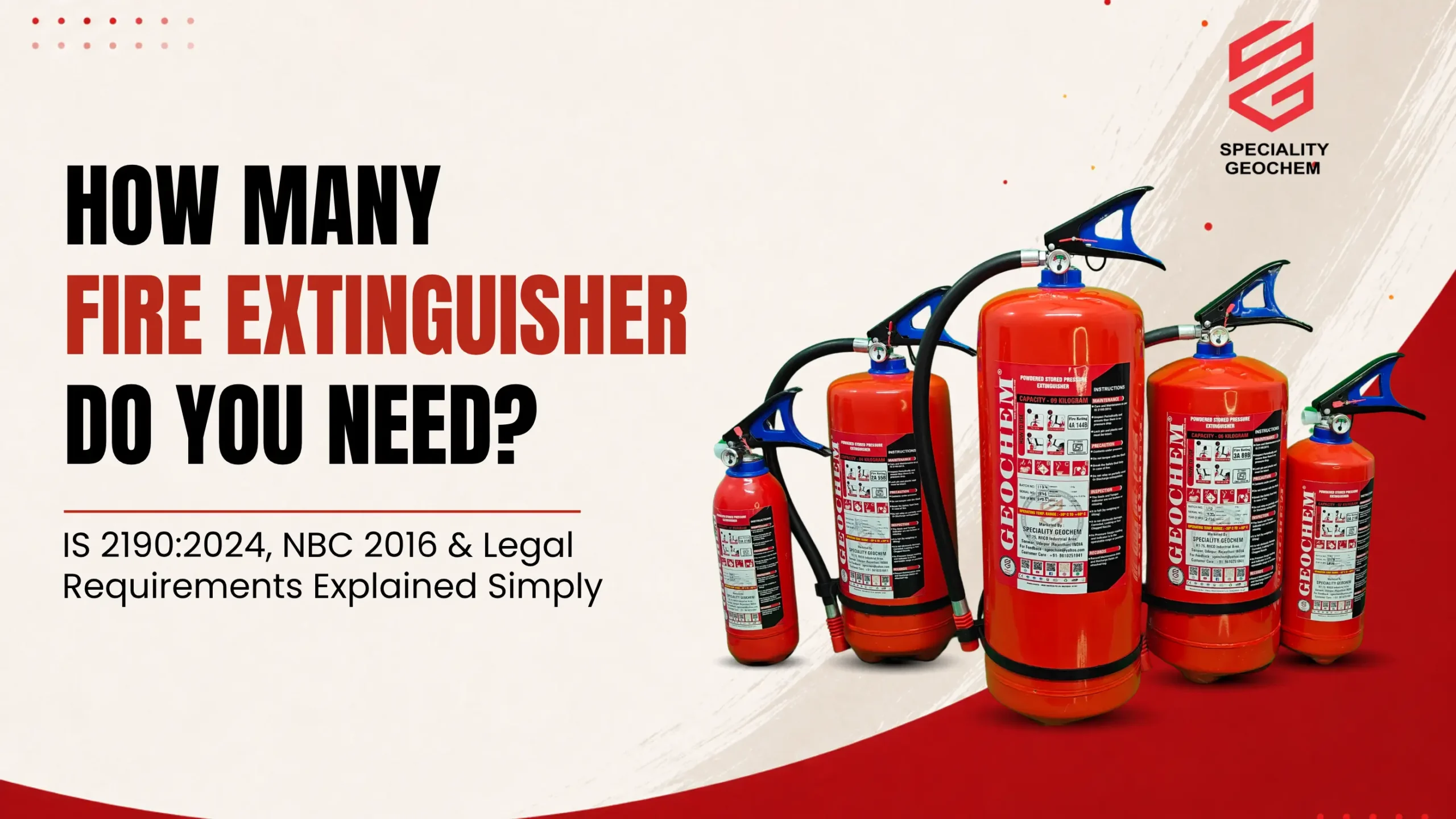
How Many Fire Extinguishers Do You Need?
The answer depends on three things: your building’s hazard level, floor area, and the maximum travel distance from any point to the nearest extinguisher. India’s governing standard, IS 2190:2024, published by the Bureau of Indian Standards (BIS), specifies all three parameters through a hazard classified coverage system, not a single universal number. At Speciality Geochem, manufacturer of BIS-certified fire extinguishers since 1996, we work with these requirements daily, and this guide gives you the exact figures your fire officer will inspect against.
Quick Answers
- Light hazard spaces (offices, schools, libraries): 1 extinguisher per 150 sq metres, IS 2190:2024
- Ordinary hazard spaces (retail shops, workshops, hospitals): 1 extinguisher per 75 sq metres, IS 2190:2024
- Extra hazard spaces (factories, warehouses, chemical storage): 1 extinguisher per 40 to 50 sq metres, IS 2190:2024, verify with fire officer
- Maximum travel distance to any extinguisher: 15 metres for all hazard levels, IS 2190:2024, Clause 6.3
- Minimum for any space, regardless of size: 1 extinguisher
- Homes: Minimum 1 per floor (IS 2190 recommended practice); kitchen and garage are priority locations
- Restaurants and commercial kitchens: A Class K wet chemical extinguisher is mandatory near cooking equipment. This is a separate requirement in addition to your area based count.
The IS 2190 Hazard Classification System | Know Your Category First
IS 2190 does not work like a single flat rule. It classifies every building by occupancy hazard first, then assigns a coverage figure to that hazard class. The reason matters: an office and a paint shop face fundamentally different fire risks. Applying an office coverage figure to a factory floor would leave you dangerously underprotected and non compliant on inspection day.
Most building owners get this wrong because they search for a single number. There is no single number. A 1,000 sq metre building could legally require anywhere from 7 extinguishers (light hazard) to 25 extinguishers (extra hazard) depending entirely on what happens inside it.
| IS 2190 Hazard Class | Typical Examples | Coverage per Extinguisher | Minimum Extinguisher Rating |
|---|---|---|---|
| Light (Low) Hazard | Offices, schools, libraries, hotels, residences | 1 per 150 sq metres | 1 × 9 litre water or equivalent |
| Ordinary (Medium) Hazard | Retail shops, workshops, hospitals, light manufacturing | 1 per 75 sq metres | 2 × 9 litre water or equivalent |
| Extra (High) Hazard | Factories, warehouses, chemical storage, paint shops | 1 per 40 to 50 sq metres | Specialist, consult IS 2190 Annex B |
Source: IS 2190:2024, Annex B, Bureau of Indian Standards
There is a nuance here that most building owners and several competitor guides miss entirely. IS 2190 classifies hazard by contents, not building type. A well designed modern office building is light hazard for the open plan floors. But if that same building contains a diesel generator room, a fuel storage area, or a server room with UPS battery banks, those zones are classified at ordinary or extra hazard.
Mixed occupancy buildings must be assessed zone by zone, and each zone’s extinguisher count calculated separately.
How to Calculate How Many Fire Extinguishers You Need
IS 2190:2024 gives you a two step test. Both steps must be satisfied. Passing one and failing the other means your building is non compliant.
Step 1 | Area Calculation
Formula: Number of extinguishers = Floor area (sq metres) ÷ Coverage area for your hazard class
Always round up. Never round down.
Worked Example 1 | Office (Light Hazard)
Floor area: 450 sq metres
Hazard class: Light
Coverage per extinguisher: 150 sq metres
Calculation: 450 ÷ 150 = 3 extinguishers minimum
Note: 301 sq metres ÷ 150 = 2.007. Always round up. Install 3, not 2.
Worked Example 2 | Retail Shop (Ordinary Hazard)
Floor area: 300 sq metres
Hazard class: Ordinary
Coverage per extinguisher: 75 sq metres
Calculation: 300 ÷ 75 = 4 extinguishers minimum
Worked Example 3 | Factory Floor (Extra Hazard)
Floor area: 500 sq metres
Hazard class: Extra
Coverage per extinguisher: 50 sq metres
Calculation: 500 ÷ 50 = 10 extinguishers minimum
Step 2 | The 15 Metre Travel Distance Override (IS 2190:2024, Clause 6.3)
This is the rule most buildings fail on inspection and the rule most online guides never mention.
IS 2190:2024, Clause 6.3 states that the maximum walking distance from any point in a building to the nearest extinguisher must not exceed 15 metres for all hazard levels. This rule operates independently of the area calculation. If your area calculation gives you 4 extinguishers but placing them evenly leaves a back corner 20 metres from the nearest unit, you install a 5th extinguisher, not 4.
The travel distance rule overrides the area calculation. A long, narrow building or an L shaped floor plan will almost always require more extinguishers than the area formula alone suggests.
Square Foot Conversion (for sq ft users):
| IS 2190 Hazard Class | Sq metres per Extinguisher | Approx. Sq Feet per Extinguisher |
|---|---|---|
| Light | 150 sq m | ~1,615 sq ft |
| Ordinary | 75 sq m | ~807 sq ft |
| Extra | 50 sq m | ~538 sq ft |
How Many Fire Extinguishers Are Required in Different Buildings?
Requirements vary significantly by building type. Here is the authoritative breakdown for each major occupancy category under IS 2190:2024 and NBC 2016.
How Many Fire Extinguishers Does a Commercial Building or Office Need?
For most open plan office floors, IS 2190:2024 classifies the occupancy as Light Hazard, 1 extinguisher per 150 sq metres. That changes the moment you add server rooms, kitchenettes, diesel generators, UPS battery rooms, or bulk paper storage. Any of those zones triggers an upgrade to Ordinary Hazard for that area.
The NBC 2016 (National Building Code, issued by the Ministry of Housing and Urban Affairs) sets a simplified baseline of 1 extinguisher per 200 sq metres for mixed occupancy buildings. IS 2190’s hazard classified figures are more conservative and should be followed, particularly in buildings where a fire safety audit will be conducted.
Key Placement Rules for Offices Under IS 2190:2024, Clause 6.2–6.3
- Mount extinguishers near exits and stairwells, never hidden behind furniture or inside locked rooms
- Place at identical positions on every floor so occupants who know one floor can navigate the others in an emergency
- Maximum 15 metres walking distance from any workstation
- Recommended types: ABC dry chemical powder fire extinguisher for general areas; CO₂ extinguishers near electrical panels and server rooms (CO₂ leaves no residue and does not damage equipment)
How Many Fire Extinguishers Are Required in a Factory?
Factories fall under Extra Hazard classification without exception. IS 2190:2024 specifies 1 extinguisher per 40 to 50 sq metres as the starting calculation. Your final number must be verified with your local fire officer as part of the factory’s approved fire safety plan.
This is not optional guidance. The Factories Act, 1948, Section 38 imposes a legal obligation on every factory registered under the Act to take adequate precautions against fire. Non compliance is not a planning oversight. It is a statutory violation. Under Section 38, fire precautions include both the provision and maintenance of extinguishers.
Required Placement Locations Inside Factories
- Near all electrical panels and switch rooms (CO₂ type)
- Adjacent to machinery with moving parts and lubrication systems
- At fuel storage points and filling areas
- Near spray booths, painting areas, and flammable liquid storage
- At compressed gas cylinder storage and usage points
- Near any diesel generators
For larger factories or plants above a threshold hazard level, portable extinguishers alone are insufficient. IS 2190:2024 recommends supplementing with automatic fire suppression tube systems for machinery enclosures and high risk process areas, particularly where a person may not be present to operate a manual extinguisher.
How Many Fire Extinguishers Are Required in a Warehouse?
Warehouses are Extra Hazard. IS 2190:2024 specifies 1 extinguisher per 40 to 50 sq metres as the baseline. Classify by the most hazardous material stored in the facility, not the average.
There is an important structural consideration that the area formula alone does not capture. High bay racking over 4 to 5 metres creates fire spread conditions, specifically the chimney effect between rack columns, that are beyond the suppression capacity of portable extinguishers alone. IS 2190:2024 recommends that tall rack warehouses supplement their portable extinguisher provision with sprinkler systems or automatic fire suppression tube systems.
For mixed goods storage, every product category must be assessed. The extinguisher type and count is governed by the highest hazard material on site.
How Many Fire Extinguishers Are Required in a Restaurant?
Restaurants require two separate calculations, one for the front of house dining area and a completely separate one for the commercial kitchen.
Front of house dining area: Classified as Ordinary Hazard under IS 2190:2024. Coverage: 1 extinguisher per 75 sq metres. ABC dry powder or CO₂ extinguishers are appropriate here.
Commercial kitchen: Classified as Extra Hazard. Separate calculation and separate extinguisher count.
The most critical rule for restaurant owners, and the one most commonly missed, is this: a standard ABC dry powder extinguisher must never be used on a Class F fire (burning cooking oil or fat). Discharging an ABC extinguisher onto a chip fryer or commercial deep fryer at high temperature causes a violent fat splatter reaction, essentially an explosion of burning oil, that can be lethal.
Commercial kitchens must have a Class K wet chemical extinguisher mounted within 5 metres of cooking equipment, visible and unobstructed. This is a mandatory requirement separate from, and in addition to, your area based count. One Class K extinguisher near the cooking line does not replace your general area extinguishers. You need both.
How Many Fire Extinguishers Do You Need in a Home?
IS 2190:2024 does not mandate specific quantities for private residences. However, IS 2190 and NBC 2016 both recommend a minimum of 1 extinguisher per floor as good practice provision.
The Fire Extinguishers (Quality Control) Order, 2023, a Government of India order under the Bureau of Indian Standards Act, makes BIS certification mandatory for all fire extinguishers sold in India. This protects homeowners from cheap, uncertified equipment that may fail to discharge or discharge incompletely during an actual fire.
When buying a fire extinguisher for your home, look for the BIS mark and a valid IS 2190 compliance certificate.
Practical Placement for Homes
- Kitchen: CO₂ or ABC (ideally CO₂ to avoid powder residue on food and appliances)
- Living room or main hallway: ABC dry powder, accessible without passing through the kitchen
- Garage or vehicle parking area (if enclosed): ABC or foam extinguisher near the exit
- Near any inverter, UPS, or generator installation: CO₂ type
For hard to access spaces such as loft areas, false ceiling cavities, and electrical distribution board cupboards where a person cannot reach and operate a manual extinguisher in time, consider a fire extinguisher ball. A fire extinguisher ball activates automatically on flame contact, requires no human operation, and is an effective supplementary device for enclosed at risk spaces.
How Many Fire Extinguishers Are Required on a Boat?
In India, fire extinguisher requirements for registered vessels are governed by the Directorate General of Shipping (DGSS) under the Merchant Shipping Act. Requirements vary by vessel type, size, and classification. Consult DGSS or your flag state authority for vessel specific compliance.
As a practical minimum, fit at least 1 Type B (Class B/C capable, CO₂ or dry powder) extinguisher in or immediately outside each enclosed engine compartment, and 1 general extinguisher in the cabin or galley.
US reference point for globally registered vessels: USCG regulations under 33 CFR 175 require at least one USCG approved Type B extinguisher per enclosed engine compartment based on engine space volume. This is a useful benchmark even outside US jurisdiction.
What IS 2190 and NBC 2016 Actually Say | The Legal Framework
IS 2190:2024 is the Indian Standard for the selection, installation, and maintenance of portable first aid fire extinguishers. It is published and maintained by the Bureau of Indian Standards (BIS). The 2024 revision is the most current version. Most competitor guides and some older installation certificates still reference the 2010 or 1992 versions, which have been superseded.
The Fire Extinguishers (Quality Control) Order, 2023, issued under the BIS Act by the Government of India, makes BIS certification mandatory for all fire extinguishers manufactured or sold in India. Any extinguisher without the BIS mark is not legally compliant for sale or installation.
NBC 2016 (National Building Code of India, 2016) is published by the Bureau of Indian Standards on behalf of the Ministry of Housing and Urban Affairs. NBC sets the overarching planning and design standards for buildings, while IS 2190 provides the operational standard for extinguisher selection and placement. The two documents work together, not as alternatives.
NBC’s simplified “1 per 200 sq metres” baseline applies to general mixed occupancy planning. IS 2190’s hazard classified tables govern what you actually install. Where they differ, IS 2190 is more conservative and should be followed.
Factories Act, 1948, Section 38 imposes a statutory duty on every occupier of a factory registered under the Act to take adequate precautions against fire, including provision, positioning, and maintenance of fire extinguishing apparatus. This is law, not guidance.
State fire services acts can impose additional requirements that are stricter than national standards. Always verify with your state fire authority and local fire officer before finalising your provision.
⚠ Compliance Note
The figures in this guide are based on IS 2190:2024 and NBC 2016 and are intended as general guidance. For final compliance, always commission a site assessment from a certified fire safety officer. Requirements can vary by state, building occupancy classification, and local fire department rules.
The 2024 revision of IS 2190 updated several provisions. If your building permit or fire safety certificate predates 2024, verify your provision against the current standard.
Getting the number right is only half the job. IS 2190:2024 specifies maintenance intervals that are legally referenced during fire safety audits, and the Fire Extinguishers (Quality Control) Order, 2023 mandates that only BIS certified fire equipment is installed, which also ties into serviceability requirements.
| Inspection Type | Frequency | Who Performs It | IS 2190 Reference |
|---|---|---|---|
| Visual check (pressure gauge, safety pin, label, accessibility) | Monthly | Building safety officer or owner | IS 2190 Clause 10.1 |
| Professional inspection and service | Annual | BIS licensed fire safety technician | IS 2190 Clause 10.2 |
| Hydraulic pressure test | Every 3 to 5 years (type dependent) | Authorised service centre | IS 2190 Clause 11 |
| Refill / recharge | Immediately after any use, full or partial | Licensed supplier | IS 2190, a partially discharged extinguisher must never be returned to service |
IS 2190:2024 also requires a written maintenance register to be kept on the premises at all times. This register must record serial numbers, inspection dates, service details, and next due dates for every extinguisher in the building. The register is inspected during fire safety audits and licensing visits. Its absence is treated as a compliance failure independent of the extinguishers’ physical condition.
Quick Reference | All Requirements at a Glance
| Space Type | IS 2190 Hazard Class | Coverage per Extinguisher | Key Rule |
|---|---|---|---|
| Private home | Light | Min 1 per floor (IS 2190 recommended practice) | CO₂ or ABC in kitchen |
| Office | Light | 1 per 150 sq metres | CO₂ near server rooms; same position on every floor |
| Retail shop | Ordinary | 1 per 75 sq metres | Near exits; upgrade zones if storing flammables |
| Hospital / clinic | Ordinary | 1 per 75 sq metres | CO₂ only near medical equipment, no powder |
| Restaurant (front of house) | Ordinary | 1 per 75 sq metres | Separate Class K extinguisher required for kitchen |
| Commercial kitchen | Extra | Assess with fire officer | Class K (wet chemical) mandatory within 5m of cooking equipment |
| Factory / plant | Extra | 1 per 40 to 50 sq metres | Factories Act S.38 applies; automatic suppression for large plants |
| Warehouse | Extra | 1 per 40 to 50 sq metres | Supplement with sprinklers for high bay racking |
| Boat / vessel | Varies | Per DGSS norms | Type B near each enclosed engine compartment |
| All spaces | — | Max 15 metres travel distance | Both the area rule AND the 15m travel rule must be satisfied simultaneously |
The Right Type of Extinguisher Matters as Much as the Right Number
Knowing how many fire extinguishers you need is step one. Installing the wrong type for your fire class makes the count irrelevant. An ABC powder extinguisher on a burning cooking oil fire creates a fat splatter explosion. A water extinguisher on a live electrical panel can electrocute the user. The right number of the wrong extinguisher is still non compliant.
A Quick Fire Extinguisher Type Guide
- Class A fires (wood, paper, textiles): Water or ABC powder
- Class B fires (flammable liquids, fuels): Foam, CO₂, or dry powder
- Class C fires (electrical): CO₂ only (non conductive)
- Class F fires (cooking oils and fats): Class K wet chemical only
Our classes of fire guide explains each fire class and the correct extinguisher type in full detail. For standard building protection, our ABC powder fire extinguisher covers Classes A fire, B, and C in a single unit, making it the most common general purpose choice for offices, retail spaces, and warehouses.
Frequently Asked Questions
Q1: How many fire extinguishers do I need for my business?
It depends on your building’s IS 2190 hazard class and floor area. For light hazard spaces (offices, retail with no flammable storage), the IS 2190:2024 figure is 1 extinguisher per 150 sq metres. For ordinary hazard spaces (workshops, light manufacturing), it is 1 per 75 sq metres. As a minimum, every floor must have at least 1 extinguisher, regardless of size.
Q2: How many fire extinguishers are required per square metre in India?
IS 2190:2024 does not specify a single universal figure. The correct coverage depends on your hazard class: light hazard spaces require 1 extinguisher per 150 sq metres, ordinary hazard spaces require 1 per 75 sq metres, and extra hazard spaces (factories, warehouses) require 1 per 40 to 50 sq metres. Always verify your hazard classification before calculating.
Q3: How do I calculate how many fire extinguishers I need?
Divide your floor area in sq metres by the IS 2190:2024 coverage figure for your hazard class, then round up. For example, a 600 sq metre ordinary hazard workshop requires 600 ÷ 75 = 8 extinguishers. You must also check that no point in the building is more than 15 metres walking distance from the nearest extinguisher. This travel distance rule (IS 2190:2024, Clause 6.3) can require additional units beyond the area calculation result.
Q4: How many fire extinguishers are needed in a warehouse?
Warehouses are classified as Extra Hazard under IS 2190:2024. The coverage figure is 1 extinguisher per 40 to 50 sq metres. Verify the exact figure with your local fire officer as part of your fire safety plan. For warehouses with high bay racking over 4 to 5 metres, portable extinguishers alone are insufficient. IS 2190:2024 recommends supplementing with automatic fire suppression systems for tall rack storage areas.
Q5: How many fire extinguishers are required in a home in India?
IS 2190:2024 and NBC 2016 both recommend a minimum of 1 extinguisher per floor as good practice for residential properties. Priority locations are the kitchen (CO₂ or ABC), the main hallway of each floor, and any garage or generator area. For loft spaces, false ceiling cavities, or electrical panel cupboards that cannot be reached quickly, a fire extinguisher ball provides automatic protection without needing human operation.
Q6: What does IS 2190 say about fire extinguisher placement?
IS 2190:2024, Clause 6.3 specifies that the maximum walking distance from any point in a building to the nearest extinguisher must not exceed 15 metres for all hazard levels. Clause 6.2 also requires extinguishers to be positioned near exits and stairwells, mounted at the same locations on every floor, clearly visible, and unobstructed. Written maintenance records must be kept on the premises.
Q7: How many fire extinguishers does OSHA require?
OSHA 29 CFR 1910.157 (a US standard) requires 1 extinguisher per 278 sq metres (3,000 sq ft) for light hazard US workplaces, with a maximum travel distance of 22.9 metres. OSHA does not apply in India. Indian buildings must comply with IS 2190:2024 and NBC 2016, which are more conservative. IS 2190’s light hazard figure of 1 per 150 sq metres requires nearly double the number of extinguishers compared to OSHA’s equivalent figure.
Q8: How many fire extinguishers are required in a restaurant?
The front of house dining area is classified as Ordinary Hazard under IS 2190:2024, 1 extinguisher per 75 sq metres. The commercial kitchen is classified as Extra Hazard and requires a separate calculation. Additionally, IS 2190 and fire safety standards require a Class K wet chemical extinguisher mounted within 5 metres of commercial cooking equipment. This is mandatory and separate from the area based count because ABC powder extinguishers must never be used on Class F cooking oil fires.
Q9: How many fire extinguishers do you need on a boat in India?
For vessels registered in India, fire extinguisher requirements are set by the Directorate General of Shipping (DGSS) under the Merchant Shipping Act. Requirements vary by vessel type and size. As a practical minimum, fit at least 1 Type B (CO₂ or dry powder, Class B fire/C capable) extinguisher near each enclosed engine compartment, and 1 general extinguisher in the cabin or galley area. Always consult DGSS or your flag state authority for vessel specific compliance requirements.
Q10: How often should fire extinguishers be inspected in India?
IS 2190:2024 specifies monthly visual checks (pressure, pin, label) by the building safety officer, annual professional service by a BIS licensed technician, a hydraulic pressure test every 3 to 5 years at an authorised service centre, and immediate recharge after any use, full or partial. IS 2190 also requires a written maintenance register to be kept on the premises, recording all inspection dates and serial numbers for every extinguisher.
Conclusion
How many fire extinguishers you need is not a single number. It is a calculation with three inputs: your IS 2190:2024 hazard classification, your floor area, and the 15 metre travel distance rule that overrides the area result wherever your building’s layout demands it. Get the hazard class wrong and every number that follows is wrong too.
Speciality Geochem manufactures BIS certified fire extinguishers built to IS 2190:2024 and NBC 2016 standards. Our products are designed to the same specifications your fire officer will inspect against. If you need help selecting the right type and quantity for your building, our team can help. Explore our fire safety equipment.