
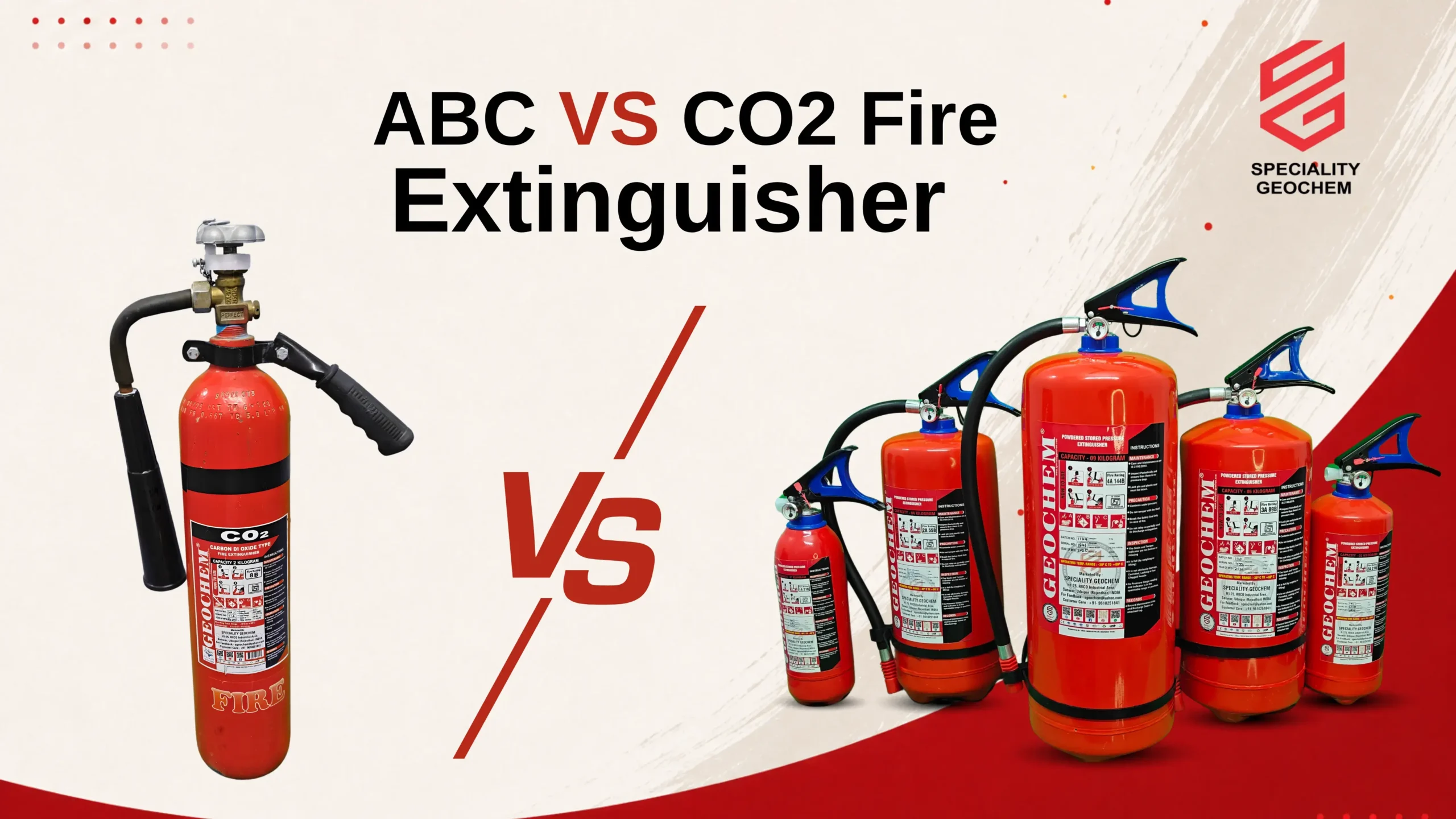
An electrical fire breaks out in an office corner near a printer. There are two wall-mounted extinguishers—ABC and CO2. One of them is snatched by somebody, is unsure and wastes seconds trying to determine what each one does. That’s a lot more prevalent than many are aware. In other cases, the improper extinguisher may cause additional damage that is more costly than the fire damage. This guide covers the practicalities of using a ABC vs CO2 fire extinguisher as well as maintenance requirements and safety concerns – and which is appropriate for your home, car, office, server room, and industrial facility.
What Is an ABC Fire Extinguisher?
A fire extinguisher with the letters ABC has a monoammonium phosphate dry chemical powder to deal with Class A, B and C fires. This encompasses fire involving wood, paper, fabric, rubber, plastic, petrol, diesel and live electrical equipment. In India these extinguishers are certified according to IS 15683 part 1.
The powder disrupts the combustion reaction’s chain and forms a layer to get in the way of any chance of a second flame. This makes ABC powder fire extinguishers very useful for combustible materials which may smoulder after the flames have been extinguished. Due to their versatility of use, ABC extinguishers are a common sight in homes, factories, warehouses, vehicles and offices throughout India.
What Is a CO2 Fire Extinguisher?
CO2 fire extinguishers contain CO2 gas that is stored under high pressure in a steel cylinder. It is intended for use with Class B fires (flammable liquids) and Class C electrical fires. CO2 fire extinguishers do not work on Class A combustible fires, as they will not extinguish the flames. CO2 extinguishers should not be used for combustible fire (Class A ), because they cannot put the fire out. They are certified in India according to IS 15683 Part 2.
The extinguisher displaces oxygen around the fire as well as cools the burning material. The gas does not leave behind any residue once discharged, which makes CO2 extinguishers very suitable for electronics, server rooms, electrical panels, UPS rooms and laboratories.
Common sizes in India are 2 kg, 3 kg, 4.5 kg, 6.5 kg and 9 kg; and CO2 extinguishers have a flared discharge horn and typically have no pressure gauge because the CO2 charge level is determined by the weight.
ABC vs CO2 Fire Extinguisher — Core Differences
The difference becomes clear once you compare where each extinguisher succeeds and where it fails.
| Feature | ABC Fire Extinguisher | CO2 Fire Extinguisher |
|---|---|---|
| Extinguishing agent | Monoammonium phosphate dry chemical powder | Compressed carbon dioxide gas |
| Fire classes covered | Class A, B, and C | Class B and C only |
| Leaves residue? | Yes, heavy powder residue | No residue |
| Safe for electronics? | Not recommended for sensitive electronics | Yes |
| Safe for enclosed spaces? | Use with caution — evacuate first | Use with caution — evacuate first |
| Suitable for cars? | Good for engine bay fires | Good for cabin and electrical fires |
| Suitable for homes? | Yes | Limited |
| Suitable for server rooms / data centres? | No | Yes |
| Suitable for kitchen fires? | Limited backup option | Poor choice for cooking oil fires |
| Common sizes available in India | 1 kg, 2 kg, 4 kg, 6 kg, 9 kg | 2 kg, 3 kg, 4.5 kg, 6.5 kg, 9 kg |
| Approximate price range (India, ISI-certified) | ₹500–800 for 1 kg; larger sizes ₹2,000–3,500 | ₹1,200–1,800 for 2 kg; larger sizes ₹4,000–6,000 |
| Refill availability in India | Widely available across most cities | More limited outside major cities |
| IS certification | IS 15683-1 | IS 15683-2 |
But, for many buyers, the simple rule is right. ABC extinguishers are the more versatile option and safer all-purpose fire extinguishers since they extinguish more types of fire. There are CO2 extinguishers that are designed for specific environments where residue damage is of no consequence. For this reason, a large part of offices, homes and factory floors make use of ABC units, and instead of that, server rooms, electrical control panels and data centres use CO2 or clean-agent systems.
Which Fire Classes Does Each Cover?
There are various types of Fire Classes with varying extinguishing agents. Fire classes are used to categorize fires according to the fuel involved.
- Class A fires are caused by solid combustible items like wood, paper, fabric, plastic and rubber. ABC extinguishers are effective as the powder puts out the fire and prevents re-ignition.
- Class B fires are flammable liquid fires (petrol, diesel, solvents etc.), and Class C fires are live electrical equipment fires. These fires can be extinguished with any type of ABC or CO2 extinguisher.
The CO2 extinguishers are not effective for class A fires because the CO2 is too volatile and does not leave a protective coating. Special extinguishers, other than an ABC or CO2 extinguisher, are used to extinguish Class D metal fires or Class K/F cooking oil fires.
ABC vs CO2 Fire Extinguisher for Cars
Car fires have multiple fire hazards in a single building. Fuel leaks, electrical short circuits, overheated wiring, rubber hoses, plastic engine covers, upholstery and battery systems all can burn under certain conditions. Therefore the choice of the extinguisher will rely on the location of the fire; this is why it is important to choose the right extinguisher.
CO2 for Cabin and Electrical Fires
The CO2 extinguishers are very effective extinguishers for electrical fires in the cabin area. The extinguisher does not leave a residue on the dashboard electronics, infotainment systems, wiring looms, upholstery, sensors, or airbag systems.
This is important because there are electronics inside today’s cars that are sensitive to the environment behind panels and ventilation systems. CO2 can easily be used to extinguish a small electrical fire and reopen the interior for repairs as needed.
The characteristics of ABC powder inside a vehicle cabin are drastically different. The powder is fed into the air conditioning vents, switchgear, gaps in dashboard, mechanisms for the seats and electrical connectors. It is very hard to completely clean. As time goes on, residual powder can draw moisture and cause corrosion inside of the electrical system.
ABC for Engine Bay Fires
The situation in the engine bay is a totally different one. These are usually the burning of rubber hoses, insulation material, plastic covers or flammable liquids in close proximity to hot engine parts. These fire conditions are mostly Class A, with Class B fire risks.
Generally, CO2 can only put out a visible fire for a short time, and as soon as the gas disperses, the fire will resume due to the heat that has been trapped beneath the burning materials. More effective because ABC powder coats the burning surfaces and interferes with the combustion process more completely.
Practical Guidance for Indian Car Owners
In India, many drivers have only one extinguisher as they lack space and budget. Then, the most practical single extinguisher to have on hand is a 1 kg or 2kg CO2 extinguisher for cabin fires and electrical fires. It is not as effective in a big engine compartment fire.
The best arrangement is to have a 2 kg CO2 extinguisher in the cabin and a 2 kg ABC extinguisher in the boot. This combination offers more protection against both electrical and combustible fire.
AIS-052 and MoRTH regulations stipulate the use of extinguishers in most commercial vehicles, and there is no specific guideline for CO2 versus ABC in private passenger vehicles. These recommendations are intended for fire safety concerns and not required as part of the law for private vehicles.
ABC Fire Extinguisher for Home Use
In India, most domestic fires are of type A which involve combustibles like domestic goods. Open fires burn curtains, overloaded plug points heat up and catch fire near furniture or broken wiring starts a fire in mattresses and wooden cabinets. That’s why ABC extinguishers are widely recommended for home use.
Why ABC Works Better for Most Homes
In the case of cooking oil and deep-fat fryer fires, the wet chemical extinguishers are the proper type, as they are designed to extinguish grease fires. But few Indian houses have a separate wet chemical unit.
In practice, ABC extinguishers are the most useful all-purpose extinguishers since they can be used for extinguishing a furniture fire, LPG-related fire, and electrical fire all with one cylinder. This makes them useful for multi-fire-hazard situations in an apartment, villa and independent home.
Kitchen Fire Considerations
The response and the selection of the extinguisher are essential for kitchen fires. When cooking oil can catch fire and a wet chemical fire extinguisher is not available, an ABC extinguisher is the best backup fire extinguisher. It will extinguish fire quickly, but will leave film on kitchen surfaces and equipment.
CO2 extinguishers are not as effective for general home use because they are not able to extinguish a fire after the gas has dissipated and there is a possibility that the fire will reignite. Furniture, curtains, mattresses, or wooden cabinets can again catch fire.
ABC powder also makes it hard to see and can make it irritating to breathe in small apartments. Discharge should be made in a short burst, if possible, control the fire, and then get away. A four kg ABC extinguisher is a useful general purpose extinguisher for most Indian homes.
ABC vs CO2 Fire Extinguisher for Offices and Server Rooms
Mixed fire hazards are present on one premises, like in an office. Paper, office furniture, computers, electrical outlets, air conditioners and wiring systems can all start a variety of fires. The result is that ABC extinguishers, in general, are the best type of extinguishers to use in a typical office.
ABC for General Office Areas
ABC extinguishers can be used to tackle paper, combustible furniture and electrical fires at the same time. A thin coating of powder on papers or office equipment is easier to deal with than covering a large area in case of an emergency.
In typical office environments, 2-4 kg ABC extinguishers located near the primary escape path can be usefully employed as a first response device.
CO2 for Server Rooms and IT Areas
There’s a vast difference between server rooms, UPS rooms, control rooms and data centres. In this area, the use of CO2 or clean-agent extinguishers is essential as powder contaminates could permanently render equipment useless.
ABC powder is used in cooling fans, power supply units, fibre systems, gaps in server racks and PCB tracks. The contamination can cause corrosion or electrical failures hours after the fire has been extinguished. In many instances, the amount of powder damage is greater than the actual loss caused by the fire.
That’s why CO2 extinguishers are commonly used for electrical fire protection in IT environments. This gas is a nonconductive quelling agent.
Fixed suppression systems are typically used in large data centres, like FM-200 or inert gas flooding systems. The portable CO2 extinguishers are still very valuable as a first line of defense before the automated systems kick in.
ABC vs CO2 Fire Extinguisher — Size, Weight, and Capacity Guide
The proper size of extinguishers is as critical as the appropriate extinguishing agent. If too small, a unit will be depleted before the fire is controlled. If the cylinder is too large, the untrained user may have trouble using it during an emergency.
Common Sizes Available in India
ABC powder extinguishers are sold in various sizes in India, ranging from 1 kg to 9 kg. The CO2 extinguishers are commonly found in 2kg, 3kg, 4.5kg and 6.5kg capacity, standards certified by ISI.
The small CO2 extinguishers generally are mounted in areas where electrical panels or small IT rooms are located. The larger units are 4.5 kg or 6.5 kg, and are more suitable for server rooms, laboratory, and industrial electrical applications.
Weight and Handling Differences
- CO2 extinguishers are heavier than most consumers realize due to the very high pressure of the gas used to operate the extinguisher. The walls of cylinders need to be much heavier than ABC extinguishers.
- The weight of fully charged 4.5kg CO2 extinguisher is in the range of 14kg to 17kg. This has an impact on a cylinder’s mounting height and portability, and whether it can be easily lifted and aimed by an unskilled user in emergency situations.
- The other difference between the two types is the length of time they are allowed to discharge. Typically, a 2 kg CO2 extinguisher will last between 8 and 12 seconds. A similar-sized ABC extinguisher typically delivers about 10-15 seconds.
- Bad technique uses agent inefficiently. Those who use the extinguisher from a distance or aim in an uncontrolled manner tend to “under-drain” the extinguisher before the fire is extinguished.
ABC vs CO2 Fire Extinguisher — Refilling and Maintenance in India
Even if fire extinguishers are never used, they still need regular inspection and maintenance. Over time, even a “good-looking” cylinder can leak, have valve issues, or fail the internal inspection.
ABC Refilling in India
ABC extinguisher refilling is not so complicated and easily available in India. When serviced, the old powder is removed, the cylinder is internally cleaned, fresh monoammonium phosphate powder poured in and then the cylinder is re-pressurised with nitrogen gas. The process is less specialised and thus ABC refill services are also available in many smaller cities and industrial areas in India. The rates can vary considerably from extinguisher size to service provider ranging from ₹200 to ₹500 per refill.
CO2 Refilling Requirements
CO2 extinguishers must be filled with high pressure filling systems and weighing equipment. Not all fire safety vendors have this capability. CO2 refill availability may be a real problem in tier 2 cities, rural industrial areas and remote areas.
The cost of refilling generally starts from ₹400 to ₹900, varying by cylinder size and supplier. CO2 cylinders may not be pressure checked by a standard pressure gauge alone as is done with ABC extinguishers. After refilling the cylinder, it needs to be weighed to ensure that the correct amount of gas has been placed in it.
Inspection and Hydrostatic Testing
ABC and CO2 extinguishers must be inspected annually by a certified technician. Any discharge, even if it’s partial or accidental, must be refilled immediately before the extinguisher goes back into service.
Indian safety standards also stipulate that hydraulic pressure testing must be performed every five years, or as often as manufacturers recommend. This hydrostatic testing is to ensure that the cylinder body is capable of safely handling the operating pressure.
Which One is Safer to Use? ABC vs CO2 Fire Extinguisher Safety
The discharge and use of the extinguisher are significant factors in safety. There are certain operational risks associated with both ABC and CO2 extinguishers which should be understood before an incident before they can take place.
CO2 Safety Risks
CO2 extinguishers produce very cold temperature extinguishment. The temperature of the horn can get as low as around −78 °C during operation; direct contact with the metal horn can result in a profound cold burn in just a few seconds.
The users should only grip the insulated handle when operating the extinguisher. CO2 also displaces oxygen quickly in confined areas. If it is possible to discharge for a long time without emptying the room, there can be a real risk of asphyxiation in smaller rooms.
It’s best to pour water on it, cover it, and exit the room after it has been poured out.
The following are safety concerns with ABC Powder.
ABC extinguishers form dense powder clouds and can make it difficult to see by almost immediately in small areas. A user who is not familiar with the operation of the extinguishers can become disoriented after using an extinguisher.
The powder is also irritating to the respiratory system. It’s not acutely toxic, but it may lead to significant breathing problems for those who suffer from asthma, or other respiratory sensitivities or for the elderly.
The best way to stop it is to sweep it briefly, concentrating on the base of the fire, and then immediately leave the area before the powder cloud reaches full size.
Practical Safety Conclusion
ABC extinguishers typically have a broader array of fire classes and can be used in more open or semi-open areas without as much situational judgment.
CO2 extinguishers require a higher level of consciousness of oxygen displacement and cold-burn hazards. Both of these extinguishers are safe to use if used properly. Risk seems to occur when the user is not aware of the limitation and behaviour in use of the extinguisher prior to use.
Common Mistakes When Choosing Between ABC and CO2
- A lot of people incorrectly fit a CO2 extinguisher in their homes, believing that it can extinguish all fires. CO2 is effective on electrical and flammable liquid fires and it is not effective on Class A fires (curtains, furniture, mattresses, wood) that might reignite after the CO2 gas has dissipated.
- Another expensive fiasco is the use of ABC powder in server rooms. The powder gets into cooling systems, circuit boards and electrical connectors, and can actually cause more damage than the fire.
- There is another reason why buyers prefer uncertified extinguishers; it is that they don’t have to pay for certification by ISI and IS 15683. Poor quality units may break during an emergency.
- This is an issue that is often ignored in smaller cities, regarding CO2 refill. Another error in the construction of mixed-risk buildings is that they sometimes only select one type of extinguisher rather than both.
Quick Decision Guide – Which Extinguisher Is Suitable for Your Area?
It is necessary to know the type of fire risk present in a certain environment to be able to select the correct extinguisher. Really, ABC are the best extinguisher for homes offices factories, and warehouses as they are capable of extinguishing furniture LPG paper, and electrical fires all in one.
Wet chemical extinguishers mainly serve in kitchen cooking fires, while ABC can be used as the first line of defense. CO2 extinguishers are more suitable for car cabins, server rooms laboratories IT facilities, and areas with electrical equipment because they do not leave any residue. Yet, engine bay fires typically require ABC powder to stop re-ignition.
Warehouses and mixed-risk facilities usually require two types located at different places. Outdoor areas tend to favour ABC because CO2 would very quickly be spread in an open area.
Frequently Asked Questions
Can I use a CO2 fire extinguisher on a Class A fire?
A: CO2 extinguishers are ineffective on most Class A fires because the gas disperses without leaving a protective coating behind. Once oxygen returns to the burning surface, materials such as wood, fabric, rubber, or paper often reignite. ABC powder or wet chemical extinguishers are more suitable for Class A combustible fires.
Is an ABC fire extinguisher safe to use in a car?
A: ABC extinguishers are effective for engine bay fires involving burning rubber hoses, fluids, and plastic components. The drawback is residue damage. If discharged inside the cabin, the powder can coat wiring, vents, upholstery, and electronics. For interior fires, CO2 or clean-agent extinguishers are generally safer for the vehicle itself.
Which fire extinguisher is best for a server room in India?
A: CO2 or clean-agent extinguishers such as HFC-227ea or Novec 1230 are the correct choice for server rooms. ABC powder can permanently damage electronics, cooling systems, connectors, and PCB traces even after the fire is extinguished. In IT environments, this is considered non-negotiable fire safety practice.
Does a CO2 fire extinguisher damage electronics?
A: CO2 leaves no residue and is considered safe for electronics, which is why it is commonly installed near servers, UPS systems, and electrical panels. Users should avoid directing the extremely cold discharge horn directly onto delicate equipment surfaces at close range to reduce thermal shock risk.
How often should ABC and CO2 extinguishers be serviced or refilled?
A: Both extinguisher types should undergo annual inspection by a certified technician. Any discharge, even partial or accidental, requires immediate refill before the extinguisher returns to service. Hydraulic pressure testing is generally required every five years according to Indian standards and manufacturer recommendations.
Which fire extinguisher is better for home use in India, ABC or CO2?
A: ABC extinguishers are generally better for home use because they cover the three most common household fire scenarios: Class A combustible fires, LPG-related flammable liquid fires, and electrical fires. CO2 extinguishers cover only Class B and C fires, leaving a significant gap for household combustible materials.
What is the price of ABC and CO2 fire extinguishers in India?
A: ISI-certified ABC extinguishers typically cost around ₹500–800 for 1 kg units and ₹2,000–3,500 for larger 9 kg units. CO2 extinguishers are more expensive, usually ranging from ₹1,200–1,800 for 2 kg units and ₹4,000–6,000 for larger 6.5 kg capacities. Prices vary by brand, capacity, and supplier.
Is CO2 fire extinguisher refilling available in smaller Indian cities?
A: Not always. CO2 refilling requires specialised high-pressure gas filling infrastructure that may not be available in many tier-2 or tier-3 cities. ABC refill services are generally easier to source across India. Businesses using CO2 extinguishers should verify local refill capability before installation.
What does IS 15683 mean on a fire extinguisher in India?
A: IS 15683 is the Indian Standard covering portable fire extinguishers. IS 15683-1 applies to dry chemical ABC extinguishers, while IS 15683-2 applies to CO2 extinguishers. The ISI mark confirms the extinguisher meets BIS testing and performance requirements under Indian certification standards.
Which fire extinguisher should I keep in a car — CO2 or ABC?
A: The safest setup is one of each: a 1–2 kg CO2 extinguisher for cabin and electrical fires, plus a 2 kg ABC extinguisher in the boot for engine bay fires. If carrying only one extinguisher, many professionals prefer CO2 for cabin protection because it avoids residue damage to electronics and upholstery.
Can ABC powder damage electronics?
A: Yes. Monoammonium phosphate powder can penetrate connectors, PCB gaps, cooling systems, and electrical housings. Over time, the residue may absorb moisture and accelerate corrosion. In server rooms and control panels, a single ABC discharge can cause extensive secondary equipment damage.
What is the difference between CO2 and clean agent fire extinguishers?
A: Both are residue-free and safe for sensitive electronics. CO2 extinguishers mainly cover Class B and C fires. Clean-agent extinguishers such as HFC-227ea or Novec 1230 also provide Class A coverage, making them more versatile for high-value environments where residue damage cannot be tolerated.
Choosing between ABC and CO2 extinguishers is really about matching the extinguisher to the actual fire risk profile of the space. A home, server room, warehouse, car cabin, and factory floor all behave differently during a fire. That is why most commercial facilities eventually use both extinguisher types together rather than relying on only one. Since 1996, Speciality Geochem has manufactured ABC dry powder and CO2 fire extinguisher cylinders certified under IS 15683 Part 1 and IS 15683 Part 2 respectively, supplying fire safety equipment across India.
To find the right extinguisher for your space, contact Speciality Geochem or browse the full range at Speciality Geochem Product Range.