
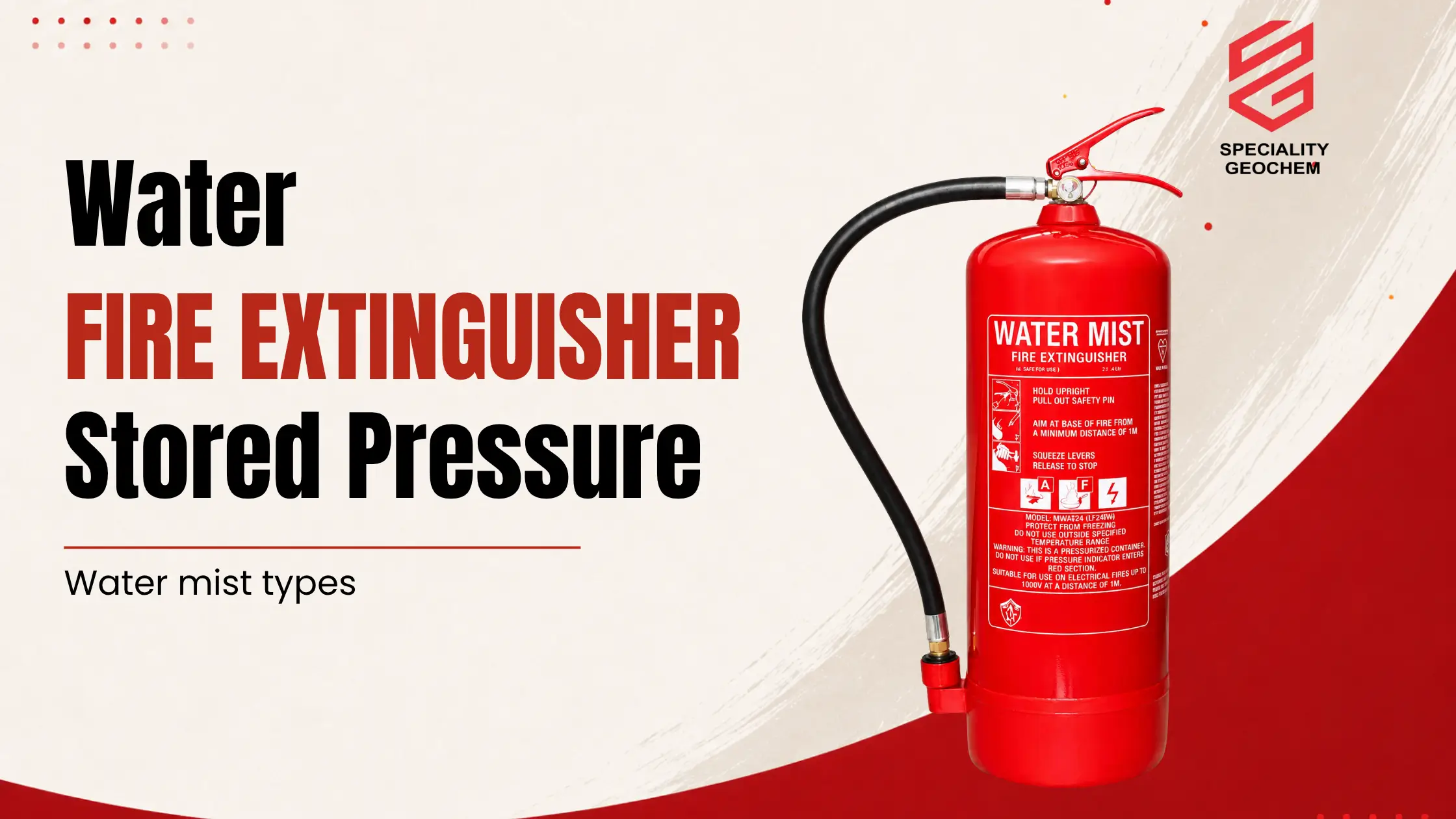
Water Fire Extinguisher : Stored Pressure & Water Mist Types
A water fire extinguisher is a portable Class A fire suppression device that uses pressurised water to cool burning material and cut off the heat that sustains combustion. Available in stored pressure and cartridge operated designs, it is the most cost effective and eco friendly extinguisher for fires involving wood, paper, cloth, and other solid combustibles.
At Speciality Geochem, we manufacture ISI certified water fire extinguishers in 2, 6, and 9 litre capacities from our facility in Udaipur, serving homes, offices, factories, schools, and warehouses across India since 1996.
Specification Table
| Parameter | Details |
|---|---|
| Type | Stored Pressure / Cartridge Operated |
| Capacities Available | 2 Litre, 6 Litre, 9 Litre |
| Fire Class | Class A (wood, paper, cloth, rubber, plastics) |
| Extinguishing Agent | Water |
| Operating Pressure | 15 kg/cm² |
| Discharge Range | Up to 4 metres |
| Minimum Discharge Time | 8 seconds |
| Activation Time | 8 to 13 seconds |
| Effective Coverage Area | 360° / 1.80 cubic metres |
| Storage Temperature | +5°C to +60°C |
| Cylinder Diameter | 148 mm |
| Body Colour | Signal Red |
| Certification | IS 15683 (BIS / ISI Certified) |
| Valve Type | Squeeze grip (stored pressure) |
What Is a Water Fire Extinguisher?
A water fire extinguisher works on a straightforward principle: water absorbs heat rapidly, lowering the temperature of burning material below its ignition point and stopping the fire from spreading. Because water penetrates deep into fibrous and porous materials, wood, cardboard, fabric, it not only knocks down visible flames but also suppresses the hidden hotspots that cause re ignition.
Water is the oldest and most effective agent for Class A fires. It leaves no chemical residue, requires no specialist disposal, and is completely safe for the environment. This makes water type extinguishers the preferred choice wherever post fire cleanup and environmental impact matter.
There are two design variants commonly available in India:
Stored Pressure Type:
The water and the expelling gas (compressed air) are stored together in the same cylinder under approximately 15 kg/cm² pressure. This is the most common design, simplest to maintain, and is identified by a built in pressure gauge on the valve head.
Cartridge Operated Type:
The water and the CO₂ propellant cartridge are stored separately. The gas is released into the water cylinder only when the extinguisher is operated. This design is preferred in environments with extreme temperature variation, as there is no risk of slow pressure loss over time.
Water Mist Fire Extinguisher A More Versatile Option
A water mist extinguisher uses a specialist nozzle to break water into ultra fine droplets, a high pressure mist rather than a concentrated jet. This dramatically changes what the extinguisher can do.
Because the droplets are so small, they vaporise almost instantly when they contact flames. The rapid evaporation absorbs enormous amounts of heat (water needs 2,260 kJ/kg to evaporate), cooling the fire far more efficiently than a solid stream. The vapour cloud also displaces oxygen around the fire, adding an additional smothering effect.
Crucially, a fine water mist does not conduct electricity in the way that a solid water stream does. This makes water mist extinguishers safe for use near electrical equipment, which a standard stored pressure water extinguisher is not.
Water Mist Extinguisher — Fire Classes Covered:
| Fire Class | Description | Water Mist Safe? |
|---|---|---|
| Class A | Wood, paper, cloth, rubber | ✅ Yes |
| Class B | Flammable liquids (petrol, oil) | ✅ Yes (fine mist only) |
| Class C / E | Electrical equipment | ✅ Yes (up to 35kV tested) |
| Class F | Cooking oils and fats | ✅ Yes (9 litre models) |
| Class D | Metal fires | ❌ No |
This multi-class fire coverage makes water mist extinguishers the better choice for offices, server rooms, hospitals, schools, and any mixed-risk environment where you need a single extinguisher type to cover multiple hazards.
Water Fire Extinguisher vs Water Mist Extinguisher | Key Differences
| Feature | Stored Pressure Water | Water Mist |
|---|---|---|
| Agent discharge | Solid stream / jet | Ultra fine mist droplets |
| Fire class | Class A only | Class A, B, C/E, F |
| Safe near electrics? | ❌ No, conductive | ✅ Yes |
| Kitchen fires? | ❌ No | ✅ Yes (9 litre) |
| Residue | None | None |
| Price range (India) | ₹1,200 to ₹2,500 | ₹4,500 to ₹8,500 |
| Best for | Homes, warehouses, schools | Offices, hospitals, server rooms |
Where to Use a Water Fire Extinguisher
Water extinguishers are ideal wherever Class A fire risk is the primary concern:
Homes and residential buildings
Kitchens (keep away from cooking oil), living rooms, storage areas, and garages (for paper and cardboard)
Offices and commercial spaces
Paper records, wooden furniture, ceiling tiles, and soft furnishings; pair with a CO₂ extinguisher near electrical equipment
Schools and educational institutions
Classrooms, libraries, and auditoriums
Warehouses and storage facilities
Cardboard, packaging, timber pallets, and textile goods
Factories and industrial units
Wood processing, textile mills, paper manufacturing, and packaging lines
Hotels and hospitality
Guest rooms, reception areas, restaurants (keep away from the kitchen fryer)
Hospitals
Corridors, wards, and non electrical storage areas
Important: Never use a standard stored pressure water extinguisher on electrical equipment, cooking oil fires (Class F), or flammable liquid fires (Class B fire). Water is electrically conductive and can cause fatal electric shock. For mixed risk environments, specify a water mist extinguisher or a CO₂ / ABC dry powder unit.
Why Buy From Speciality Geochem?
Speciality Geochem has manufactured fire safety equipment in Udaipur since 1996. Our water fire extinguishers are manufactured and tested to IS 15683, the Bureau of Indian Standards specification for portable fire extinguishers, and carry BIS / ISI certification.
What this means for you as a buyer:
IS 15683 / BIS Certified:
Every unit is tested to Indian Standard IS 15683, the mandatory specification that governs portable fire extinguisher performance, construction, and labelling in India. IS 15683 certified extinguishers are the only type accepted for Fire NOC compliance and factory inspections under the Factories Act.
28+ Years of Manufacturing Experience:
Since 1996, we have supplied fire safety equipment to commercial establishments, industrial plants, educational institutions, and government facilities across Rajasthan and beyond.
Multiple Sizes for Every Application:
2 litre units for vehicles and small rooms; 6 litre units for offices and classrooms; 9 litre units for warehouses, factories, and open plan commercial spaces.
Eco Conscious Choice:
Water leaves zero chemical residue. No post fire chemical cleanup, no disposal cost, no environmental impact, unlike dry powder or foam agents.
How to Use a Water Fire Extinguisher (PASS Method)
Using any fire extinguisher correctly can mean the difference between a contained incident and a devastating fire. Follow the PASS technique:
- P Pull the safety pin from the handle. This breaks the tamper seal and unlocks the operating lever.
- A Aim the nozzle or hose at the base of the fire, not the flames. Hitting the base cuts off the fuel source.
- S Squeeze the lever or handle firmly to release the water. Do not release until you are ready to stop.
- S Sweep the nozzle from side to side across the base of the fire in a slow, steady motion. Keep sweeping until the fire is completely out.
Maintain a safe distance of at least 1 to 2 metres from the fire. Always ensure you have a clear exit route behind you before you begin. Once the fire is out, watch for re ignition. Water extinguishers cool the fuel, but smouldering material can re ignite if not fully cooled.
Always call emergency services (101) even after successfully extinguishing a small fire. A structural fire can continue inside walls or ceilings even when surface flames are out.
Water Fire Extinguisher Maintenance | IS 2190 Guidelines
Fire extinguishers are safety-critical equipment. Under IS 2190:2010 (the Indian Standard for selection, installation, and maintenance of fire extinguishers), the following maintenance schedule applies:
| Maintenance Task | Frequency |
|---|---|
| Visual inspection (pressure gauge, label, pin) | Monthly |
| Operational check by trained technician | Annual |
| Refilling / recharging | After every use, or every 3 years if unused |
| Hydraulic pressure (hydrostatic) test | Every 5 years |
| Full replacement (if body corroded or damaged) | As required |
Key monthly checks you can perform yourself:
- Pressure gauge needle should be in the green zone
- Safety pin and tamper seal intact
- No visible corrosion, dents, or damage to the cylinder
- Discharge hose and nozzle free of blockage
- Mounting bracket secure and accessible
Store the extinguisher upright in a visible, accessible location — never inside a locked cupboard. Position it near exits so it can be reached quickly in an emergency.
Fire Classes Explained | Choosing the Right Extinguisher
Understanding fire classes is essential to choosing the right extinguisher for your premises:
| Fire Class | Fuel Type | Recommended Extinguisher |
|---|---|---|
| Class A | Wood, paper, cloth, rubber, plastics | Water, Water Mist, ABC Powder |
| Class B | Petrol, diesel, paint, solvents | Foam, CO₂, ABC Powder |
| Class C / E | Electrical equipment, wiring | CO₂, Water Mist, ABC Powder |
| Class D | Combustible metals | Specialist dry powder only |
| Class F | Cooking oils and fats | Wet chemical, Water Mist (9L) |
For most homes and offices in India, a combination of one water or water mist extinguisher (for Class A) and one CO₂ extinguisher (for electrical) covers the primary risks. Factories and warehouses should consult IS 2190 for zoned placement and capacity guidance.
Frequently Asked Questions
What is a water fire extinguisher used for?
A water fire extinguisher is used for Class A fires, fires involving solid combustible materials such as wood, paper, cardboard, cloth, rubber, and most plastics. It works by cooling the burning material below its ignition temperature using a pressurised water stream.
What is the difference between a water fire extinguisher and a water mist extinguisher?
A standard water extinguisher discharges a solid jet of water and is suitable for Class A fires only. A water mist extinguisher uses a high pressure nozzle to break water into ultra fine droplets, making it effective on Class A, B, electrical (Class E/C), and kitchen fires (Class F). Water mist is also safer near electrical equipment because the fine mist does not conduct electricity.
Can a water extinguisher be used on electrical fires?
No. A standard stored pressure water extinguisher must never be used on electrical equipment. Water is electrically conductive and can cause a fatal electric shock back through the jet to the operator. For electrical fires, use a CO₂ extinguisher or a water mist extinguisher (which is tested safe near electricity).
What sizes do water fire extinguishers come in?
Speciality Geochem manufactures water fire extinguishers in 2 litre, 6 litre, and 9 litre capacities. The 2 litre unit is suited to vehicles and small rooms; the 6 litre is the standard office and classroom size; the 9 litre is used in warehouses, factories, and large commercial spaces.
What is IS 15683 certification for fire extinguishers?
IS 15683 is the Bureau of Indian Standards (BIS) specification that governs the design, construction, testing, and performance requirements for portable fire extinguishers in India. IS 15683 certified (ISI marked) extinguishers are mandatory for Fire NOC compliance, factory inspections under the Factories Act, and compliance with National Building Code (NBC) requirements.
How long does a water fire extinguisher last?
The cylinder of a well maintained water extinguisher can last 10 to 15 years. However, the water charge should be replaced every 3 years even if unused, and a hydraulic pressure test is required every 5 years as per IS 2190:2010. Always check the annual service date tag on the cylinder.
Can I use a water fire extinguisher on a kitchen fire?
No, unless it is specifically a water mist type rated for Class F fires. Standard stored pressure water extinguishers must never be used on cooking oil fires. Water hitting hot cooking oil causes a violent steam explosion that spreads burning oil over a wide area, dramatically worsening the fire. Use a wet chemical extinguisher or a Class F rated water mist extinguisher for kitchen fires.
How much does a water fire extinguisher cost in India?
A standard 9 litre stored pressure water fire extinguisher costs approximately ₹1,200 to ₹2,500 depending on brand and certification level. Water mist extinguishers in the 6 to 9 litre range cost approximately ₹4,500 to ₹8,500. Prices vary based on cylinder material, valve quality, and after sales service support.
What is the discharge range of a water fire extinguisher?
Speciality Geochem water extinguishers discharge up to 4 metres, with an effective coverage area of 360° across 1.80 cubic metres. The minimum discharge time is 8 seconds, with activation occurring within 8 to 13 seconds of operation.
Get a Quote | Water Fire Extinguishers
Speciality Geochem supplies water fire extinguishers directly from our Udaipur manufacturing facility to businesses, institutions, and distributors across India. We offer bulk pricing, AMC (Annual Maintenance Contract) support, and Fire NOC documentation assistance.
Contact us for:
- Single-unit and bulk orders
- Water mist extinguisher sourcing
- Annual maintenance contracts
- Site assessment and placement guidance
- IS 15683 compliance documentation
📞 +91-9799661841 / +91-9680211841 📧 sgeochem@yahoo.com | sales@specialitygeochem.com 📍 103, Ostwal Plaza 2, Sundarwas, Udaipur (Raj.) India — 313001