Most panel fires give warnings first. A lug turns brown. A breaker feels warm to the touch. On a hot afternoon, the panel room smells of burning. The fire itself usually comes later, often at night when the room is empty and nobody is there to catch it.
In factories, electrical panels catch fire mainly because of heat at loose or corroded connections, overloading, and dust or moisture that lets current track across parts. Electrical panel fire prevention comes down to two jobs. The first is maintenance: thermography, torque checks and a clean, dry panel room. The second is suppression: a CO2 fire extinguisher outside the panel, and an automatic fire suppression tube inside it for the hours when nobody is watching. This guide covers both, with a checklist your maintenance team can follow and a suppression plan for every type of panel.
Warning signs of an electrical panel fire
| What you notice | Most likely cause | What to do |
|---|---|---|
| Discoloured or blackened lugs and terminals | Loose or under-torqued connection heating up | Isolate, clean, re-terminate and torque to the maker’s value |
| A breaker or cable that feels warm | Overload or undersized cable | Measure the load current, then rebalance or upgrade |
| Burning or “fishy” smell | Insulation overheating | Find the source with a thermal camera before it fails |
| Breakers tripping more often | Overload, earth leakage or a failing breaker | Test the breaker and check any load added recently |
| Dust layer inside the panel | Poor sealing, open covers | Clean with the power off, replace gaskets, close entries |
| Water marks, rust, condensation | Roof leak, humid room, no panel heater | Fix the leak and add a panel heater or ventilation |
| Rat droppings, chewed cables | Open cable entries | Seal the entries and repair damaged cables |
| Jumpers, taped joints, open doors | Unplanned additions | Redesign the circuit and never leave panels open |
If you see two or more of these signs in one panel, treat it as urgent.
Electrical panel fire prevention checklist for factories
| Task | How often |
|---|---|
| Walk-through of panel rooms: smell, sound, heat, doors closed | Weekly |
| Check extinguishers at panel rooms: gauge, pin, seal | Monthly |
| Look at suppression tubes: intact, not kinked or rubbed, gauge reading | Monthly visual check, full inspection yearly |
| Thermography under normal load | Every 12 months; every 6 months for critical or heavily loaded panels |
| Torque check of terminations | At every planned shutdown, at least once a year |
| Clean panel interiors, check gaskets and cable entries | At shutdowns |
| Test breakers and protection relays | As per the maker’s schedule |
| Compare actual load with design load | After every new machine is added |
Thermography deserves a special mention. A thermal camera picks up a hot joint months before it fails, and it does this while the panel is running. It is the cheapest early warning a factory can buy.
Fire suppression options for electrical panels
Maintenance lowers the risk, but it can’t remove it. These three suppression options cover what maintenance misses, and each one protects a different part of the panel room.
1. Suppression option 1: CO2 fire extinguisher outside the panel
Use CO2. Carbon dioxide does not conduct electricity and leaves no residue on switchgear. Our CO2 fire extinguishers are made to IS 15683 for Class B and electrical (Class C) fires and come in 2, 4, 6 and 9 kg. For electrical switchgear rooms, a 4 kg unit is the usual choice. For server rooms, 2–4 kg is typical.
ABC powder extinguishers also work on electrical fires. The downside is that they leave powder inside the equipment, which then has to be cleaned out.
Never use water or foam on a live panel. Both conduct electricity.
Every portable extinguisher has the same limit: someone has to be there to use it, and it cannot reach inside a closed panel.
2. Suppression option 2: Automatic fire suppression tube inside the panel
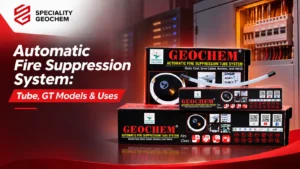
An automatic fire suppression tube system protects the inside of a panel when nobody is there. A closed, pressurised tube filled with HFC-227ea (FM-200) clean agent runs inside the panel, close to the busbars and terminals. When a fire heats the tube to about 110°C, it ruptures at the hottest spot and releases its agent straight onto the fire. The agent absorbs heat, stops combustion and leaves no residue on the equipment.
The tube needs no wiring, sensors, batteries or power supply. It lasts up to 5 years under standard conditions, with periodic visual inspections.
Choose the tube length based on the volume of the panel:
| Model | Tube length | Max electrical panel volume |
|---|---|---|
| GT50 | 0.5 m | 0.17 m³ |
| GT100 | 1.0 m | 0.44 m³ |
| GT200 | 2.0 m | 0.89 m³ |
| GT300 | 3.0 m | 1.34 m³ |
| GT400 | 4.0 m | 1.75 m³ |
Worked example: A panel that is 1.2 m tall, 0.8 m wide and 0.6 m deep has a volume of 1.2 × 0.8 × 0.6 = 0.576 m³. That is above the GT100 limit but within the GT200 limit, so the GT200 is the right choice.
3. Suppression option 3: Fire extinguisher ball above open DBs
A fire extinguisher ball is a 1.3 kg ball filled with MAP (mono ammonium phosphate) dry powder. It activates within 3–8 seconds of direct flame contact, covers about 1.8 m³ and sounds a 120 dB alarm. It needs no maintenance during its shelf life of up to 5 years.
The ball suits places where the equipment is open rather than enclosed: distribution boards in corridors, meter banks and small electrical rooms. Mount it just above the DB so the powder falls over it. For closed panels, the suppression tube is the better tool.
Which suppression option fits each panel in your factory?
| Equipment | Inside | Outside |
|---|---|---|
| LT panel, MCC, PCC | Suppression tube sized to panel volume | 4 kg CO2 at the panel room door |
| Distribution boards in corridors | Fire ball mounted above | 2 kg CO2 or an ABC extinguisher nearby |
| Server racks and network cabinets | Suppression tube | 2–4 kg CO2 |
| UPS and battery cabinets | Suppression tube | 4 kg CO2; ventilated room |
| DG set control panel | Suppression tube | 4 kg CO2, plus an ABC extinguisher for the fuel area |
| Meter rooms | Fire ball above the meter bank | 4 kg CO2 at the door |
Always isolate power before fitting anything inside a panel. Seal large openings so the agent stays where the fire is.
Conclusion
The cheapest fire protection in any plant is a torque wrench and a thermal camera. Tight, cool joints do not start fires. Suppression tubes, fire balls and CO2 extinguishers are there for the day maintenance misses something, and on that day they decide whether you lose one panel or the whole building. Do both: maintain first, then protect what you cannot watch.
Need help choosing protection for your panels? Contact Speciality Geochem with your panel sizes, and we’ll suggest the right mix.
FAQs
Q1. Why do electrical panels catch fire?
Mostly because of heat at loose or corroded connections. Other common causes are overload, dust, moisture, rodent damage and unplanned additions to the circuit.
Q2. How can factories prevent electrical panel fires?
Run thermography at least once a year and torque-check terminations at every shutdown. Keep panels clean, dry and sealed, and recheck the load whenever a new machine is added. Then protect each panel with a CO2 extinguisher outside it and an automatic suppression tube inside it.
Q3. Which fire extinguisher is best for an electrical panel?
CO2. It does not conduct electricity and leaves no residue. A 4 kg unit is the usual choice for switchgear rooms. ABC powder also works, but it leaves powder inside the equipment.
Q4. Can water or foam be used on an electrical panel fire?
No. Both water and foam conduct electricity and can cause electrocution on live equipment.
Q5. How does an automatic fire suppression tube work in a panel?
The tube runs inside the panel. When a fire heats it to about 110°C, it ruptures at the hottest point and releases HFC-227ea clean agent onto the fire. It needs no power, no wiring and no person.
Q6. How do I choose the right suppression tube size?
Multiply the panel’s height, width and depth to get its volume in m³. Then pick the smallest model whose limit is higher than that figure. For example, a 0.576 m³ panel needs a GT200.
Q7. Is a fire extinguisher ball safe for electrical fires?
Yes. It uses MAP dry powder, which is rated for Class A, B and C fires, including electrical fires. It works best above open equipment such as distribution boards and meter banks.
Q8. How often should electrical panels be checked with thermography?
At least once a year under normal load. Check critical or heavily loaded panels every six months.