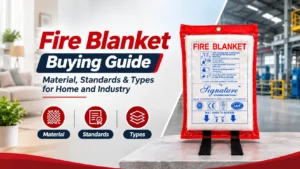
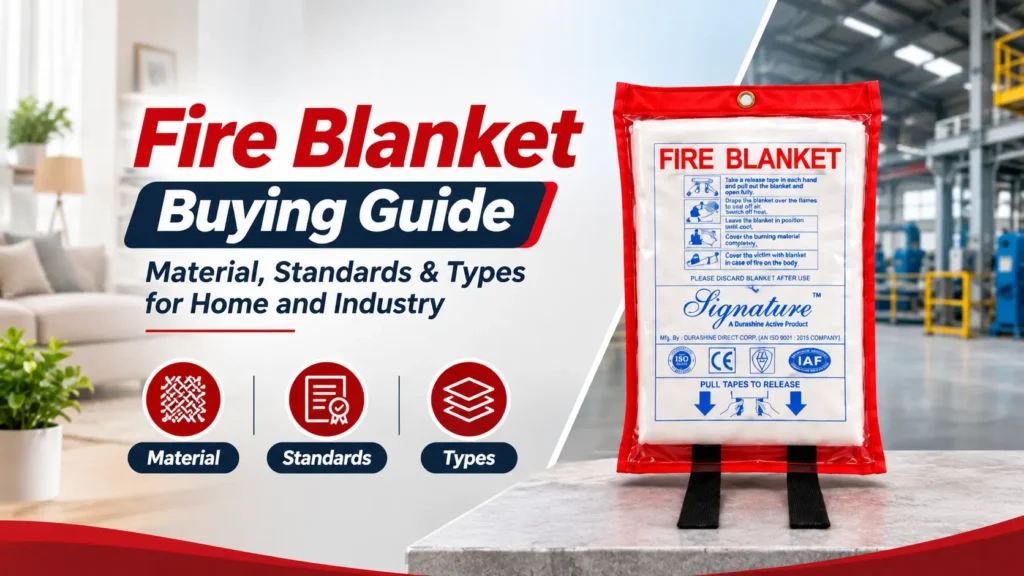
Two fire blankets can look identical in their red pouches and still perform very differently. One may be woven fibreglass with a published heat rating and a quick-release pouch; the other may be thin fabric with no test data at all. Because a fire blanket is used only in an emergency, you rarely find out which kind you bought until it matters. This guide explains what a fire blanket should be made of, which standards apply in India, the main types for homes and industry, and the questions to ask before you place an order.
Quick answer: buy a woven fibreglass fire blanket with a published heat rating, a quick-release pouch with two pull tapes, and a size that matches the risk. For a home kitchen, 1 m x 1 m is usually enough; commercial kitchens, labs and workshops need larger sizes.
How a fire blanket works, in one paragraph
A fire needs heat, fuel and oxygen. A fire blanket removes the oxygen: laid over a burning pan or wrapped around a person, the tightly woven fabric cuts off the air and the flames die down. Unlike an extinguisher, it has no pressure, no powder and nothing to recharge, so it is ready to use for as long as it hangs on the wall undamaged. Our step-by-step guide on how to use a fire blanket covers the technique.
Fire blanket material: what to look for
The material decides how much heat the blanket can take and how well it seals.
| Material | How it performs | Where it fits |
|---|---|---|
| Woven fibreglass | High heat resistance, tight weave, does not burn | The standard for kitchens, homes, offices and most workplaces |
| Treated fibreglass | Fibreglass with heat and chemical treatment for extra fire resistance | Commercial kitchens, labs, industrial sites |
| Treated wool | Natural fibre treated to resist fire; heavier and bulkier | Older designs and some specialist uses |
| Untested fabric | Unknown heat rating, may char or let flame through | Avoid |
Our fire blankets are made from premium-grade fibreglass fabric with heat and chemical treatments for fire resistance. The 1 m x 1 m blanket in our fire safety combo 3-in-1 is rated to 550°C.
What to check on the product:
the fabric type, a stated heat resistance, the size, and the manufacturer’s name and batch details.
Fire blanket standards in India and abroad
A standard tells you that the blanket’s material, construction and performance have been tested in a set way.
- IS 15381:2003 (India). The Indian Standard for fire blankets covers materials, construction, performance and dimensions, for blankets made of treated wool or fibreglass. It is intended for small fires, particularly cooking oil and fat fires, and for wrapping a person whose clothes are on fire.
- EN 1869 (Europe). The European standard for fire blankets, often seen on imported products and export orders.
When buying in bulk, ask the manufacturer which standard the blanket is tested to and ask for the test report, not just a logo on the pouch.
Types of fire blanket
1. Kitchen and home fire blankets- Compact fibreglass blankets in a wall-mounted quick-release pouch. They are designed for pan and kadhai fires and for clothing fires. Most homes need one 1 m x 1 m blanket near the kitchen exit.
2. Commercial fire blankets- Larger sizes for restaurant kitchens, canteens, hotels and hospital kitchens, where pans and fryers are bigger and several cooking stations run at once.
3. Laboratory and workshop blankets- Used in school and college labs, workshops and machinery spaces to smother small spills and wrap a person whose clothing catches fire.
4. Welding and industrial blankets- Heavier fabrics used as a shield to protect floors, machinery and nearby materials from sparks and spatter during hot work. These protect an area during work; they are different from an emergency fire blanket, which is kept ready to smother a fire.
Choosing the right size
Common nominal sizes are 1.0 m x 1.0 m, 1.2 m x 1.2 m, 1.2 m x 1.8 m and 1.8 m x 1.8 m. As a rule, choose a blanket large enough to cover the biggest pan, fryer or work area it protects, with margin on every side. Larger sizes are also better for wrapping an adult. The how-to guide linked above includes a size-by-space table.
Storage: pouch, case or cabinet
A fire blanket is only useful if it comes out in one movement:
- Soft quick-release pouch. The most common format for homes and offices; two pull tapes hang below the pouch.
- Rigid wall case. Better for commercial kitchens and industrial sites, where the blanket must be protected from grease, dust and knocks.
- Cabinet or wall-mounted container. Useful where several blankets or other equipment are stored together.
Whatever the format, hang it at roughly shoulder height (around 1.5 m), close to a way out and clear of the cooktop, so nobody has to reach over a fire to get it.
Fire blanket vs extinguisher: which one to buy?
For most kitchens the answer is both. When oil in a kadhai or fryer catches fire (a Class F fire), the blanket is the better first move, since it seals the pan without throwing oil around. ABC powder is not recommended for cooking oil fires. An extinguisher is the better tool once a fire spreads to cabinets, curtains or wiring. Our guide to putting out a cooking oil fire explains the steps for a pan fire.
Buyer’s checklist for bulk orders
If you are buying for a hotel, school, hospital, housing society or factory, ask every supplier:
- What is the blanket made of, and what heat is it rated to?
- Which standard is it tested to, and can you share the test report?
- Which sizes do you offer, and which do you recommend for each area?
- What storage format comes with it: pouch, case or cabinet?
- Are mounting fixings included?
- Do you offer custom branding or OEM supply?
- What is the lead time and minimum order quantity?
Care and replacement
A fire blanket needs no recharging, but it does need checking. Once a month, make sure the pouch is closed, the pull tapes hang free and nothing blocks the wall in front of it. Replace a blanket if the pouch is torn, the fabric is damaged, or it has been exposed to intense heat. After a cooking oil fire, a blanket contaminated with oil should be replaced.
Buy fire blankets direct from the manufacturer
Speciality Geochem manufactures fibreglass fire blankets for homes, restaurants, schools, hospitals and industries, with bulk and OEM supply across India.
Compare options on our fire blanket page, or call +91-9680211841 for sizes and pricing.
Frequently asked questions
Q1. What is a fire blanket made of?
Most fire blankets are woven fibreglass, sometimes treated with heat and chemical treatments for extra fire resistance. Some older designs use treated wool. Avoid blankets that do not state their material or heat rating.
Q2. Which standard applies to fire blankets in India?
IS 15381:2003 is the Indian Standard for fire blankets. It covers materials, construction, performance and dimensions for wool and fibreglass blankets used on small fires, especially cooking oil fires. Imported products often cite EN 1869.
Q3. What size fire blanket is best for a home kitchen?
A 1 m x 1 m blanket covers most home pans and kadhais. Larger kitchens may need 1.2 m x 1.2 m, and commercial kitchens usually need 1.2 m x 1.8 m or more.
Q4. Is a welding blanket the same as a fire blanket?
No. A welding blanket shields floors and equipment from sparks during hot work. An emergency fire blanket is kept in a quick-release pouch to smother a fire or wrap a person.
Q5. Does a fire blanket expire?
It needs no recharge, but check it monthly and replace it if the pouch or fabric is damaged, or after it has been used on a fire.