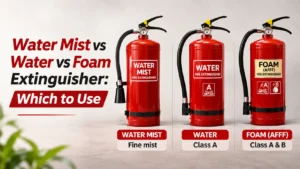
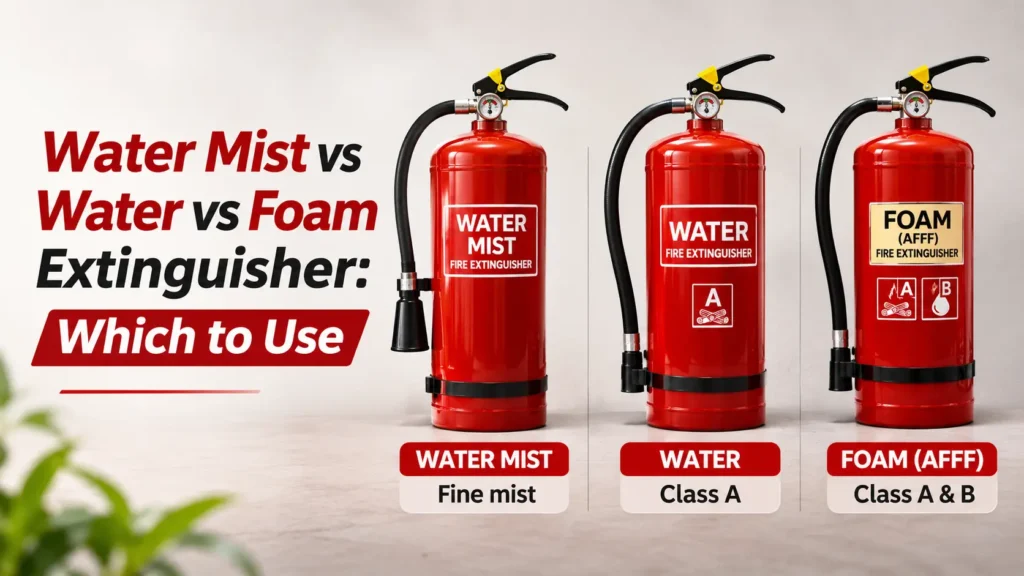
All three use water, but they work differently. A water-type extinguisher throws a solid jet that cools burning wood, paper and cloth. A water mist extinguisher breaks de-ionised water into very fine droplets that cool the fire and push oxygen away, with far less water damage. An AFFF foam extinguisher lays a film over burning liquids like petrol and paint and stops them re-igniting.
If you only remember one line: water for paper and wood, foam for fuel, and check the label before you trust water mist with anything else.
Start here: what burns in your space?
1. Mostly paper, wood, cloth, cartons? (schools, libraries, record rooms, textile and jute godowns, furniture shops) → A water-type extinguisher is enough and costs the least. Add CO2 near the electrical board.
2. Petrol, diesel, oil, paint, solvents? (garages, DG rooms, paint shops, fuel stores, workshops) → AFFF foam. Water alone will spread a liquid fire.
3. A mix of furniture, computers and people, where you do not want powder everywhere? (offices, hotels, hospital wards) → Water mist, if the model you buy is rated for the classes you need. Otherwise ABC powder plus CO2.
4. Cooking oil in deep fryers? → None of these, unless the label specifically says it is rated for cooking oil. Use a wet chemical extinguisher and a fire blanket.
5. Live electrical panels? → Not water-type, not foam. Use CO2. Water mist only if the label shows an electrical test rating.
What exactly is a water mist extinguisher?
It is a stored pressure extinguisher filled with de-ionised water and fitted with a special nozzle that turns the stream into a fine mist. The tiny droplets turn to steam almost instantly, which takes heat out of the fire and displaces oxygen around it. Because it uses so little water, there is very little mess afterwards.
What a water mist unit can safely handle depends entirely on how that model was tested. Some carry ratings for liquid fires, cooking oil or use near electrical equipment; many do not. The label is the only reliable guide. Do not assume.
What is a water-type extinguisher, and what is “water CO2”?
A water-type extinguisher is the simplest kind. The cylinder holds plain water under pressure, or uses a small CO2 cartridge to push the water out when you squeeze the handle. That second version is what people call a “water CO2” extinguisher. Both put out Class A fires the same way: by cooling.
Our water type fire extinguisher is made to IS 15683, with a 50–60 second discharge, a 6–8 m jet and a 35 kgf/cm² test pressure. The long discharge time is the useful part: you can soak a burning pile of cartons until it is properly out, instead of knocking the flames down for a few seconds.
What is AFFF foam, and why does it work on petrol?
AFFF stands for Aqueous Film Forming Foam. When it lands on a burning liquid, the foam spreads and leaves a thin water film on top. That film cuts off oxygen and, more importantly, seals in the flammable vapour, so the fire cannot flash back once it is out. It also cools and works on ordinary Class A fires.
Our AFFF foam extinguisher is a 9 litre stored pressure model to IS 15683, with a 50–60 second discharge and a 6–8 m jet. Buyers often ask for a “9 kg foam extinguisher”; foam models are rated by volume, so this is the same thing.
One technique tip: aim foam at a wall or the back edge of a tray so it flows gently over the liquid. Spraying straight into a pool of fuel can splash burning liquid.
Side by side
| Comparison Factor | Water type | Water mist | AFFF foam |
|---|---|---|---|
| How it puts the fire out | Cools | Cools and displaces oxygen | Covers, seals vapour, cools |
| Wood, paper, cloth (Class A) | Yes | Yes | Yes |
| Petrol, oil, paint (Class B) | No | Only if rated | Yes |
| Live electrics | No | Only if rated | No |
| Cooking oil in a pan | No | Only if rated | No |
| Mess afterwards | Water damage | Very little | Foam to clean |
| Discharge (our models) | 50–60 s | Depends on model | 50–60 s |
Maintenance: what is different?
All three are pressurised. Check each month that the gauge needle is in the green, the pin and seal are in place and the nozzle is clear. Water and foam charges age, so refill at the intervals in IS 2190 and the maker’s manual, and always after any use, even a short squeeze. In cold hill stations, keep water and foam units where they will not freeze. Our refilling guide covers the process.
If you want the broader picture including ABC powder and CO2, see ABC, CO2, foam or water: which to choose.
Conclusion
For a school or a godown full of cartons, buy water-type and save money. For anything with fuel, paint or oil, buy foam and do not let anyone talk you into water. For an office that wants one clean extinguisher on every floor, water mist can make sense, but only after you have read what its label says it can do. Everywhere there is live wiring, keep a CO2 unit as well.
FAQs
Q1. What is a water mist fire extinguisher used for?
Mainly Class A fires such as wood, paper and cloth, with much less water damage than a water jet. Some models are also rated for liquid, cooking oil or electrical risks, so always check the label.
Q2. Can a water extinguisher be used on electrical fires?
A standard water-type extinguisher must never be used on live electrics, because water conducts electricity. Use CO2 or ABC powder.
Q3. Which is better for a petrol fire, foam or water?
Foam. AFFF covers the burning petrol and seals in the vapour. Water spreads burning petrol and makes the fire worse.
Q4. Is AFFF foam safe on cooking oil fires?
No, unless the label says it is rated for cooking oil. For pan and fryer fires, use a fire blanket or a wet chemical extinguisher.