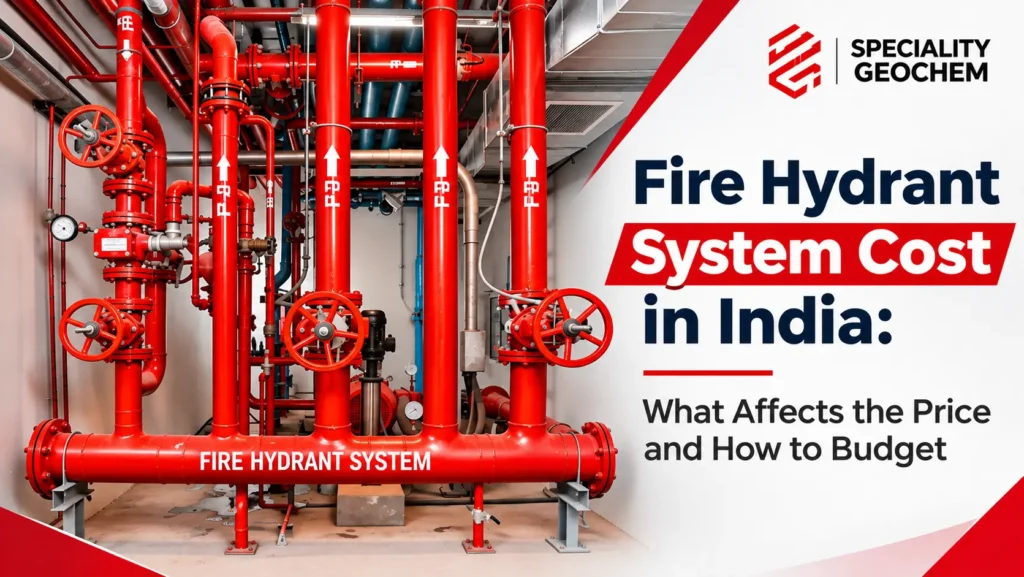
There is no fixed price for a fire hydrant system, but there are useful ranges. As a rough guide, a hydrant system for a small commercial building generally costs between ₹4 lakh and ₹10 lakh, while large industrial systems can go well above ₹35 lakh. Where your project falls depends on the building’s height and area, the pump set, how much pipe is needed and whether the water tank is part of the job.
The quickest way to understand the cost is to look at three different buildings.
Example 1: a G+3 commercial building in a city market
A showroom on the ground floor and offices above, about 15 m tall.
- What it needs: a riser in the staircase shaft with a landing valve and hose reel on each floor, a fire brigade inlet, a jockey pump and main pump, and a dedicated fire water tank.
- What keeps the cost down: a compact footprint, short pipe runs and one riser.
- What can push it up: having no space for an underground tank, so a new one must be built; an upgrade of the electrical supply for the pump.
- Where it usually lands: the small commercial range, roughly ₹4–10 lakh.
Example 2: a single-storey warehouse in an industrial area
A large shed with racks of packed goods, low height but a big footprint.
- What it needs: external yard hydrants on a ring main around the building, hose boxes at each hydrant, main electric pump, diesel standby pump and jockey pump, and a large water reserve.
- What drives the cost: the length of the ring main. A long perimeter means far more pipe, trenching and valve chambers than a tall building of the same floor area.
- Watch out for: road crossings for the fire tender, soil conditions for buried pipe, and diesel fuel storage for the standby pump.
Example 3: a manufacturing plant with several buildings
A factory with production halls, a store, a utility block and an office.
- What it needs: yard hydrants around every building, internal hose reels, higher-capacity pumps based on the fire load, a large fire water tank, and sometimes sprinklers or foam systems for special risks.
- What drives the cost: pump capacity, pipe sizes, the number of outlets and the civil work for the tank and pump room.
- Where it usually lands: this is where systems can exceed ₹35 lakh.
The same rule runs through all three: buildings that are spread out cost more in pipe; buildings that are tall cost more in pumps and risers; and every building pays for water storage.
What are you actually paying for?
| Part | Why it matters to cost |
|---|---|
| Fire water tank | Often the biggest civil item. The required size depends on the building type; for example, high-rise residential buildings commonly need at least 50,000 litres, and hospitals at least 1,00,000 litres. Your fire officer confirms the figure. |
| Main electric pump | Sized for the flow and pressure the building needs. A system must keep a minimum residual pressure of about 3.5 kg/cm² at the topmost outlet. |
| Diesel standby pump | Runs when power fails; adds engine, fuel tank and exhaust work |
| Jockey pump | Small pump that keeps the network pressurised |
| Pipes, valves, fittings | Grows with every metre of pipe and every outlet |
| Landing valves, hose reels, yard hydrants, hoses | Count must match the approved drawing |
| Pump room panel and wiring | Automatic start, alarms, dedicated power feed |
| Testing and approvals | Pressure tests, flow tests, drawings, fire department inspection |
Wet riser or dry riser: does it change the cost?
Yes. A wet riser is always full of water under pressure and is used in buildings above 15 m. A dry riser stays empty until the fire brigade pumps water into it, and is used in buildings up to 15 m. A wet riser needs pumps and storage working all the time, so it costs more to build and to maintain. A yard hydrant system, used around factories and warehouses, costs more as the site perimeter grows.
What does a hydrant AMC involve?
Plan for it from day one. A typical annual maintenance contract covers weekly pump test runs, monthly checks of valves, hoses and the jockey pump, and a yearly full-flow test, plus the records the fire department asks for at NOC renewal. A hydrant system that is not maintained can fail its renewal inspection even if it was built perfectly.
How to compare two hydrant quotes
Ask each vendor to fill the same table. The cheaper total often hides a smaller pump, thinner pipe or a missing tank.
| Ask for | What to check |
|---|---|
| All three pumps: make, model, flow and head | Are the two “main pumps” really the same size? |
| Pipe material, class and total running metres | The biggest silent difference between quotes |
| Number of landing valves, hose reels, yard hydrants, hoses | Does it match the drawing? |
| Standards for valves and fittings | IS-certified parts pass pressure tests |
| Water tank | Included or not? Capacity and civil work? |
| Testing, commissioning, NOC support | Does the quote stop at installation? |
| AMC price for year one and after | The real cost over 10 years |
The design rules come from NBC 2016 Part 4 and IS 908:2019, with related standards such as IS 5290 for landing valves. Get the requirement for your building from a fire consultant or the fire department first, so every vendor prices the same system.
Speciality Geochem handles fire hydrant systems from design to NOC clearance. To understand each part in more detail, read how a fire hydrant system works.
Before you sign
Do not sign a hydrant quote that you cannot check against five numbers: pump flow and head, total pipe length, number of outlets, tank capacity, and the AMC price. If two quotes give you those five, you can compare them in ten minutes. If one quote will not, that tells you something too.
FAQs
Q1. How much does a fire hydrant system cost in India?
Small commercial building systems generally cost between ₹4 lakh and ₹10 lakh. Large industrial systems may exceed ₹35 lakh, depending on project size and pump capacity.
Q2. Can hydrant cost be worked out per square foot?
Only roughly. A spread-out warehouse needs far more pipe than a compact building of the same area, so a per-square-foot rate can mislead. Price the actual pump set, pipe length and tank.
Q3. Does a hydrant quote include the water tank?
Not always. Many quotes include the pump set but leave out the tank’s civil work. Ask each vendor to say clearly what is included.
Q4. Is a fire hydrant system mandatory for my building?
It depends on the building’s use, height and area under NBC 2016 and your state fire rules. Most factories, warehouses, hospitals, hotels and buildings above 15 m need one.
Q5. What does a hydrant AMC cover?
Weekly pump runs, monthly checks of valves, hoses and pumps, a yearly flow test and the records needed for fire NOC renewal.