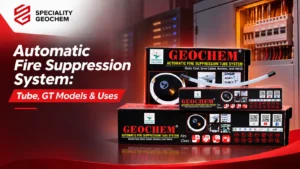
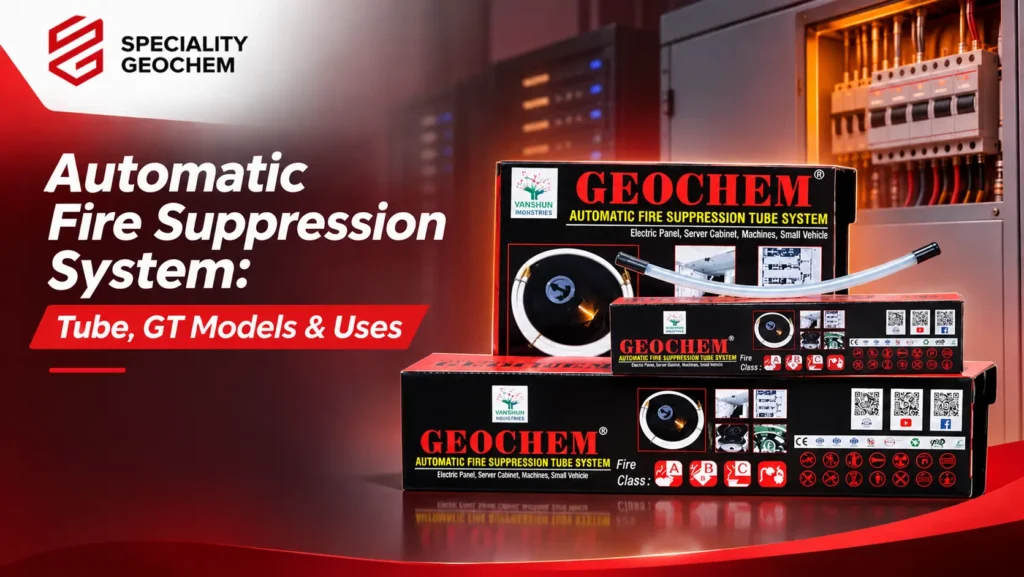
Many fires start inside a closed box: an electrical panel, a battery cabinet, a server rack or a bus engine compartment. By the time smoke escapes and someone fetches an extinguisher, the fire has had minutes to grow, and the extinguisher still cannot reach inside. An automatic fire suppression system solves this by sitting inside the enclosure and acting on its own. This guide explains how the tube-based system works, how to choose between the GT50 and GT400 models, and where it should and should not be installed.
What is a tube-based automatic fire suppression system?
It is a closed, pressurised, heat-sensitive tube filled with HFC-227ea (also known as FM-200), a clean fire suppression agent. The same tube does two jobs: it detects the fire and it delivers the agent. There are no separate detectors, no control panel, no wiring and no power supply.
That makes it different from most fire suppression system designs, which rely on smoke or heat detectors wired to a panel that then opens a cylinder. With a tube, the detector is the pipe itself, running right past the parts most likely to overheat.
How the tube system works, step by step
| Stage | What happens |
|---|---|
| 1. Standby | The tube sits inside the enclosure, routed close to terminals, batteries, motors or fuel lines |
| 2. Heat build-up | A fault, overload or fuel leak raises the temperature at one point |
| 3. Rupture | At around 110°C, the tube bursts at its hottest spot |
| 4. Discharge | HFC-227ea is released straight onto the fire source |
| 5. Suppression | The agent absorbs heat and interrupts combustion before the fire spreads beyond the enclosure |
| 6. Clean-up | Nothing to clean: the agent leaves no residue on electronics or machinery |
Because the tube bursts where the heat is greatest, the agent goes exactly where it is needed, not across the whole room.
Direct and indirect systems
There are two ways to build a tube-based system:
- Direct low-pressure system. The tube itself holds the agent, and it discharges through the rupture point. This is the compact design used for most panels, cabinets and engine compartments.
- Indirect system. The tube acts as the detector and is connected to a separate agent cylinder, which discharges through nozzles when the tube ruptures.
Our GT series is a direct system: the agent is in the tube.
Choosing the right GT model
All GT models use a 19 mm outer diameter tube. The difference is length, which sets the enclosure volume each one can protect:
| Model | Tube length | Max volume: electrical panel | Max volume: vehicle |
|---|---|---|---|
| GT50 | 0.5 m | 0.17 m³ | 0.13 m³ |
| GT100 | 1.0 m | 0.44 m³ | 0.31 m³ |
| GT200 | 2.0 m | 0.89 m³ | 0.67 m³ |
| GT300 | 3.0 m | 1.34 m³ | 1.03 m³ |
| GT400 | 4.0 m | 1.75 m³ | 1.26 m³ |
Worked example. An electrical panel measures 1.2 m high, 0.8 m wide and 0.6 m deep. Its volume is 1.2 × 0.8 × 0.6 = 0.576 m³. That is more than the GT100 limit of 0.44 m³ and within the GT200 limit of 0.89 m³, so a GT200 is the right choice.
Each model protects a smaller volume in a vehicle than in a panel, so always use the vehicle column for engine compartments.
Where an automatic fire suppression system is used
| Application | Typical fire cause | Why a tube suits it |
|---|---|---|
| Electrical panels and switchgear | Loose connections, overheating, short circuits | Detects inside the closed panel, no residue on components |
| Server racks | Cable faults, failing power supplies or fans | Clean agent, no water damage to hardware |
| UPS and battery cabinets | Thermal runaway, charging faults | Acts at the source in a confined space |
| Buses, trucks and heavy machinery | Fuel and oil leaks, hot engine parts | No power needed; works while the vehicle is unattended |
| CNC machines and enclosed equipment | Hydraulic oil ignition, friction heat | Fits inside tight machine enclosures |
| Generator rooms and cabinets | Electrical overloads, oil ignition | Independent of the generator’s own power |
The system is a good automatic fire suppression system for electrical panel protection in particular, because panels are closed, unattended and full of exactly the faults that cause fires.
Where it is not the right tool
A suppression tube protects an enclosure, not a room. It is not a replacement for:
- Portable extinguishers, which you still need for fires outside the protected box
- Room-wide systems in a large server hall or warehouse
- Hydrant systems where NBC requires them
Think of it as one layer in a wider plan. For a fire extinguisher option for the open space around the panel, see our guide to CO2 fire extinguisher uses.
Suppression tube vs fire extinguisher ball
Both work without power or people, but they protect different spaces:
| Point of comparison | Suppression tube | Fire extinguisher ball |
|---|---|---|
| Where it sits | Inside the enclosure | Above or near the risk, in the open |
| Trigger | Tube bursts at around 110°C | Flame contact |
| Agent | HFC-227ea clean agent, no residue | Dry chemical powder |
| Best for | Closed panels, racks, cabinets, engines | Open areas around panels, racks and machinery |
Many sites use both: a tube inside the panel and a fire extinguisher ball above it. See our fire extinguisher ball range.
Installation in five steps
- Choose the GT model from the enclosure volume, using the vehicle column for engines.
- Route the tube through the enclosure, close to terminals, batteries, engines or hydraulic lines.
- Fix it firmly so vibration cannot rub or kink it, and keep it away from sharp edges.
- Seal cable entries and openings so the agent stays inside the enclosure when it discharges.
- Record the installation date, so the 5-year service life can be tracked.
Wear gloves while handling the tube, because damaging it during installation can set it off.
Maintenance and service life
The GT series has a service life of up to 5 years, with an annual inspection. At each inspection, check that the tube is intact and correctly fixed, that it has not been kinked, cut or rubbed, and that no new openings have been made in the enclosure. Replace the system after any discharge, and at the end of its service life. It is rated for ambient temperatures from 40°C to 90°C, so it suits hot plant rooms and vehicle engines across India.
Get the right GT model for your equipment
Speciality Geochem manufactures the GT50 to GT400 range in Udaipur under ISO 9001, ISO 14001, ISO 45001, CE and IS 15683 certifications, with OEM variants and installation guidance across India. Send us your enclosure sizes, or explore our automatic fire suppression tube system page. Call +91-9680211841 for a quote.
Frequently asked questions
Q1. How does a fire suppression tube activate?
The tube is filled with HFC-227ea under pressure. When the temperature at any point reaches around 110°C, the tube bursts at that hottest spot and releases the agent directly onto the fire.
Q2. Where can an automatic suppression tube be installed?
Inside electrical panels, switchgear, server racks, UPS and battery cabinets, CNC machines, generator cabinets, and the engine compartments of buses, trucks and heavy machinery.
Q3. Does the system need electricity?
No. It needs no power, wiring, sensors or batteries, so it keeps working during power cuts and in unattended equipment.
Q4. Is it safe for electronics?
Yes. HFC-227ea is a clean agent that leaves no residue, so it does not damage electrical or electronic components.
Q5. How long does a suppression tube last?
Up to 5 years, with an annual inspection. Replace it after any discharge or at the end of its service life.