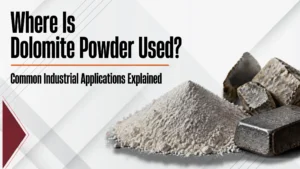
Dolomite powder doesn’t start as a powder at all. It starts as rock — a sedimentary carbonate mineral called dolomite, mined from deposits found across the world. Chemically, it’s a combination of calcium and magnesium carbonate, which is what sets it apart from plain limestone. Once the rock is pulled from the ground, it goes through crushing and grinding to become the fine, workable material most industries actually use: dolomite powder.
What makes this material worth knowing about isn’t the powder itself so much as dolomite powder uses across different industries. Steelmakers use it. So do glassmakers, ceramic manufacturers, construction material producers, paint formulators, plastics processors, and farmers managing acidic soil. That’s a wide spread for one mineral, and the reason it works across so many industries comes down to a handful of variables — composition, purity, how fine it’s ground, and how it was processed. Understanding these factors also helps explain why dolomite powder uses can vary so much from one application to another. Get those right for a given use case, and dolomite earns its place. Get them wrong, and it may not perform as expected.
Dolomite Powder Uses: Where Is It Used?
Understanding Dolomite as a Mineral
Dolomite is one of those minerals that also gives its name to the rock it forms — so “dolomite” can mean the mineral or the rock, depending on context. Its textbook formula is CaMg(CO₃)₂: calcium, magnesium, carbon, and oxygen, bound together. In the real world, deposits rarely match that formula perfectly. Most contain traces of other minerals, which is exactly why dolomite from one quarry can behave differently from dolomite mined somewhere else.
What Is Dolomite Powder, Exactly?
Once the rock is quarried, it’s crushed and ground down into powder — but “powder” covers a lot of ground. Some grades are coarse, some are milled to a near-talc fineness, and the difference isn’t accidental. It’s driven by what the material needs to do next. A foundry doesn’t need the same grade as a paint manufacturer.
A few things determine whether a given batch is fit for purpose: its chemical makeup, the ratio of calcium to magnesium, particle size, purity, whiteness, hardness, and how fine it’s been ground. None of these matter in isolation — they matter in combination, relative to the application.
How Is Dolomite Powder Made?
The process is fairly straightforward on paper, even if getting it right consistently takes real quality control:
- Raw material selection — the right dolomite rock is chosen based on the quality the final product needs.
- Crushing — large rock is broken down into manageable pieces.
- Grinding — those pieces are milled down to the fineness the application calls for.
- Screening and classification — particles get sorted by size.
- Quality testing — the powder is checked against whatever the buyer needs: composition, purity, particle size, moisture, and so on.
- Packing — finished material is packed for storage and transport.
It’s tempting to think of this as just “grinding a rock into dust,” but that undersells it. The whole point of the process is matching the output to a spec — a batch destined for a steel plant and a batch destined for a paint line are held to completely different standards, even though they both started as the same rock.
Where Is Dolomite Powder Used?
Steel and Metallurgy
Dolomite has been part of iron and steel production for a long time, mostly as a flux — a material that helps manage the chemistry of the melt during processing. It also turns up in refractory materials, the linings and components that need to survive extreme heat without breaking down. The calcium and magnesium in dolomite are what make it useful here, but metallurgical buyers aren’t casual about specs — this is an application where the chemical and physical requirements are tightly defined, not a “any dolomite will do” situation.
Glass Manufacturing
In glass production, dolomite contributes calcium and magnesium to the raw material mix. Glass is unforgiving about purity, though — even small amounts of iron in the dolomite can affect the clarity or color of the finished glass, so the composition of the powder matters more here than in almost any other application on this list. Different glass products (container glass versus flat glass, for instance) can call for different raw material specs.
Ceramics
Ceramic manufacturers work dolomite into their formulations for similar reasons — it’s a source of calcium and magnesium that behaves in specific, useful ways during firing. As with glass, particle size and chemical consistency aren’t nice-to-haves; they’re what keeps a ceramic body behaving predictably batch after batch. Different ceramic products require different grades, so this isn’t a one-size-fits-all material even within a single industry.
Construction and Building Materials
This is probably where most people unknowingly encounter dolomite powder — mixed into cement-related products, concrete formulations, tiles, and putty. It’s rarely the star of the show in these applications; it’s a component within a larger mix. But particle size and mineral composition still affect how well it performs once it’s blended in, which is why construction-grade dolomite still comes with its own specifications.
Paints, Putty, and Coatings
Here, dolomite typically functions as a filler or extender — something added to bulk out a formulation and influence its behavior without carrying the whole cost of more expensive ingredients. In this role, particle size, whiteness, and purity all show up in the final product’s look and feel. It’s worth being honest that a filler’s actual effect depends entirely on the rest of the formulation it’s mixed into — dolomite isn’t a magic ingredient that guarantees better paint on its own.
Plastics and Rubber
Dolomite can also work as a filler in select plastic and rubber formulations, where it’s added to modify properties like stiffness or bulk. Whether it works well comes down to how finely it’s ground, how evenly it disperses through the base material, and how pure it is. Not every polymer or rubber compound is a good match — the fit depends on what that specific formulation is trying to achieve.
Agriculture
Agricultural dolomite is applied to soil mainly to supply calcium and magnesium and to help correct acidity. This is one area where it’s easy to overstate things, so it’s worth saying plainly: how much dolomite a field needs — or whether it needs any at all — depends entirely on that field’s actual soil conditions. A blanket application rate isn’t good advice. Soil testing and input from an agronomist should come before any dolomite goes down.
Dolomite Powder Applications at a Glance
Why the Properties Actually Matter
Different industries use dolomite powder for different reasons, so the required grade can change significantly from one application to another. The table below gives a quick overview of where it is used and which properties generally matter most.
| Industry | How Dolomite Powder Is Used | Properties Commonly Considered |
|---|---|---|
| Steel & Metallurgy | Used in fluxing and refractory-related applications | Chemical composition, purity, magnesium and calcium content |
| Glass Manufacturing | Added as a source of calcium and magnesium in glass formulations | Purity, chemical composition, low impurity levels |
| Ceramics & Tiles | Used as a mineral component in ceramic and tile formulations | Particle size, purity, chemical consistency |
| Construction | Used in putty, tiles, cement-related products, and building materials | Fineness, particle size, composition |
| Paints & Coatings | Used as a mineral filler or extender | Whiteness, fineness, purity, dispersion |
| Plastics & Rubber | Used as a filler in selected formulations | Particle size, purity, dispersion, consistency |
| Agriculture | Used to supply calcium and magnesium and help manage acidic soils | Calcium-magnesium content, composition, soil requirements |
It’s easy to list “purity” and “particle size” as bullet points and move on, but each one solves a specific problem. Composition tells you whether a batch is chemically right for a job. Purity matters most when even small amounts of other minerals would throw off a formulation — glass and ceramics are the clearest examples. Particle size governs how the powder handles, mixes, and disperses once it’s in production. Whiteness matters cosmetically in paints, coatings, and some ceramics. And consistency — batch after batch behaving the same way — is what lets a manufacturer actually plan around the material instead of adjusting their process every time a new shipment arrives.
There’s no such thing as the “best” dolomite powder in the abstract. There’s only the right grade for a specific job.
Choosing the Right Dolomite Powder
Anyone selecting a grade should be looking at chemical composition, purity, particle size or mesh, whiteness, moisture content, bulk density where it’s relevant, and how consistent the material is between batches. The mistake worth avoiding is picking a powder based on price or general appearance and hoping it works — the better approach is starting from the actual end-use requirements and working backward from there.
Conclusion
Frequently Asked Questions About Dolomite Powder
Dolomite powder earns its place across metallurgy, glass, ceramics, construction, paints, plastics and rubber, and agriculture — not because it’s a universal fix, but because its calcium-magnesium chemistry happens to be useful in a lot of different contexts, each with its own specs. The right grade for one job is rarely the right grade for another. Speciality Geochem supplies industrial mineral products across these categories — you can see available dolomite grades and specifications on our Dolomite Powder product page.
Dolomite Powder is a finely processed mineral powder made from natural dolomite rock. It mainly contains calcium magnesium carbonate and is used across industries such as construction, ceramics, glass, paints, plastics, and agriculture.
Dolomite Powder is produced from natural dolomite rock, which primarily contains calcium magnesium carbonate. Its exact composition may vary depending on the mineral source, processing method, and required industrial specifications.
Dolomite Powder is widely used in steel and metallurgy, glass, ceramics, construction, paints, coatings, plastics, rubber, and agriculture. Its properties make it suitable for different industrial and manufacturing applications.
Important properties include chemical composition, purity, particle size, fineness, whiteness, and moisture content. The required specifications can vary depending on the industry, manufacturing process, and intended application.
Dolomite Powder is generally manufactured through a process that includes crushing, grinding, screening, classification, quality testing, and packing. The material is processed according to the required particle size and application specifications.
Yes, Dolomite Powder can be used as a mineral filler in selected paint, plastic, rubber, and coating formulations. It can contribute to desired properties, but its suitability depends on the formulation and required product specifications.
Dolomite Powder and Limestone Powder are both carbonate minerals, but their compositions differ. Dolomite contains significant amounts of calcium and magnesium carbonates, while limestone mainly consists of calcium carbonate.
Yes, Dolomite Powder is used in steel and metallurgical applications. Its calcium and magnesium carbonate composition makes it useful in selected processes, including applications related to slag formation and refractory materials.
Choosing Dolomite Powder depends on factors such as chemical composition, purity, particle size, fineness, whiteness, and application requirements. Industrial buyers should select specifications that match their manufacturing process and end use.
Dolomite Powder can be purchased from established mineral manufacturers and suppliers in India. When selecting a supplier, consider product specifications, quality consistency, processing standards, packaging, supply capacity, and delivery requirements.