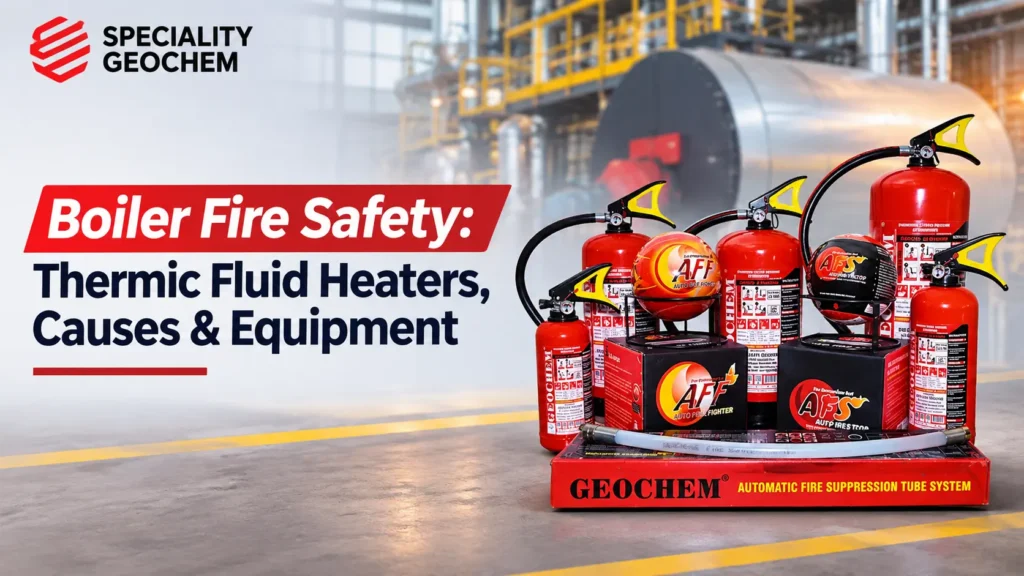
Boilers and thermic fluid heaters run many Indian factories, from textile dyeing and food processing to chemicals and plywood. They also bring together fuel, very high heat and oil under pressure. Good boiler fire safety is less about one big device and more about knowing where fires start, matching the right extinguisher to each fire class, and running simple checks every shift.
This boiler fire safety guide covers the common causes, why thermic fluid fires need special care, and which extinguishers belong in a boiler house.
Why Boiler and Heater Rooms Catch Fire
Most boiler room fires start small, close to the fuel or heat source:
- Fuel leaks: diesel or furnace oil dripping from pumps, filters, flanges or burner lines onto hot surfaces.
- Thermic fluid leaks: hot oil escaping from a gland, valve or weakened pipe joint.
- Solid fuel build-up: coal dust, rice husk, wood chips or briquettes collecting near the furnace door or under conveyors.
- Gas leaks: in LPG, PNG or biogas-fired units, a loose fitting near the burner.
- Electrical faults: overheated burner control panels, motors and blower wiring.
- Poor housekeeping: oily rags and cotton waste stored near the boiler.
Because one room can hold all of these at once, boiler fire safety starts with identifying which fire classes are present.
Thermic Fluid Leaks and Hot-Oil Fires
A thermic fluid heater circulates heat-transfer oil at high temperature. If it leaks onto insulation or a hot surface, it can ignite and spread along the pipeline.
Burning thermic fluid and furnace oil behave like Class B fires (flammable liquids). As our guide to the classes of fire explains, Class B fires burn at the surface and should be tackled with foam, dry chemical powder (DCP) or CO2. Water is a “never use” agent here: on hot oil, water turns to steam instantly and can throw burning oil outward.
What helps most is acting before a leak becomes a fire:
- Watch for oil-soaked insulation; it is an early warning sign.
- Tighten or replace leaking glands and flanges at the next safe shutdown.
- Keep drip trays under pumps and clean them every shift.
Fuel Handling: Diesel, Coal, Husk and Gas
Each fuel brings its own fire class, and your boiler room fire safety plan should cover all of them:
| Fuel/area | Fire class | Suitable extinguisher |
|---|---|---|
| Diesel, furnace oil, thermic fluid | Class B | Foam (AFFF), ABC/DCP powder, CO2 |
| Coal, rice husk, wood, briquettes | Class A | Water, foam, ABC powder |
| LPG, PNG, biogas burners | Class C | ABC or DCP powder, after shutting the gas supply |
| Burner panels, motors, blowers | Electrical | CO2 or DCP, after cutting the power |
Keep fuel drums away from the furnace front and sweep fuel dust daily.
Right Fire Extinguishers for a Boiler House
Good boiler fire safety mixes extinguisher types so every likely fire has an answer within a few steps.
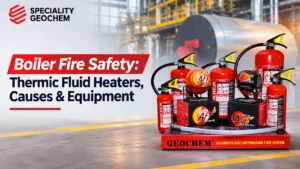
1. Foam (AFFF) for oil areas- Our 9 kg AFFF and mechanical foam extinguishers are designed mainly for Class B flammable liquids such as petrol, diesel and oil, and can also handle some Class A fires. Keep one near the fuel tank and one near the heater.
2. ABC powder as the all-rounder- An ABC powder fire extinguisher covers Class A, B and C fires. Our ABC range runs from 1 kg to 9 kg; for industrial areas the 6 kg unit (15–20 seconds discharge, 5–6 m throw) and 9 kg unit (18–22 seconds, 6–7 m throw) give more reach and time. They are BIS certified, ISI marked and tested under IS 15683.
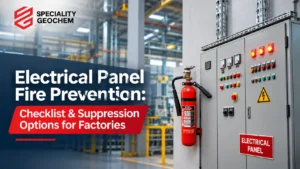
3. CO2 for control panels- For burner control panels and motor starters, a CO2 fire extinguisher is rated for Class B and electrical fires. For manufacturing plants, a 6 kg CO2 unit is a practical size.
4. Automatic protection inside panels- Panels often catch fire when nobody is watching. An automatic fire suppression tube system fitted inside the panel releases HFC-227ea clean agent when the tube heats past roughly 110°C, covering Class A, B, C and electrical fires.
Placement tip: mount extinguishers near the boiler room exit, not beside the furnace, so no one walks toward a fire to reach one, and make sure every shift knows which extinguisher fits which fire.
Operator Checks Every Shift
A simple shift checklist:
- Look for oil or fuel leaks at pumps, burners, glands and flanges.
- Check insulation for oil soaking or discolouration.
- Empty drip trays and remove oily rags.
- Sweep coal, husk or wood dust away from the furnace and conveyors.
- Confirm extinguishers are in place, pins are sealed and pressure gauges read in the green.
- Keep panel doors closed and the exit path clear.
Annual Inspection and Records
Once a year, alongside your statutory boiler inspection, review:
- The condition of thermic fluid lines, valves and insulation.
- Fuel storage layout and distance from heat sources.
- Electrical panel wiring and the condition of any suppression tubes.
- Extinguisher service, refilling and replacement dates.
- Training records for boiler operators.
Keeping these records together helps during a fire safety audit.
Boiler Fire Safety: The Short Version
Most boiler fires come from leaks, fuel build-up or electrical faults. Identify the fire classes in your boiler house, keep foam and ABC extinguishers near fuel and thermic fluid areas, use CO2 and automatic tubes for panels, and check for leaks every shift. If a fire grows beyond a first-aid extinguisher, evacuate and call 101 or 112.
Speciality Geochem, Udaipur, manufactures ABC, CO2, foam and water-based extinguishers and suppression tubes for industry across India. Talk to our team about your boiler house.
Frequently Asked Questions
Q1. What causes fires in boiler rooms?
Usually diesel or thermic fluid leaks on hot surfaces, fuel dust near the furnace, gas leaks or overheated panels.
Q2. Which fire extinguisher is used for a thermic fluid fire?
A thermic fluid fire is a Class B flammable-liquid fire. Use a foam (AFFF), ABC/DCP powder or CO2 extinguisher. Never use water.
Q3. Can water be used on a hot-oil fire?
No. Water turns to steam on hot oil and can throw burning oil outward, spreading the fire.
Q4. What is the best fire extinguisher for a boiler control panel?
CO2 or DCP, after cutting the power. An automatic suppression tube inside the panel adds protection when nobody is present.
Q5. Where should extinguishers be placed in a boiler house?
Near the exit: foam near fuel and the heater, ABC for general areas, CO2 near panels.
Q6. Which size of ABC extinguisher suits a boiler room?
For industrial areas, 6 kg or 9 kg ABC units give longer discharge and more throw than smaller sizes.
Q7. How often should boiler fire safety be checked?
Check leaks and extinguishers every shift, and review lines, fuel storage, panels and records once a year.
Q8. Can coal or rice husk fires be put out with an ABC extinguisher?
Yes. Coal, husk and wood are Class A materials, and ABC powder covers Class A fires. Water and foam also work on them.