
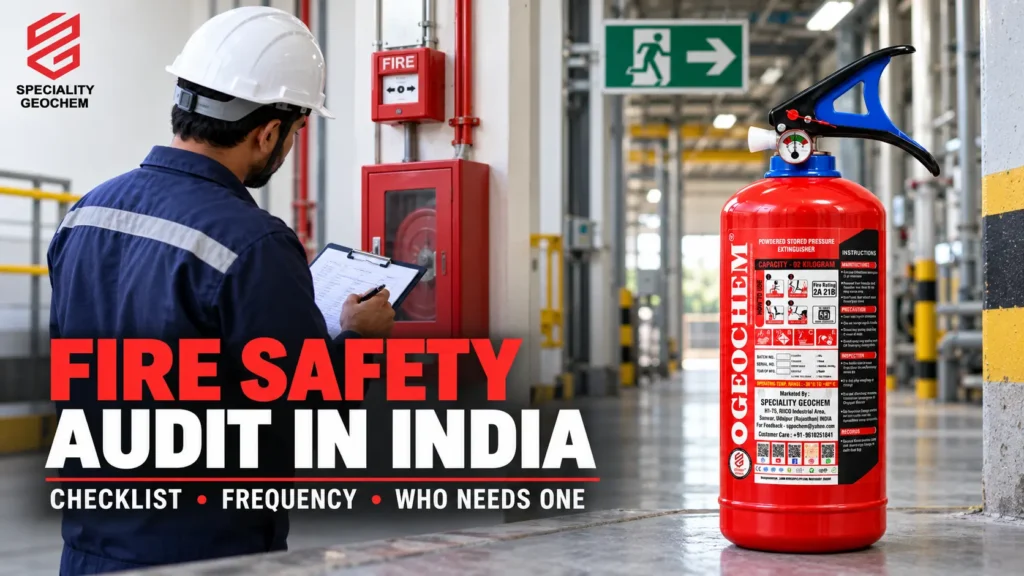
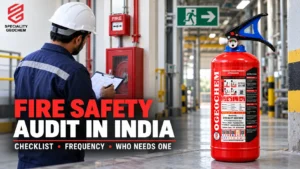
A fire safety audit is the moment you find out whether your fire equipment would actually work. Extinguishers that look fine on the wall often fail on paper: an unsigned service tag, an overdue pressure test, a cylinder blocked behind stock. This page works as a worksheet. Go through it before your fire safety audit, tick what is in place, and fix what is not before the auditor arrives.
What is a fire safety audit?
A fire safety audit is a structured review of a building’s fire protection: the equipment installed, whether it is the right type and in the right place, whether it has been maintained, and whether the records prove it. It looks at the whole system, not just one extinguisher.
In India, portable extinguishers are selected, installed and maintained under IS 2190:2010, and building fire safety requirements sit in the National Building Code (NBC) 2016 Part 4. During fire NOC approvals, factory licence checks and insurance assessments, authorities check whether buildings follow these rules.
Who needs a fire audit?
Any building that needs a fire NOC should expect its fire safety arrangements to be checked. Typical examples include:
| Building type | Why it gets audited |
|---|---|
| Factories and warehouses | Factory inspectors verify that portable extinguishers follow IS 2190 installation guidelines |
| Hospitals and nursing homes | Patients cannot move quickly, so equipment and records are checked closely |
| Educational institutions | Crowded spaces, labs and electrical systems |
| Commercial buildings above 15 metres | Classed as high-rise under the National Building Code |
| Hotels, hostels, malls and multiplexes | Large numbers of people and long escape routes |
Offices and housing societies are reviewed too, especially at fire NOC renewal. A fire safety audit for factory premises also covers the inspection records the Factories Act requires. Our guide on how to get a fire NOC in India lists which buildings need one.
Fire audit checklist
Use this fire audit checklist as your working sheet. It also works as a simple fire safety audit format: grouped by area, so one person can take each part.
Fire extinguishers
- Every unit is ISI marked and carries a readable manufacturing date
- The right type is in the right place: ABC for general areas, CO2 near electrical panels, foam near flammable liquids
- Each unit is mounted near an exit or escape route, visible, and reachable without moving anything
- The pressure gauge needle sits in the green zone
- The safety pin and tamper seal are intact
- The maintenance tag is signed and the last annual service date is current
- The hydrostatic test is not overdue
Hydrants, alarms and fixed systems
- Hydrant points and hoses are accessible and undamaged
- Fire alarm and detection systems are working
- Any sprinkler or automatic suppression system has current service records
Exits and signage
- Exit routes and staircases are clear
- Signage shows where every extinguisher is, as NBC 2016 Part 4 requires
Training and records
- Staff know how to use an extinguisher and where the exits are
- A written inspection register exists, with a separate register for each floor in multi-floor buildings
The same list doubles as a fire safety inspection checklist in India for your monthly rounds. Our fire extinguisher inspection guide covers the monthly checks in more detail.
How often should you audit?
There is no single date that suits every building. Two cycles decide how often you are checked:
- Your fire NOC renewal. Most states require renewal every 1 to 5 years, depending on building type. Commercial buildings often renew every year, residential societies every 3 to 5 years, and industrial buildings often need an annual inspection. The fire department may also make surprise visits.
- Your own equipment checks. Under IS 2190:2010, extinguishers follow a three-tier routine: monthly visual checks by trained in-house staff, quarterly checks, and annual servicing by a certified fire safety technician.
The safest approach is to run your own internal fire safety audit before every NOC renewal, so nothing comes as a surprise.
Documents auditors ask for
Keep these ready in one file. A fire audit report is only as strong as the paperwork behind it.
| Document | What it shows |
|---|---|
| Fire NOC and renewal history | The building is approved for its use |
| Extinguisher inspection register | Monthly, quarterly and annual checks, by floor or zone |
| Signed maintenance tags | Annual servicing was actually done |
| Hydrostatic test records | Cylinders were pressure tested on time |
| Product certificates | Extinguishers are BIS certified and ISI marked |
| Training records | Staff were shown how to respond |
Fire NOC renewal in most Indian states needs documented proof that installed extinguishers have had annual inspection and servicing. Premises under the Factories Act must also keep quarterly inspection records.
Common findings and how to fix them
| Finding | Why it fails | Fix |
|---|---|---|
| Unsigned or outdated maintenance tag | No proof the annual service was done | Book a certified technician; keep the signed tag on the unit |
| Hydrostatic test overdue by years | The cylinder’s strength is unproven | Send it for testing at a recognised facility, or replace it |
| Extinguisher blocked by stock or furniture | It must be reachable without moving anything | Clear the area and mark it |
| Wrong type for the risk | For example, CO2 in a kitchen where cooking oil is the main hazard | Match the type to the fire class |
| Fire ball installed where a portable extinguisher is required | Fire balls are supplementary, not a replacement under NBC 2016 | Install BIS-certified extinguishers, and keep the ball as extra protection |
| Too few extinguishers | Not enough cover for the floor area | Add units so every area is covered |
| No staff training | People cannot use what they do not understand | Run a short session on the PASS method |
Most of these are paperwork or placement problems, not equipment failures, which means they are cheap to fix before the audit. Where a unit does need replacing, buy ISI-marked stock directly from a fire extinguisher manufacturer.
Audit vs inspection vs NOC: what is the difference?
| Point | Fire safety audit | Equipment inspection | Fire NOC |
|---|---|---|---|
| What it is | A review of the whole fire safety system and its records | A routine check of each extinguisher | A certificate from the fire department |
| Who does it | A qualified fire safety professional or the authority | Trained staff (monthly); certified technician (annual) | The state fire department |
| How often | Before NOC renewal and as required by the authority | Monthly, quarterly and annually | On approval, then at renewal |
| Output | A fire audit report with findings | A signed tag and register entry | The NOC |
Frequently asked questions
Q1. What is included in a fire safety audit?
A fire safety audit checks your extinguishers, hydrants, alarms, exits, signage, training and records. Auditors look at whether each extinguisher is the right type, correctly placed, ISI marked, serviced on time and recorded in the inspection register.
Q2. How often is a fire audit required in India?
It depends on your building and state. Fire NOC renewal usually falls every 1 to 5 years: often yearly for commercial buildings and every 3 to 5 years for residential societies. Extinguishers themselves need monthly, quarterly and annual checks under IS 2190:2010.
Q3. Who can conduct a fire safety audit?
Monthly extinguisher checks can be done by trained in-house staff, but annual servicing must be done by a certified fire safety technician who signs the tag. A full building audit should be carried out by a qualified fire safety professional accepted by your state fire department.
Q4. What is the difference between fire audit and fire NOC?
A fire NOC is a certificate issued by the fire department that approves a building for use. A fire safety audit is a review of the building’s fire equipment, maintenance and records. A good audit result makes NOC approval and renewal much smoother.
Q5. What equipment fails most often in audits?
Portable extinguishers, usually because of paperwork rather than the cylinder itself: unsigned or outdated maintenance tags, overdue hydrostatic tests, units blocked from view, or the wrong type for the risk, such as CO2 in a kitchen.
Get audit-ready
A clean fire safety audit starts with certified equipment. Speciality Geochem makes ISI-marked ABC, CO2, foam and water extinguishers under licence CM/L 2533146, along with fire balls, fire blankets and hydrant systems. See our fire fighting equipment range, or call +91-9799661841 for a quote before your next audit.

One Response