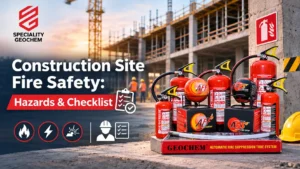
Quick answer: Construction site fire safety rests on three controls: a hot work permit with a fire watch for every welding or cutting job, safe and separate storage of fuel, paint and gas cylinders, and the right extinguisher in every zone. IS 3016 asks for a fire watch of at least one hour after hot work ends.
Key takeaways
- Construction site fire safety starts with four hazards: welding sparks, fuel, timber and temporary wiring.
- Every hot work job needs a permit, cleared combustibles and a fire watch afterwards.
- IS 3016 sets a safe distance of at least 15 m between hot work and combustible material.
- Fuel, paint and gas cylinders need their own ventilated storage, away from site offices.
- Match extinguishers to the zone: ABC powder for general areas and fuel, CO2 for electrical panels.
Why is construction site fire safety so important?
A building under construction has no working sprinklers, no fire doors and often no finished staircases, yet it holds diesel, shuttering timber, paints, gas cylinders and temporary wiring. A grinder spark can smoulder in thermocol for an hour before anyone notices. Night shifts and changing contractors raise the risk, so construction site fire safety has to be managed daily, not only at handover.
What hazards does construction site fire safety need to control?
| Hazard | Typical cause | Control |
|---|---|---|
| Welding, cutting and grinding | Sparks and hot slag reaching combustibles | Hot work permit, screens, fire watch |
| Fuel and lubricants | Spills while refuelling machinery | Fixed refuelling point, drip trays |
| Timber and packaging waste | Loose shuttering, cartons, thermocol | Daily housekeeping, separate scrap yard |
| Temporary electrics | Bare joints, overloaded boards | Proper cables, MCB/ELCB, daily checks |
| Labour camp cooking | LPG and open stoves near sheds | Separate cooking area, extinguisher nearby |
What is a hot work permit and when is it needed?
A hot work permit is written permission to weld, cut, grind or use an open flame at a set place and time, the core document of construction site fire safety.
The Indian Standard IS 3016, Code of practice for fire precautions in welding and cutting operations, sets out the main controls:
- Obtain a written permit before hot work in hazardous locations.
- Keep combustibles at a safe distance of at least 15 m, or protect them.
- Wet wooden floors, cover them with damp sand or shield them with sheet metal.
- Keep suitable fire equipment within easy reach of the welder.
- Clean drums and tanks of all flammable material before cutting them.
- Post a fire watch for at least one hour after the job ends.
The fire watch matters because many hot work fires start after the welder has left.
How should fuel, paint and gas cylinders be stored on site?
- Store diesel in a fixed, ventilated area with drip trays, away from site offices and exits.
- Keep paints and thinners closed, in a separate store outside the building.
- Store gas cylinders upright and chained, with oxygen and fuel gas cylinders kept apart.
- Put “No Smoking” signs and an ABC extinguisher at every storage point.
Which extinguishers does construction site fire safety need, zone by zone?
| Zone | Suggested equipment |
|---|---|
| Fuel store and DG set | 9 kg ABC powder extinguisher |
| Welding and fabrication bay | 6 kg ABC powder extinguisher, kept within reach of the welder |
| Each working floor and stair core | 4 kg or 6 kg ABC extinguisher |
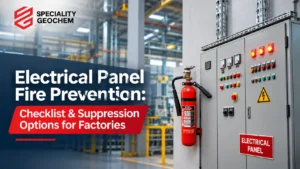
| Temporary electrical panels | 4 kg CO2 extinguisher |
| Site office and stores | 4 kg ABC extinguisher |
| Labour camp kitchen | 4 kg ABC extinguisher and a fire blanket |
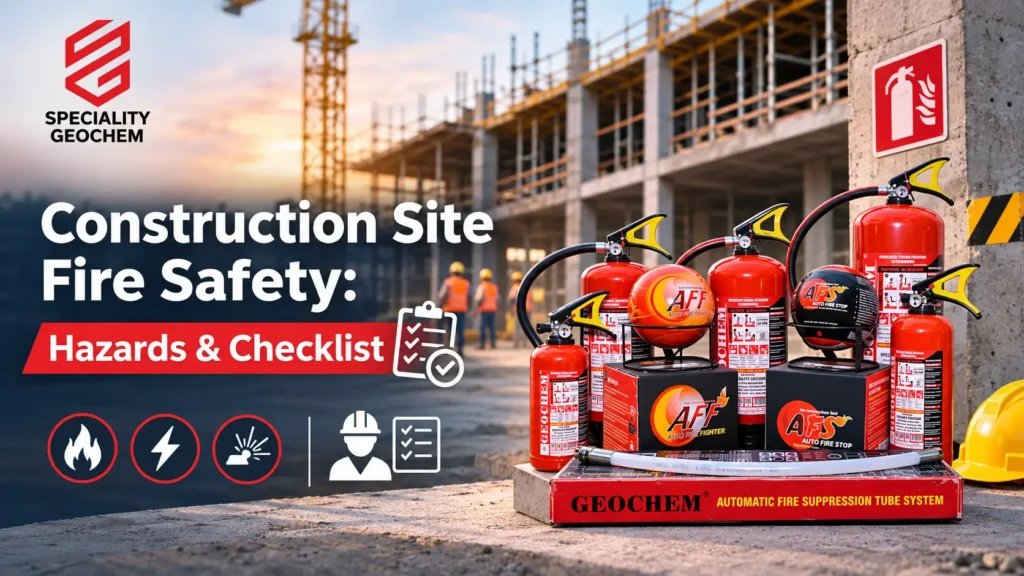
Speciality Geochem’s ABC powder fire extinguishers come in 1 kg to 9 kg sizes made to IS 15683, with the 6 kg suited to workshops and the 9 kg to fuel zones. For temporary panels and switchgear, a CO2 fire extinguisher leaves no powder residue on electrical parts.
Mount extinguishers where workers can see and reach them. Our fire extinguisher placement guide covers height, distance and signage.
How do you protect site vehicles and heavy equipment?
Excavators, cranes, transit mixers and DG sets carry fuel and hot engines, so keep a portable ABC extinguisher in every cabin. For engine compartments, an automatic fire suppression tube system ruptures at around 110 °C at the hottest point and releases clean agent with no wiring or power supply. The GT range covers vehicle compartments from 0.13 m³ to 1.26 m³.
Daily construction site fire safety checklist
- Are all hot work permits for today signed and displayed?
- Is a fire watch assigned for every hot work job?
- Have scrap timber, packaging and thermocol been cleared?
- Are extinguishers in place, sealed and pressurised?
- Are temporary electrical joints covered and boards not overloaded?
- Are fuel and gas cylinders in their stores and not on the work floor?
- Are stairways and exits free of material?
- Does every supervisor know the assembly point and 101 / 112?
When should workers stop fighting a fire?
In construction site fire safety, lives come first. Evacuate when the fire spreads beyond its starting point, when smoke fills a floor, when a gas cylinder is exposed to flames, or when the extinguisher is empty. Use the stairs, gather at the assembly point, take a head count and call 101 (fire) or 112.
For contractors and EPC firms: Speciality Geochem, Udaipur, manufactures ABC and CO2 extinguishers, fire balls and suppression tube systems, with bulk supply to project sites across India. Ask us for a zone-wise construction site fire safety equipment list.
Frequently asked questions
Q1. Which fire extinguisher is best for a construction site?
For most construction site fire safety needs, an ABC dry powder extinguisher, as it handles timber, paper, fuel and gas fires. Add CO2 near electrical panels.
Q2. What is a hot work permit?
A written approval to weld, cut, grind or use an open flame at a specific place and time. It confirms that combustibles are cleared, an extinguisher is ready and a fire watch is assigned.
Q3. How many extinguishers does a construction site need?
It depends on site area, floors and fire load. Place at least one on each working floor, at every fuel and welding point, and near each panel. A consultant can confirm numbers.
Q4. Can fuel be stored on a construction site?
Yes, in limited quantity, in a ventilated store with drip trays, away from offices, exits and hot work, with an ABC extinguisher and “No Smoking” signs.
Q5. Who is responsible for construction site fire safety?
The main contractor usually manages it through a safety officer, and subcontractors must follow permits and housekeeping rules. Write duties into contracts and the site safety plan.
Q6. How long should a fire watch continue after welding?
IS 3016 asks for a fire watch of at least one hour after the job ends, and longer where the surroundings are more dangerous.
Q7. What safe distance is needed between welding and combustible material?
IS 3016 recommends a safe distance of at least 15 m. If material cannot be moved, cover it with sheet metal or fire-resistant screens.
Q8. Do site vehicles need fire extinguishers?
Yes. Keep a portable ABC extinguisher in each cabin. Engine bays of heavy machines can also be fitted with an automatic suppression tube.