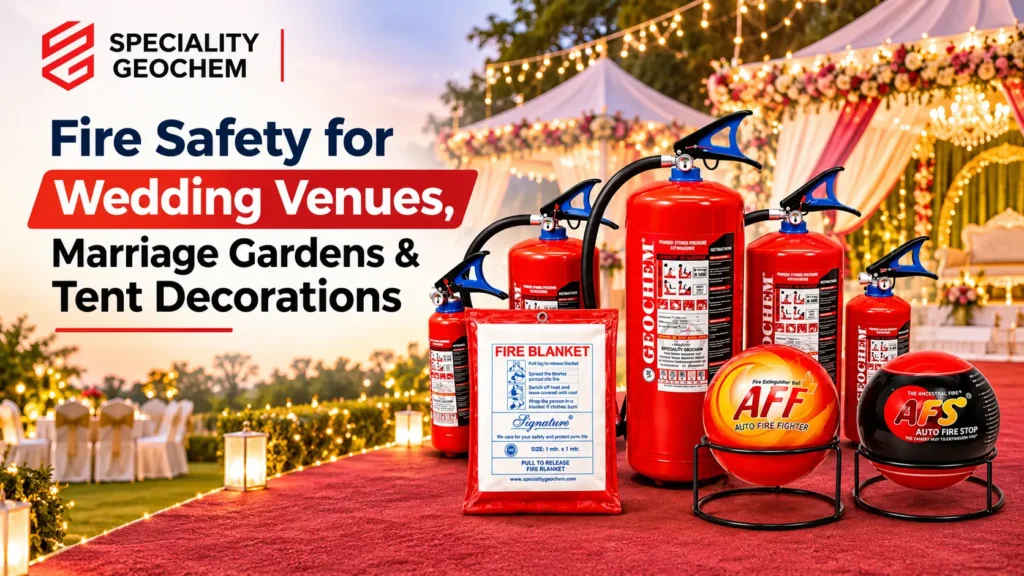
Quick answer: Fire safety for wedding venues comes down to four things: non-synthetic tent material, clear exits on all sides, the right extinguisher at every risk point (kitchen, generator, stage, electrical panel), and one named person in charge on the day. Most wedding fires start from a short circuit, a bhatti or fireworks, and spread through drapes within minutes.
Key takeaways
- Good fire safety for wedding venues starts with tent material: synthetic decor turns a spark into a venue-wide fire.
- The four main hazards are generators, bhattis and LPG, fireworks, and overloaded decor lighting.
- Every zone needs its own equipment: ABC powder for general areas, CO2 for panels, automatic fire balls for unwatched points.
- Delhi Fire Service asks for exits on all sides of a pandal, each at least 2.5 m wide.
- Venue owner, tent contractor and caterer share responsibility; put it in writing.
Why does fire safety for wedding venues matter so much?
A marriage garden on a wedding night has everything a fire needs: cloth canopies, drapes, flower walls, hundreds of guests and dozens of temporary electrical joints. A flame at the stage can reach the roof canopy before anyone finds an extinguisher.
Recent Indian stage fires during varmala and mehendi functions started from short circuits behind decor and overheated AC units, then spread to curtains and tents. Guests escaped because exits were open. Fire safety for wedding venues is a planning job, not just an equipment purchase.
What are the main fire hazards at a marriage garden?
| Hazard | Where it starts | Main control |
|---|---|---|
| Generators (DG sets) | Fuel spills, hot exhaust near tent walls | Keep outside the tent, diesel stored away, ABC extinguisher nearby |
| Bhattis and LPG | Caterer’s cooking area | Separate kitchen, cylinders upright and outside, regulator checks |
| Fireworks and sky lanterns | Baraat, entry, varmala | No open-flame fireworks near the structure |
| Decor lights and DJ setup | Loose joints, overloaded extension boards | Proper cables, MCB protection, no wiring under drapes |
The caterer’s area needs extra attention because LPG and hot oil sit next to fabric walls. Our guide on LPG cylinder fire safety covers leak checks and the first steps if a cylinder catches fire.
What equipment does fire safety for wedding venues need, area by area?
Plan fire safety for wedding venues zone by zone, not as one number for the whole garden.
| Zone | Suggested equipment |
|---|---|
| Kitchen and bhatti area | 6 kg ABC powder extinguisher + fire blanket |
| DG set and fuel store | 9 kg ABC powder extinguisher (suited to fuel zones) |
| Main electrical panel, DJ and sound console | 4 kg CO2 extinguisher (leaves no residue on electronics) |
| Stage, mandap and lighting junctions | 4 kg ABC extinguisher + automatic fire ball |
| Tent entry points and perimeter | ABC extinguishers and water buckets at strategic points |
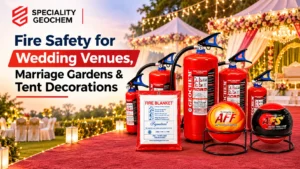
Speciality Geochem supplies ABC and CO2 fire extinguisher cylinders in 1 kg to 9 kg sizes for this kind of setup. For junction boxes and decor-light points that nobody watches during the function, an automatic fire extinguisher ball activates on flame contact within 3 to 8 seconds and sounds a 120 dB alarm. It adds a layer; it does not replace portable extinguishers.
Quantities depend on area and fire load. Our guide to where to place fire extinguishers explains height, spacing and signage.
How should exits and aisles be planned?
The Delhi Fire Service instructions for temporary structures and pandals give a practical baseline that venues in other states can also use:
- Exits on all sides, each at least 2.5 m wide.
- At least 4.5 m clear space between the pandal and existing buildings.
- At least 15 m from railway lines, electric substations and furnaces.
- No structure under a live electrical line, and a ceiling height of at least 3 m.
- No synthetic cloth or synthetic ropes.
- Kitchen separated by non-combustible walls such as G.I. sheets.
- Standby emergency lighting.
Keep aisles free of extra chairs, flower stands and photo booths.
Who is responsible: venue owner, tent contractor or caterer?
| Party | Responsible for |
|---|---|
| Venue owner | Permissions, fire NOC where required, permanent equipment, exits |
| Tent contractor | Fabric type, structure, wiring, distance from hazards |
| Caterer | Bhatti and LPG safety, kitchen separation, kitchen extinguisher |
| Event planner | Fireworks control, crowd flow, briefing the staff |
Rules differ by state, so check with your local fire office. Our guide on fire NOC in India explains the general process.
Pre-event checklist for fire safety for wedding venues
- Walk all exits and confirm they open outward and stay clear.
- Check every extinguisher’s pressure gauge and seal.
- Brief two staff members on using an extinguisher (PASS method).
- Test emergency lights and the generator changeover.
- Inspect cable joints behind the stage and under the decor.
- Fix a fireworks zone well away from the tent.
- Save the local fire station number and 101 / 112 on every supervisor’s phone.
When should staff stop fighting the fire?
Fire safety for wedding venues always puts people before property. Leave the fire to professionals when flames reach the roof canopy, when smoke fills the tent, or when an LPG cylinder is involved and the regulator cannot be shut. Move guests out through the nearest exit, keep them away from the structure and call 101 (fire) or 112.
For venue owners, tent houses and wedding planners: Speciality Geochem, Udaipur, manufactures ABC and CO2 extinguishers, automatic fire balls and fire blankets, with bulk supply across India. Ask us for a zone-wise plan for fire safety for wedding venues and marriage gardens.
Frequently asked questions
Q1. Is a fire NOC needed for a marriage garden?
It depends on your state and local body. Permanent marriage gardens and banquet halls often need fire clearance, and temporary pandals usually need local permission. Confirm with your local fire office.
Q2. How many fire extinguishers does a wedding venue need?
There is no single number; good fire safety for wedding venues is zone-based. Place at least one suitable extinguisher in each risk zone (kitchen, DG set, panel, stage) and more along the tent perimeter.
Q3. Which extinguisher suits a tent or drape fire?
An ABC dry powder extinguisher, which works on burning cloth, wood and paper. Aim at the base of the flame; for canopy fires, evacuate first.
Q4. Can fire extinguisher balls be used in pandals?
Yes, as an extra layer at unwatched points such as junction boxes and lighting clusters. The ball activates on flame contact, but it does not replace portable extinguishers.
Q5. Who is liable if a fire breaks out at a wedding?
It depends on the cause and local law, and can fall on the venue owner, tent contractor, caterer or organiser. Written responsibilities reduce disputes.
Q6. Are fireworks allowed at marriage gardens?
Local rules vary. Never use open-flame fireworks near tents or drapes; keep a separate zone with an extinguisher ready.
Q7. Which extinguisher should be kept near the DJ and electrical panel?
A CO2 extinguisher. It is non-conductive and leaves no residue on sound systems or switchgear.
Q8. How far should a generator be kept from the tent?
Keep it outside the structure, away from fabric walls and exits, with fuel stored separately and an ABC extinguisher nearby. Basic fire safety for wedding venues also means following your local fire office’s distance guidance.