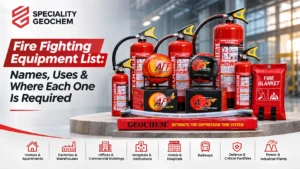
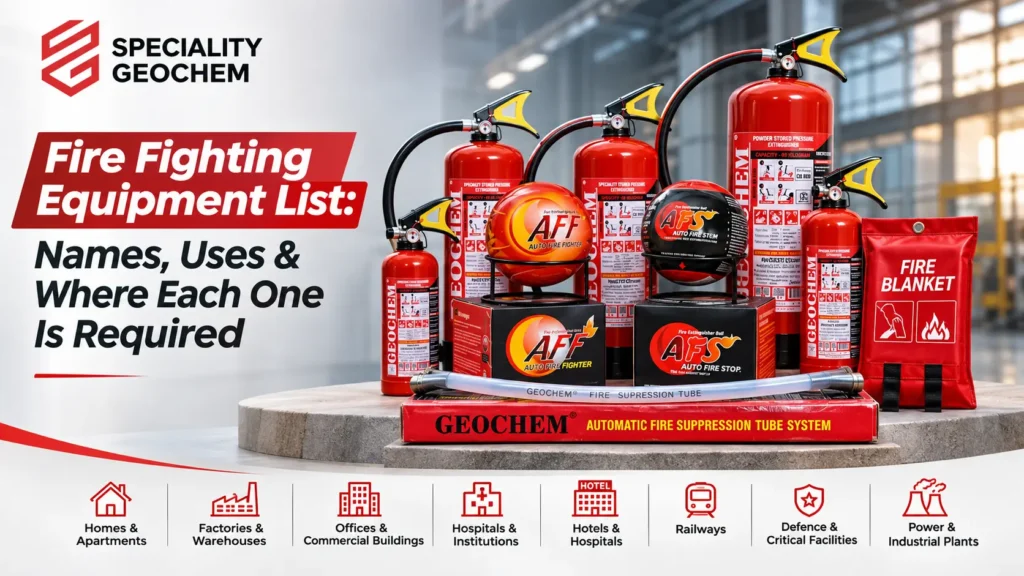
Ask ten facility managers what “fire fighting equipment” means and you will get ten different lists. Some think only of red cylinders on the wall; others think of pumps, pipes and sprinklers. In practice, a building is protected in layers, and each layer uses different equipment. This fire fighting equipment list names every common item, explains what each one does, and shows where it is typically required, so you can check what your home, office or factory has and what it is missing.
Short answer: the core fire fighting equipment list for most Indian buildings is portable fire extinguishers (ABC, CO2, foam or water type), fire blankets, automatic devices such as fire extinguisher balls and suppression tubes, and, for larger buildings, a fire hydrant system with hose reels. Detection, alarms and signage complete the picture.
The three layers of fire protection
Before looking at individual items, it helps to see how they fit together:
- First response (seconds). Equipment a person can use immediately on a small fire: portable extinguishers and fire blankets.
- Automatic response (no person needed). Devices that activate on their own at the fire source: fire extinguisher balls and suppression tube systems.
- Sustained firefighting (minutes to hours). Fixed water systems that keep supplying water: hydrants, risers, hose reels and pumps.
Most fire safety gaps come from having only one layer. A factory with extinguishers but no automatic protection inside its panels, or a home with nothing at all, is relying on luck.
Fire fighting equipment list at a glance
| Equipment | What it does | Fire classes | Typical places |
|---|---|---|---|
| ABC dry powder extinguisher | Multipurpose first-response extinguisher | A, B, C | Homes, offices, shops, factories, vehicles |
| CO2 extinguisher | Clean gas, no residue | B, C (electrical) | Server rooms, panels, labs |
| Foam (AFFF) extinguisher | Forms a blanket over burning liquids | A, B | Fuel stores, workshops, parking |
| Water type extinguisher | Cools burning solids | A only | Paper, wood and textile stores |
| Fire blanket | Smothers small fires by cutting off air | A, F (cooking oil) | Kitchens, labs, welding areas |
| Fire extinguisher ball | Activates by itself on flame contact | A, B, C | Panels, storage racks, machinery |
| Automatic suppression tube | Heat-sensitive tube releases clean agent inside an enclosure | A, B, electrical | Panels, server racks, engine compartments |
| Fire hydrant system | Pumped water network with landing valves and hoses | Large fires of all kinds where water is suitable | High-rise buildings, factories, campuses |
| Fire safety combo kit | Ball, extinguisher and blanket together | A, B, C, F | Homes, small offices, shops |
The sections below look at each item of fire fighting equipment in turn.
1. Portable fire extinguishers
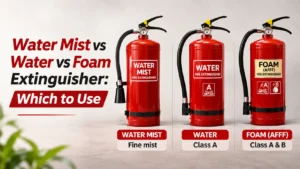
Portable extinguishers are the backbone of any fire fighting equipment list. In India they are made to IS 15683, and four types cover most risks.
ABC dry powder- The all-rounder: one cylinder handles burning solids, flammable liquids and gases, and fires that start in wiring. Sizes range between 1 kg (vehicles) and 9 kg (industrial zones); a 2 kg unit is the usual choice for homes. The powder leaves a residue and is not recommended for cooking oil fires. See our ABC powder fire extinguishers for every size.
CO2- Non-conductive and residue-free, so it is the natural pick for IT rooms, UPS areas, switchboards and labs. Its reach is short, roughly a metre, so the user has to stand near the fire.
Foam (AFFF)- Spreads a film over burning petrol, diesel and oil, which also helps stop the fire flaring up again. Common at fuel stores, workshops and parking areas.
Water type- Meant only for wood, paper and fabric fires; keep it well away from live wiring and burning oil.
Most buildings need a mix of these types rather than one type everywhere. Our ABC, CO2, foam and water guide shows how to match each type to each room.
2. Fire blankets
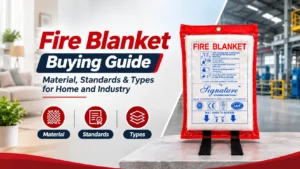
A fire blanket is woven fibreglass that smothers a small fire by cutting off its oxygen. It is the right tool for a burning pan of cooking oil, a Class F fire that powder and water handle badly, and for wrapping a person whose clothes have caught fire. Fire blankets are commonly installed in kitchens, welding areas, laboratories and machinery spaces. They need no pressure, no refill and almost no training.
3. Fire extinguisher balls
A fire extinguisher ball activates automatically when flame reaches it and releases dry chemical powder within 3 to 5 seconds. It needs no power, wiring or person nearby, which makes it useful above electrical panels, storage racks and machinery where a fire might start while nobody is watching. It can also be thrown into a small fire by hand.
4. Automatic fire suppression tube systems
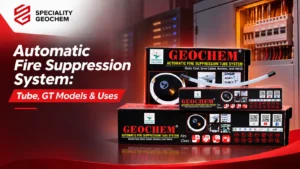
A suppression tube is a pressurised, heat-sensitive tube routed inside an enclosure such as an electrical panel, battery cabinet, server rack or vehicle engine compartment. When a fire heats the tube, it bursts at the hottest point and releases HFC-227ea, a clean agent that leaves no residue. It needs no wiring, sensors or power supply. Read more about our automatic fire suppression tube system.
5. Fire hydrant systems and hose reels
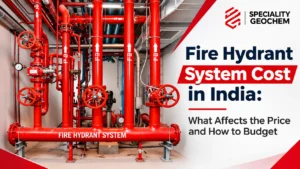
For larger buildings, portable equipment is not enough. A fire hydrant system stores water in a sump and terrace tank, keeps it under pressure with jockey, main electric and diesel standby pumps, and delivers it through risers to landing valves and hose reels on every floor. Under NBC 2016 Part 4, the requirement depends on the building’s occupancy, height and floor area.
Components include MS ERW pipes, landing valves, 19 mm hose reels, fire hoses, hydrant valves, pressure gauges and air release valves. See how we design and install a fire hydrant system.
6. Detection, alarms and signage
Fire fighting equipment works best when people know a fire has started and can find the equipment quickly. That is why NBC 2016 also covers fire detection and alarm systems, emergency exits and evacuation routes, and signage showing where extinguishers are. Inspectors check all of these during fire NOC approval.
Which fire fighting equipment does your building need?
| Building | Minimum equipment to plan for |
|---|---|
| Home or apartment | 2 kg ABC extinguisher, fire blanket in the kitchen, fire extinguisher ball over the MCB panel |
| Office | ABC extinguishers in common areas, CO2 near server and UPS rooms, signage |
| Shop or showroom | ABC extinguishers near exits, fire extinguisher ball over the electrical board |
| Commercial kitchen | Fire blankets at cooking stations, portable extinguishers for spreading fires |
| Factory or warehouse | ABC, CO2 and foam by zone, fire extinguisher balls and suppression tubes at panels and machines, hydrant system where required |
| Vehicle fleet | 1 kg or 2 kg ABC extinguisher in each vehicle, suppression tubes in engine compartments |
| High-rise building | Extinguishers on every floor, hydrant system with wet riser, alarms and signage as NBC requires |
The final list for any building depends on its size, height, occupancy and what is stored inside. Your state fire department or fire consultant confirms it during the fire NOC process.
How to check your current fire fighting equipment
Use this five-point check on every floor:
- Type matches risk. CO2 near electrical panels, foam near fuel, a fire blanket near cooking.
- Visible and reachable. Mounted near exits, not locked away or blocked by stock.
- Certified. Each extinguisher shows the ISI mark and the IS 15683 standard on its label.
- In date. Gauges in the green zone, service tags signed, fire balls within their shelf life.
- People know how to use it. At least a few people on each floor know the PASS method.
Our fire safety audit checklist turns these points into a full worksheet.
Source all your fire fighting equipment from one manufacturer
Speciality Geochem has made fire safety equipment in Udaipur since 1996: fire extinguisher cylinders, fire extinguisher balls, suppression tube systems, fire blankets, combo kits and hydrant systems. Browse our complete fire fighting equipment range, or call +91-9680211841 for a quote for your site.
Frequently asked questions
Q1. What items are on a fire fighting equipment list?
Portable fire extinguishers (ABC, CO2, foam and water types), fire blankets, fire extinguisher balls, automatic suppression tube systems, fire hydrant systems with hose reels and pumps, and supporting items such as fire alarms, detectors and signage.
Q2. Which fire fighting equipment is mandatory in India?
The requirement depends on the building. NBC 2016 Part 4 sets out fire extinguishers, detection and alarms, exits and, for larger or taller buildings, hydrant systems. Your state fire department confirms the exact list during fire NOC approval.
Q3. Which fire fighting equipment is best for electrical fires?
A CO2 extinguisher for live electrical equipment where residue would cause damage, an ABC extinguisher for general areas, and automatic protection such as a suppression tube inside the panel or a fire extinguisher ball above it.
Q4. What fire fighting equipment should a home have?
At least one 2 kg ABC extinguisher near the exit, a fire blanket in the kitchen and a fire extinguisher ball above the MCB panel. A fire safety combo kit brings all three together.
Q5. How often should fire fighting equipment be checked?
Look at extinguishers every month for pressure, seals and damage, and have them serviced every year by a certified technician. Hydrant pumps need monthly and quarterly tests, and the whole system needs an annual hydrostatic test.