Why CO2 Is Used in Fire Extinguishers: Complete Guide to CO2 Cylinders

Why CO2 Is Used in Fire Extinguishers: Complete Guide to CO2 Cylinders

Carbon dioxide (CO2) is used in fire extinguishers because it displaces oxygen, the element fire needs to burn. It leaves no residue, conducts no electricity, and works in seconds. That combination makes CO2 the default choice for electrical fires and flammable liquid fires across offices, server rooms, and industrial plants.

This guide covers everything: how CO2 fire extinguishers work, which fire classes they fight, sizes, colour codes, why they have no pressure gauge, and how often they need servicing, all as per Indian standards IS 15683 and IS 2190.

Quick Reference: CO2 Fire Extinguisher at a Glance

PropertyDetail
AgentCompressed liquid CO₂ (carbon dioxide)
Fire ClassesClass B (flammable liquids), Class E (electrical)
Colour Code (India)Red body, black band/label
Standard Sizes2 kg, 4.5 kg, 6.5 kg, 9 kg
Discharge Time8 to 15 seconds depending on size
Has Pressure Gauge?No, CO₂ cylinders are weighed, not gauged
Leaves Residue?No, completely clean discharge
Annual Service Required?Yes, plus hydrostatic test every 5 years
Indian StandardIS 15683:2018, IS 2190

Why Is Carbon Dioxide Used in Fire Extinguishers?

Carbon dioxide works on two principles at once: oxygen displacement and rapid cooling.

When CO2 is released from the cylinder, it expands from a stored liquid into gas at extremely high speed. This expansion does two things:

  • Displaces oxygen. CO2 is heavier than air and blankets the fire, pushing oxygen concentration below the 16% threshold needed for combustion. Normal air is 21% oxygen. Once it drops below 16%, fire cannot sustain itself.
  • Cools the fire zone. As liquid CO2 converts to gas, it absorbs heat rapidly. The discharge temperature at the horn drops to approximately −78°C. This cooling effect helps knock down flames in the immediate area.

No residue is left behind. No water damage. No powder contamination. The CO2 simply disperses into the air once the fire is out.

This is exactly why CO2 is the go-to agent for server rooms, switchgear panels, data centres, and laboratories, environments where the extinguishing agent can cause as much damage as the fire itself.

Read More About which gases are used in fire extinguisher and why?

How Does a CO2 Fire Extinguisher Work?

CO2 is stored as a compressed liquid inside a high-pressure seamless steel cylinder. The pressure inside is typically 55–60 bar at room temperature.

When you operate the extinguisher( the Pass Method):

  • Pull the safety pin. This breaks the tamper seal and unlocks the lever.
  • Point the horn at the base of the fire. Aim at the fuel source, not the flames.
  • Squeeze the lever. This opens the valve and releases CO2 under pressure.
  • Sweep side to side. Move the horn across the fire base in short sweeps until flames are out.

The CO2 travels through a siphon tube inside the cylinder, exits through the discharge horn (sometimes called a trumpet), and expands rapidly as it leaves the nozzle. The horn becomes extremely cold during discharge. Never grip it directly with bare hands. Always hold the horn handle.

Discharge time by size

SizeApproximate Discharge Time
2 kg8 to 10 seconds
4.5 kg10 to 12 seconds
6.5 kg12 to 14 seconds
9 kg14 to 16 seconds

Work fast. CO2 extinguishers have a short discharge window.

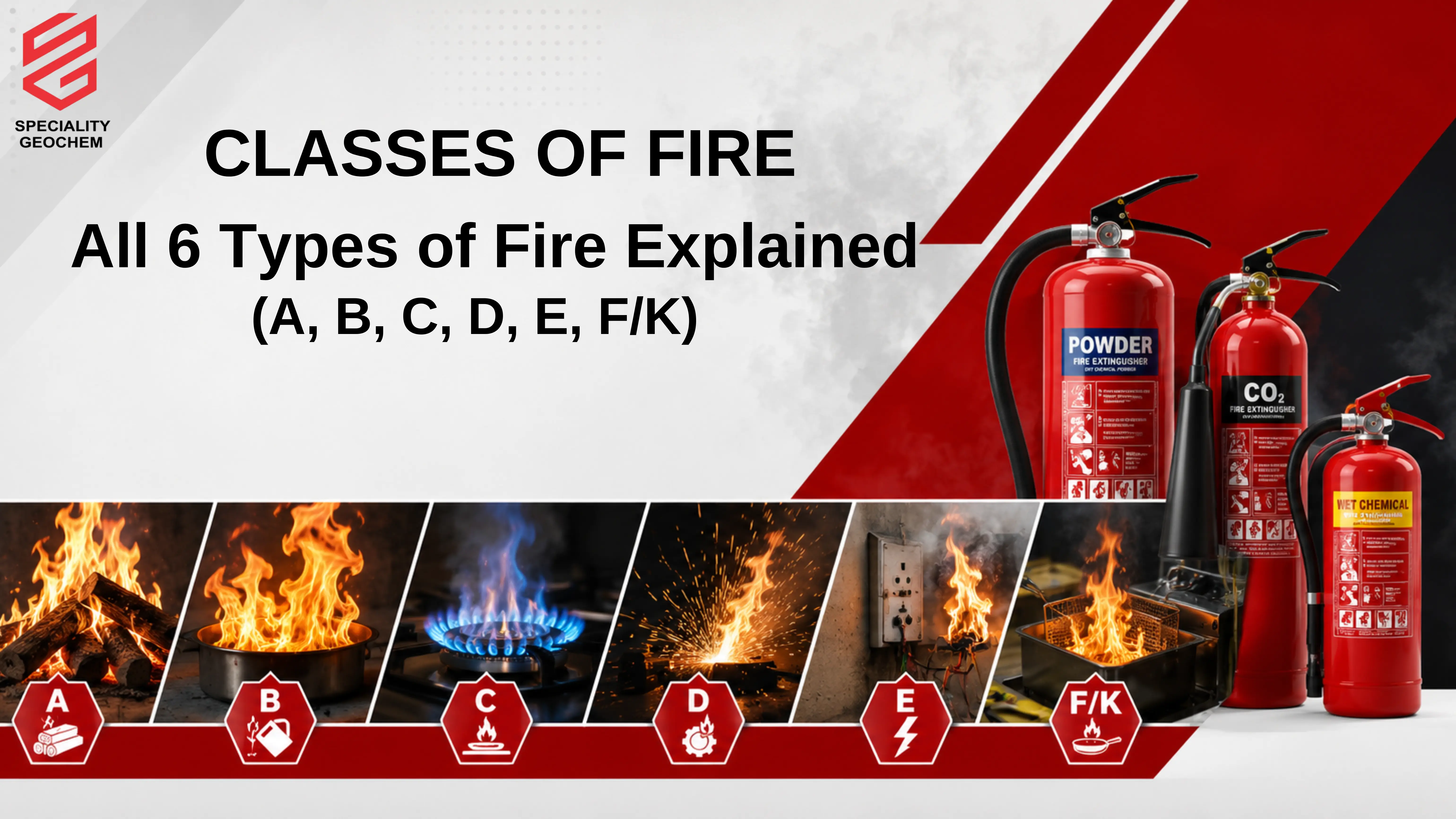
What Fire Classes Does CO2 Fight?

CO2 extinguishers are effective on two fire classes as defined under Indian and international fire standards:

Class B Flammable Liquids

Fires involving petrol, diesel, kerosene, paint, solvents, and similar liquids. CO2 blankets the fuel surface and cuts off oxygen supply.

Class E Electrical Equipment

CO2 is non-conductive. It can be safely used on live electrical equipment, switchboards, servers, motors, transformers, without risk of electrocution or short-circuit damage.

What CO2 does NOT fight:

Fire ClassTypeCO₂ Suitable?
Class AWood, paper, cloth, ordinary combustiblesNo
Class BFlammable liquidsYes
Class CFlammable gases Not recommended
Class DMetal fires (magnesium, lithium) No
Class EElectrical fires Yes
Class FCooking oils and fats No

Why not Class A? CO2 has no cooling depth. Once it disperses, deep-seated materials like wood or paper can re-ignite because the CO2 does not soak into the fuel. For Class A fires, use a water mist or ABC dry powder extinguisher.

CO2 vs ABC Powder: Which Should You Choose?

A common question Which one to choose Co2 vs ABC dry powder, here is a direct comparison:

FeatureCO₂ ExtinguisherABC Dry Powder
Fire ClassesB, EA, B, C, E
ResidueNoneSignificant powder residue
Safe on Electronics✅ Yes❌ No, powder damages equipment
Visibility After UseClearReduced, powder clouds vision
Best ForServer rooms, offices, electrical panelsOpen areas, vehicles, warehouses
Clean-up RequiredNoneExtensive
Re-ignition RiskHigher (no soaking effect)Lower on Class A
BIS Standard (India)IS 15683IS 15683

Rule of thumb: If the space has electronics or valuable equipment, choose CO2. If the space has mixed fire risks and you need broader coverage, choose ABC powder.

What Colour Is a CO2 Fire Extinguisher?

In India, as per IS 2878 and standard BIS colour coding:

  • Body colour: Signal red (RAL 3001)
  • Label / band colour: Black

The black band is the universal identifier for CO2 extinguishers. If you see a red cylinder with a black label, it is CO2.

This colour coding helps trained personnel identify the correct extinguisher quickly in an emergency, without having to read the label.

Read More on Colour Code of fire extinguisher

Why Does a CO2 Fire Extinguisher Have No Pressure Gauge?

This is one of the most searched questions about CO2 extinguishers, and the answer is straightforward.

CO2 is stored as a liquefied gas under high pressure (around 55–60 bar). Because it exists in both liquid and gas states simultaneously inside the cylinder, the pressure reading stays almost constant regardless of how much CO2 remains. A pressure gauge would show full pressure even when the cylinder is nearly empty. It gives you no useful information.

Instead, CO2 cylinders are weighed to determine charge level. Each cylinder has a stamped tare weight (empty weight) on the collar. A trained technician subtracts the tare weight from the total weight. If the difference is less than 10% of the rated charge, the cylinder needs refilling.

This is why annual servicing by a certified technician is non-negotiable for CO2 extinguishers.

CO2 Fire Extinguisher Sizes: Which Size Do You Need?

CO2 extinguishers are available in four standard sizes in India. The right size depends on the risk area:

SizeCoverage AreaTypical Use
2 kgSmall room up to 15 m²Home office, small server closet, vehicle
4.5 kgMedium space up to 30 m²Office floor, retail counter, server room
6.5 kgLarge space up to 50 m²Large server room, data centre, control room
9 kgIndustrial spaceManufacturing plant, electrical substation

As per IS 2190, placement for electrical risk areas typically requires one 4.5 kg CO2 extinguisher per floor or per defined electrical zone. For server rooms and data centres, the standard recommendation is a minimum of two 4.5 kg units at separate exits.

Note: A 2 kg CO2 extinguisher is not adequate as the sole extinguisher for a commercial server room. It is a supplementary unit.

Check Out our guide on Fire extinguisher size.

Is a CO2 Extinguisher Good for Home Use?

CO2 extinguishers are not the first choice for most Indian homes as the most reliable fire extinguisher for home. Here is why:

  • Homes have mostly Class A fires (wood, fabric, paper, cooking). CO2 is not effective on these.
  • The discharge is very cold (−78°C) and can cause frostbite if mishandled.
  • Short discharge time (8–10 seconds for 2 kg) requires confident operation.
  • CO2 in a small enclosed space can reduce oxygen enough to cause breathing difficulty.

For home use, a stored-pressure water mist extinguisher or a 1 kg ABC dry powder unit is safer and more versatile.

Exception: If your home has a dedicated home office, home server, or electrical workshop, keep a 2 kg CO2 as a supplementary extinguisher for that specific zone.

Maintenance and Servicing: How Often Does a CO2 Extinguisher Need Service?

CO2 extinguishers require structured maintenance. Neglected cylinders can lose charge without any visible sign.

Maintenance schedule as per IS 2190:

Check TypeFrequencyWho Performs
Visual InspectionMonthlyOwner / facility manager
Weight Check (Charge Verification)Every 6 monthsCertified technician
Full Service (Internal Check, Valve, Seal)AnnualBIS-certified service provider
Hydrostatic Pressure TestEvery 5 yearsAccredited testing facility

What to check during monthly visual inspection:

  • No visible dents, cracks, or corrosion on the cylinder body
  • Safety pin is intact with tamper seal unbroken
  • Discharge horn is undamaged and not blocked
  • Wall bracket is secure and cylinder is accessible
  • Location signage is visible

How long does a CO2 fire extinguisher last?

A well-maintained CO2 cylinder has a service life of 10 years from the date of manufacture, after which it must be condemned and replaced. The manufacture date is stamped on the cylinder collar.

If a cylinder fails its hydrostatic pressure test at any point during its service life, it must be replaced immediately, regardless of age.

Can a CO2 Extinguisher Be Used in a Confined Space?

No, not without precaution.

CO2 displaces oxygen. In a confined space (small room, enclosed cabinet, vehicle cabin), using a CO2 extinguisher can rapidly lower oxygen levels to the point where the person operating it may experience dizziness, loss of consciousness, or suffocation.

BIS standards and fire safety training both emphasise: after discharging a CO2 extinguisher in any enclosed area, exit the space immediately and ventilate before re-entering.

For confined spaces where fire risk is high, automatic CO2 suppression systems with engineered concentration levels and alarm/delay systems are the correct solution, not portable CO2 cylinders.

Applications: Where CO2 Extinguishers Are Used in India

CO2 extinguishers are mandatory or strongly recommended in the following locations per IS 2190:

  • IT and server rooms, primary extinguisher type; CO2 does not damage equipment
  • Electrical switchgear and control panels, non-conductive, no residue
  • Banks and financial institutions, protects documents and equipment
  • Fuel stations, effective on Class B (flammable liquid) fires
  • Laboratories, where chemical reactions may be involved
  • Manufacturing plants with electrical hazards, motor rooms, generator rooms
  • Hospitals, ICUs and medical equipment areas

At Speciality Geochem, we have supplied CO2 extinguishers to clients including the Indian Army, Indian Railways, Maruti Suzuki, Honda, Dabur, and Shalby Hospitals. Each cylinder is BIS-certified and pressure-tested before dispatch.

Frequently Asked Questions

Why is carbon dioxide used in fire extinguishers and not other gases?

CO2 is used because it is non-toxic at low concentrations, non-conductive, leaves no residue, and is naturally available in large quantities at low cost. It is also heavier than air, so it blankets the fire effectively. Alternatives like halon are banned in India due to ozone depletion. Nitrogen can displace oxygen but lacks CO2’s cooling effect during expansion.

Why does a CO2 fire extinguisher have no pressure gauge?

CO2 is stored as a liquefied gas. The internal pressure remains nearly constant whether the cylinder is full or half-empty. A pressure gauge would show full pressure even when the cylinder is almost depleted. Charge is verified by weighing the cylinder and comparing it to the stamped tare weight.

What colour is a CO2 fire extinguisher in India?

Red body with a black label band. Black is the standard colour code for CO2 extinguishers under Indian fire safety standards.

Why is CO2 used for electrical fires specifically?

CO2 is non-conductive. Water, foam, and most dry powders conduct electricity and can cause electrocution when used on live electrical equipment. CO2 suppresses the fire without any risk of conductivity.

Does a CO2 fire extinguisher leave residue?

No. CO2 converts entirely to gas after discharge and disperses into the air. There is no powder, foam, or water damage to clean up. This makes it the preferred choice for server rooms, data centres, and other areas with expensive sensitive equipment.

When should a CO2 fire extinguisher NOT be used?

Do not use CO2 on Class A fires (wood, paper, fabric). It will not suppress deep-seated combustion. Do not use it on Class D metal fires. Do not use it in extremely confined, unventilated spaces without an immediate exit available.

How often should a CO2 fire extinguisher be serviced?

Monthly visual checks by the owner. Weight verification every 6 months. Full annual service by a certified technician. Hydrostatic test every 5 years. Cylinder should be replaced after 10 years from manufacture date.

What size CO2 fire extinguisher do I need?

For small offices and home offices: 2 kg. For standard office floors and server rooms: 4.5 kg. For large server rooms and data centres: 6.5 kg or two 4.5 kg units. For industrial electrical zones: 9 kg. Always follow IS 2190 placement norms for your specific risk category.

Is CO2 fire extinguisher the same as ABC powder?

No. ABC powder is a dry chemical agent effective on Class A, B, C, and  class E fires. CO2 is effective on Class B and E only. ABC powder leaves a significant residue that damages electronics. CO2 is clean. They are used in different environments for different risk profiles.

Summary

QueryAnswer
Why is CO₂ used in fire extinguishers?Displaces oxygen, cools rapidly, leaves no residue, non-conductive
What fires does it fight?Class B (flammable liquids) and Class E (electrical)
What colour is it?Red body, black band
Does it have a gauge?No, it is weighed
Good for home use?Generally not. ABC powder or water mist is better for homes
How often to service?Monthly visual, 6-monthly weight check, annual service, 5-year hydrostatic test
How long does it last?10 years from manufacture date

Speciality Geochem is a certified fire extinguisher manufacturer and has manufactured BIS-certified CO2 fire extinguisher cylinders since 1996. Our cylinders are supplied to the Indian Army, Indian Railways, Maruti Suzuki, Honda, and major hospitals across India.