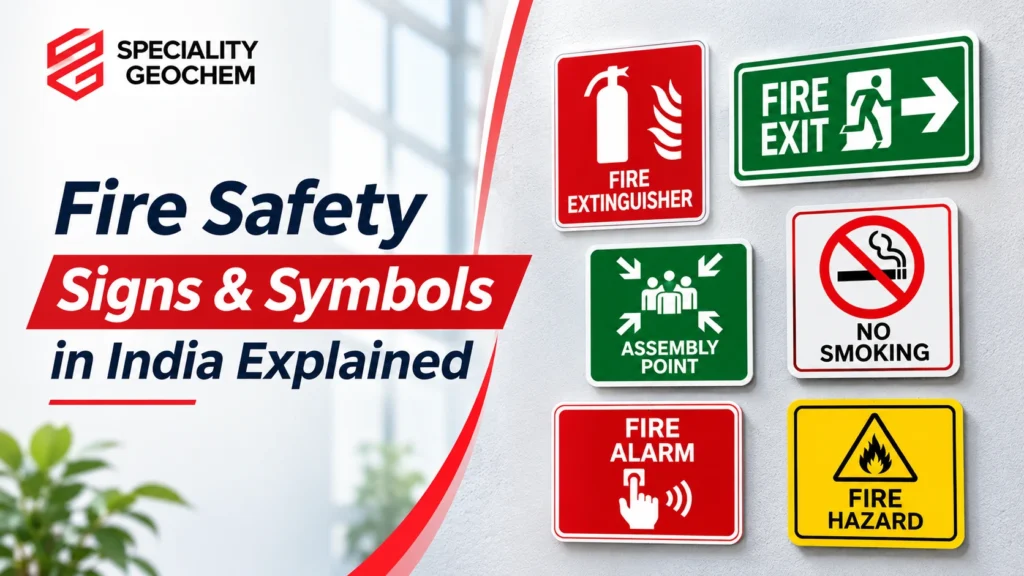
Quick answer: Fire safety signs use four colours. Red marks fire equipment and prohibitions, green marks exits and safe places, yellow warns of a hazard, and blue gives an instruction. In India, sign design follows IS 9457 and IS 12349, with symbols matching ISO 7010. NBC 2016 requires exit signs along every escape route.
Key points
- A red square sign marks fire equipment, such as an extinguisher, hose reel or alarm call point.
- A green sign with a running figure marks an emergency exit or the escape route to it.
- Photoluminescent signs glow in the dark without power for several hours after the lights fail.
- The most common audit failure is a sign hidden behind racks, decorations or a newly built wall.
- Change the signs whenever you move an extinguisher, close a door or change the layout.
Why does fire safety signage matter?
In a fire, people do not read. They scan. A clear sign tells them in one second where the exit is and where the nearest extinguisher hangs.
Signs also count during inspections. Fire officers check exit signage before they issue or renew a NOC, and insurers ask about it after a claim. Our fire safety audit guide lists signage among the first items an auditor walks through.
What do the colours on fire safety signs mean?
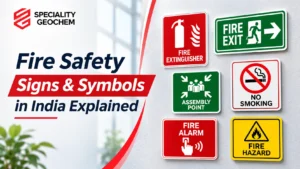
Each colour comes with a fixed shape, so the meaning is clear even from far away or to someone who cannot read the text.
| Colour | Shape | Meaning | Example |
|---|---|---|---|
| Red | Square or rectangle | Fire equipment location | Fire extinguisher, hose reel, alarm call point |
| Red | Circle with a diagonal bar | Prohibition | No smoking, no open flame, do not use lift |
| Green | Square or rectangle | Safe condition | Emergency exit, assembly point, first aid |
| Yellow | Triangle | Warning | Flammable material, electrical hazard |
| Blue | Circle | Mandatory action | Keep fire door shut, wear protective gear |
Do not mix up signage colours with cylinder colours. Signs follow the scheme above. Cylinder body and band colours follow the fire extinguisher colour code in India, which is a separate system.
What are the common fire safety symbols and what do they mean?
The ISO 7010 standard registers the symbols most of the world uses, and many Indian buildings now follow it. Use these symbols most often:
- Fire extinguisher (ISO F001): a red square with a white extinguisher.
- Fire hose reel (F002): marks the hose reel cabinet in larger buildings.
- Fire alarm call point (F005): shows where to break the glass or press the button.
- Emergency exit (E001/E002): a green sign with a running figure, a door and an arrow showing direction.
- Evacuation assembly point (E007): a green sign at the outdoor gathering spot.
- Do not use lift in case of fire (P020): a prohibition sign beside every lift.
- No smoking / no open flame (P002, P003): used near stores, fuel and gas areas.
Pair the extinguisher sign with a small instruction label that shows the steps. A label on the PASS method helps staff who have never held a cylinder act in the first few seconds.
Where should fire safety signs be installed?
- Exits: above every exit door, and at each corridor turn or junction where the route is not obvious.
- Escape routes: at intervals so the next sign is always visible, including in stairwells.
- Extinguishers and hose reels: directly above the equipment, high enough to be seen over people, racks and machines.
- Lifts: a “do not use in case of fire” sign on every floor’s lift lobby.
- Assembly point: at the outdoor spot, visible from the main exits.
Mounting height and travel distance for the extinguishers themselves are covered in our fire extinguisher placement guide.
Photoluminescent or illuminated signs: which one do you need?
A photoluminescent sign absorbs normal light and glows when the lights go off. It loses brightness if the area stays dark for long or the pigment ages, so replace faded signs.
An illuminated sign has an LED light inside and a battery or emergency power backup. It is brighter and works in smoky or low-light areas, but it needs regular battery testing. Most large buildings use both: illuminated signs above exits and photoluminescent signs and floor-level strips along routes and stairs.
What signage mistakes show up in fire audits?
- Exit signs pointing to a door that was locked or blocked after a renovation.
- Extinguisher moved to a new wall while the sign stays at the old spot.
- Signs hidden behind festival decorations, banners, stacked cartons or false ceilings.
- Faded photoluminescent signs that no longer glow.
- English-only text in public buildings. Add Hindi or the local language for visitors and workers.
Fire safety signage checklist
- Every exit door has a green exit sign that can be seen from the corridor.
- Every extinguisher, hose reel and call point has a red location sign.
- Arrows match the current route after any layout change.
- Illuminated sign batteries were tested this month.
- Lift lobbies carry a “do not use in fire” sign.
- The assembly point sign can be seen from the main exits.
In a real fire: follow the green exit signs, never the lifts, and call 101 or 112 once you are outside.
Need extinguishers and signage for your site? Speciality Geochem manufactures IS 15683-certified fire fighting equipment in Udaipur and supplies factories, offices and institutions across India.
Frequently Asked Questions
Q1. What do the colours on fire safety signs mean?
Red marks fire equipment and prohibitions, green marks exits and safe places, yellow warns of a hazard, and blue shows a mandatory action. Each colour also has a set shape, so the sign can be read from a distance.
Q2. Are fire exit signs mandatory in India?
Yes, for most buildings covered by NBC 2016 Part 4 and state fire rules, including offices, factories, hospitals, malls, hotels and institutions. The fire officer checks exit signage before issuing or renewing a fire NOC.
Q3. Where should extinguisher signs be placed?
Directly above or beside each extinguisher, high enough to be seen over people, racks and machinery. If the extinguisher is moved, move the sign the same day.
Q4. What is a photoluminescent fire exit sign?
It is a sign made with a pigment that absorbs light and glows in the dark. It needs no electricity, so it keeps working during a power cut. Replace it when it no longer glows brightly.
Q5. How often should fire safety signage be checked?
Walk the escape routes every month to check visibility and direction. Test illuminated sign batteries monthly, and review all signage after any renovation, layout change or event setup.
Q6. What colour is a fire exit sign?
Modern fire exit signs are green with a white running figure, as per ISO 7010. Some older buildings still have red “EXIT” text signs. Replace them during upgrades for consistency.
Q7. What is the ISO 7010 fire extinguisher sign?
It is sign F001: a red square with a white fire extinguisher symbol. It shows the location of a portable extinguisher.
Q8. Can I use English-only fire signs?
Symbols work in any language, but text matters for visitors and workers. In public buildings and factories, add Hindi or the local language below the English text.
Q9. What is the difference between a fire sign and a fire extinguisher colour code?
Fire signs use colour and shape to guide people. The extinguisher colour code identifies the agent inside a cylinder. They are two separate systems, and both are checked in audits.