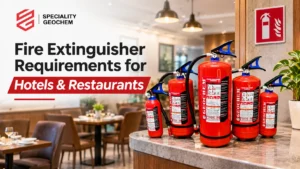
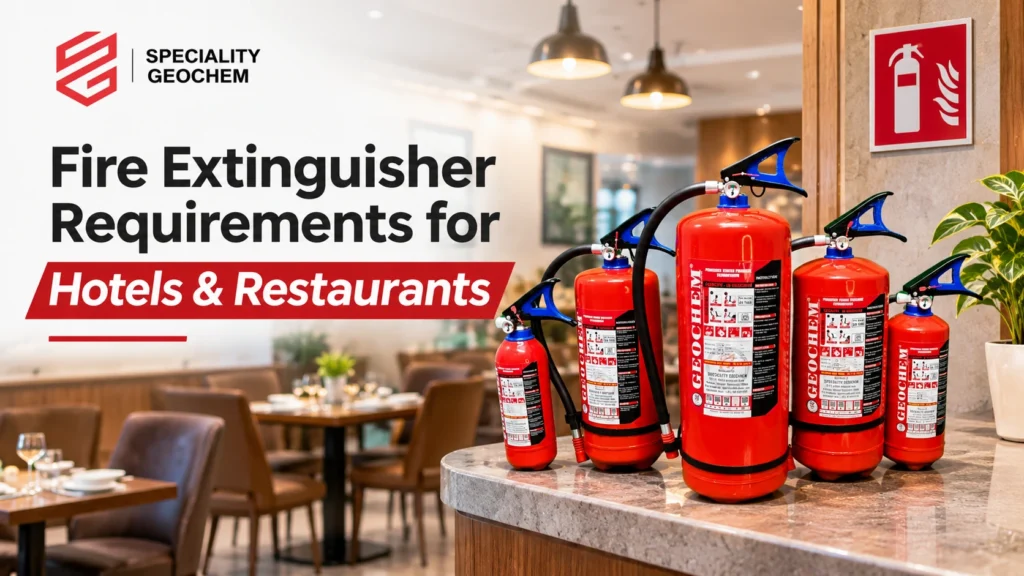
Quick answer: A hotel or restaurant needs at least three kinds of protection. Commercial kitchens need a wet chemical (Class F/K) extinguisher plus a fire blanket near the fryers. Guest floors and corridors need 4–6 kg ABC powder extinguishers. Electrical and DG rooms need CO2 units. Under NBC 2016 and IS 2190, the local fire officer finalises the exact number when issuing the NOC.
Key points
- Fryer oil can self-ignite once it passes about 300°C. ABC powder is not rated for this Class F/K fire.
- A 4 kg ABC unit carries a 3A 34B C rating and suits corridors, lobbies and banquet halls.
- CO2 leaves no residue, which makes it right for panels, server racks and kitchen electrical boards.
- Most hotel fires start back-of-house: in kitchens, laundries, stores and electrical rooms.
- Monthly checks and a written register are what an auditor or fire officer asks to see first.
Why are hotels and restaurants a high fire risk?
A hotel kitchen keeps large volumes of oil hot for hours. A grease film builds up in the exhaust hood above it. Add an LPG manifold, deep fryers and staff working fast during a 400-cover dinner, and you have fuel, heat and ignition in one room.
The guest side has a different problem. Guests sleep in unfamiliar rooms, often on high floors, and many do not know where the stairs are. A small fire that stays unnoticed for three minutes in a corridor can fill it with smoke. The National Building Code of India 2016 (Part 4, Fire and Life Safety) is the base document most state fire services follow for these buildings.
Which fire extinguisher is used in a restaurant kitchen?
A wet chemical extinguisher is the correct first choice for fryers and woks. American codes call this a Class K fire and British/European codes call it Class F, and Indian fire officers use both terms. The agent reacts with hot oil and forms a soapy layer on top. This layer cuts off oxygen and cools the oil, so it does not flash back.
Three mistakes show up again and again in restaurant audits:
- Water on a fryer fire. Water sinks, turns to steam instantly and throws burning oil across the kitchen.
- Relying only on ABC powder. Our ABC powder fire extinguishers work well on Class A, B and C fires, but our own spec sheet marks them unsuitable for Class F.
- Extinguisher kept behind the fryer. Mount it 2–3 metres away, on the exit side, so a cook can grab it without reaching over the flames.
For a small pan or wok fire, a fire blanket is often faster than any cylinder. Pull the tabs, lay it over the pan, switch off the gas and leave it for at least 30 minutes.
What equipment goes where in a hotel?
The table below shows a typical layout. The fire officer may change quantities based on floor area.
| Area | Main fire risk | Recommended equipment |
|---|---|---|
| Commercial kitchen (fryers, tandoor) | Cooking oil, LPG, grease in hood | Wet chemical extinguisher, fire blanket, hood suppression system |
| Kitchen electrical board / exhaust motor | Electrical short | 2–4 kg CO2 |
| Guest corridors, each floor | Furnishings, carpets | 4 kg ABC near exits and stair landings |
| Lobby, banquet hall, restaurant floor | Decor, crowd, electrical | 4–6 kg ABC, CO2 near AV and bar equipment |
| Laundry and linen store | Lint, fabric, dryer heat | 6 kg ABC or water type |
| DG set, LT panel, server room | Diesel, electrical | 4–6 kg CO2, automatic suppression tube in panels |
| LPG manifold / gas bank | Gas leak, jet fire | 9 kg ABC, gas shut-off valve marked clearly |
For electrical areas, our CO2 fire extinguisher comes in 2, 4, 6 and 9 kg. The 2–4 kg range covers most server rooms and small electrical rooms up to about 75 m².
What about back-of-house areas guests never see?
These are the areas where fires usually start. A laundry dryer with a blocked lint filter can ignite on its own. Electrical panels run hot when extra lighting is added for events.
For panels and DG control boxes, an automatic fire suppression tube system works without power or wiring. The tube bursts at about 110°C and releases clean agent inside the cabinet.
How should staff be trained, and what records are needed?
Train every shift, not just the morning team. Cover three things: which extinguisher fits which fire, the PASS method, and when to stop and evacuate.
Keep a simple register at the security desk. Record the monthly pressure gauge check, the seal and pin check, refill dates and drill dates. Fire officers and hotel brand auditors usually ask for this register before they look at the cylinders. If your NOC renewal is due, our step-by-step fire NOC guide lists the documents most states ask for.
When not to fight the fire: if flames reach the exhaust hood or ceiling, or smoke is filling the room, shut the gas if it is safe to do so, evacuate and call 101 or 112.
Equip your property with Speciality Geochem: We manufacture IS 15683-certified ABC and CO2 extinguishers, fire blankets and automatic suppression tubes at our Udaipur facility, and supply hotels and restaurants across India. Call +91-9680211841 or email sales@specialitygeochem.com for a site-wise quote.
Frequently Asked Questions
Q1. Which fire extinguisher is used in restaurant kitchens?
A wet chemical (Class F/K) extinguisher is used for fryer and cooking oil fires. Back it up with a fire blanket for small pan fires and a CO2 extinguisher for the kitchen’s electrical board.
Q2. Is a fire blanket enough for a kitchen fire?
For a small pan or wok fire, yes. It is not enough for a burning fryer or a hood fire. Commercial kitchens need a wet chemical extinguisher and, in larger kitchens, a hood suppression system as well.
Q3. How many fire extinguishers does a hotel need?
It depends on floor area, number of floors and travel distance under IS 2190 and NBC 2016. A common pattern is at least two units per floor near exits, plus dedicated units for the kitchen, laundry, DG and electrical rooms.
Q4. What is a Class K or Class F extinguisher?
Both names mean the same thing: an extinguisher for cooking oil and fat fires. “Class K” is the American term and “Class F” is the British and European term. Both use a wet chemical agent.
Q5. Is a fire NOC mandatory for restaurants?
In most Indian states, yes, once a restaurant crosses the state’s limit for seating capacity, floor area or building height. Rules differ by state, so check with your local fire department before opening or renovating.
Q6. Can I use an ABC extinguisher in a hotel kitchen?
Yes, for burning cartons, wiring or LPG hose fires. Do not use it as the main defence on a fryer, because ABC powder is not rated for Class F oil fires and the oil can reignite.
Q7. Where should extinguishers be placed in hotel corridors?
Place them near exit doors and stair landings, mounted so the handle is easy to reach and clearly signed. Never place them inside locked service rooms or behind room-service trolleys.
Q8. How often should hotel fire extinguishers be checked?
Check them visually every month: pressure gauge, seal, pin and hose. Get them serviced once a year by a trained technician and pressure-tested on the schedule given in IS 2190.
Q9. Do hotel guest rooms need their own extinguisher?
Most guest rooms rely on corridor extinguishers, smoke detectors and sprinklers. Suites with kitchenettes and serviced apartments should keep a small ABC unit or a fire blanket inside.