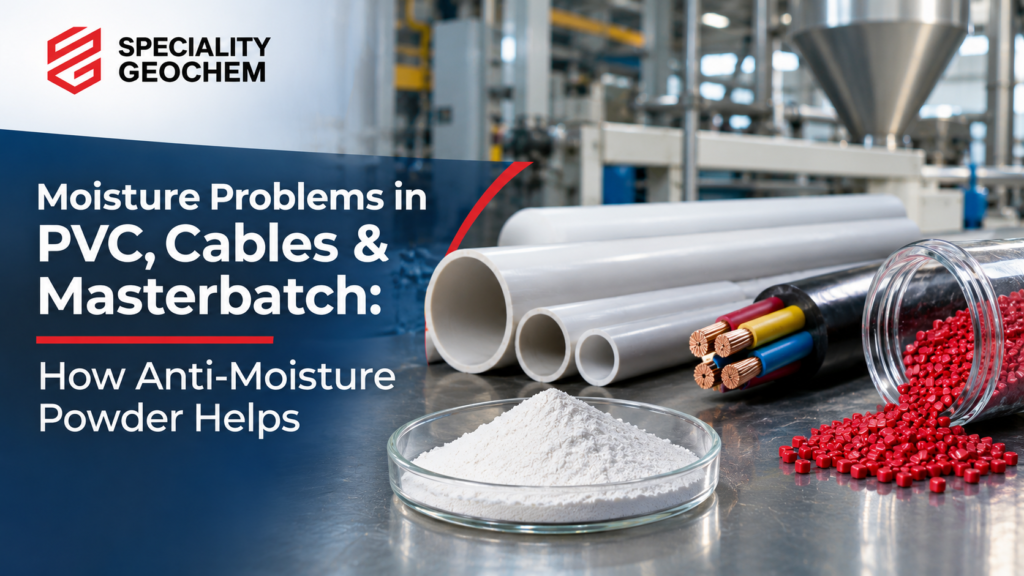
Your PVC pipes show voids on the cut face. Your cable sheathing has bubbles. Your masterbatch strands come out foamy. And every monsoon, it gets worse. When moisture problems in PVC, cables and masterbatch follow the weather, damp material is the first thing to suspect.
Anti-moisture powder is an additive based on calcium oxide (quicklime). It is mixed into the compound and chemically locks the water away before it can turn into steam inside the machine. This guide approaches the problem the way a process engineer would: confirm the cause, fix it, then stop it from coming back.
Is it really moisture? Four signs to check first
Moisture defects follow a pattern. Check these four signs before you change anything else on the line:
- It is seasonal. Rejects rise in the monsoon or on humid days.
- It follows the material, not the machine. The problem arrives with a new filler lot, recycled granules or a bag left open overnight.
- It shows up as gas. You see voids, bubbles, splay (silver streaks), pinholes or foamy surfaces, not unmelted particles or colour streaks.
- Drying makes it go away. A small batch dried in an oven or hopper dryer runs clean.
If three of these four are true, moisture is very likely the cause.
How moisture shows up in each product
| Product | What you see | Why moisture causes it |
|---|---|---|
| PVC pipes and fittings | Voids in the wall, rough bore, failed pressure test | Steam pockets weaken the wall |
| Cable insulation and sheathing | Bubbles, uneven thickness | Steam expands as the compound leaves the die |
| Filler and colour masterbatch | Poor dispersion, foamy strands | Damp filler and carrier release steam in the extruder |
| Injection moulded parts | Silver streaks (splay), surface blisters | Steam escapes along the surface as the mould fills |
| Blown film and bags | Pinholes, lensing, weak spots | Steam breaks through the thin film |
| Recycled granules | All of the above, only worse | Washing leaves water inside the flakes |
Calcium carbonate filler needs special attention. It picks up humidity from the air, so high-filler PVC compounds and filler masterbatch are often where the problem starts.
How anti-moisture powder removes moisture inside the machine
Our anti-moisture powder is made with high-quality quicklime (calcium oxide) as its main ingredient. Calcium oxide reacts with water:
CaO + H₂O → Ca(OH)₂
The water turns into calcium hydroxide, a stable solid that stays spread evenly through the melt. Once the water is locked up, there is nothing left to flash into steam. Because the powder works inside the compound during processing, you don’t need a separate drying cycle for every batch.
Speciality Geochem also manufactures quicklime powder and calcite powder at its own facility in Udaipur, so the raw material stays under our own control.
How much anti-moisture powder to add
Start low and increase the dose step by step until the defects stop. Use this table as a starting point:
| Condition of material | Starting dose (by weight) |
|---|---|
| Virgin plastic with low moisture | 0.5–1% |
| Dry recycled granules | 1–2% |
| Washed or moisture-exposed material | 2–3% |
| High moisture conditions | 3–5% |
Don’t go above 5%. More powder won’t help, and it can start to affect properties and clarity. Mix it evenly with the compound or filler in the high-speed mixer before extrusion or moulding.
Keep a simple log for two weeks with the date, weather, material lot, dose and reject rate. You’ll quickly see what dose your line needs in each season.
How to stop moisture problems coming back
The powder is a safety net, not the whole solution. Store raw materials so they pick up less water in the first place:
- Keep fillers, granules and the powder in a closed, dry godown, on pallets and off the floor.
- Reseal opened bags straight away. Anti-moisture powder left open to the air absorbs moisture from it and loses strength.
- Use stock on a first-in, first-out basis.
- Let cold material reach room temperature before you open the bag, so condensation doesn’t form.
- Keep the powder away from water and acids. Calcium oxide heats up when wet, so handle it with gloves, goggles and a dust mask.
Anti-moisture powder or a hopper dryer?
They do different jobs. A hopper dryer or dehumidifier removes moisture before processing, but it costs time, energy and investment. It also does nothing for filler that is added later in the mixer. Anti-moisture powder works inside the compound during processing.
Many plants use both: a dryer for sensitive virgin resins, and the powder for filled and recycled compounds.
For grades, technical data and bulk supply, contact Speciality Geochem with your product type and filler content, and we’ll suggest a starting dose for your line.
FAQs
Q1. Why are there bubbles in my PVC pipe?
The most common cause is moisture in the PVC compound or filler. In the extruder it turns into steam and forms voids. Degraded resin and wrong temperature settings can cause bubbles too, so confirm moisture first.
Q2. What causes bubbles in cable insulation and sheathing?
Usually moisture in the compound. The steam expands as the compound leaves the die, which leaves bubbles and uneven wall thickness. Damp calcium carbonate filler is a frequent source.
Q3. Why does my masterbatch come out with foamy strands?
Damp filler or carrier releases steam inside the extruder, which causes foamy strands and poor dispersion. Adding anti-moisture powder in the mixer locks this water away before extrusion.
Q4. What is anti-moisture powder made of?
Speciality Geochem’s anti-moisture powder is based on high-quality quicklime (calcium oxide). It reacts with water to form stable calcium hydroxide.
Q5. How much anti-moisture powder should be added?
About 0.5–1% for virgin plastic with low moisture, 1–2% for dry recycled granules, 2–3% for washed or moisture-exposed material, and 3–5% in high moisture conditions. Don’t go above 5%.
Q6. Does anti-moisture powder affect colour?
At the right dose, the effect is small. The powder is white, so it suits white and light-coloured products. Too high a dose can reduce clarity in transparent film.
Q7. Is anti-moisture powder better than a hopper dryer?
Neither replaces the other. A dryer removes moisture before processing, while the powder works inside the compound during processing. Many plants use a dryer for virgin resins and the powder for filled and recycled compounds.
Q8. How should anti-moisture powder be stored?
In a closed, dry godown on pallets, with opened bags resealed straight away. The powder absorbs moisture from the air, so an open bag slowly loses strength.