
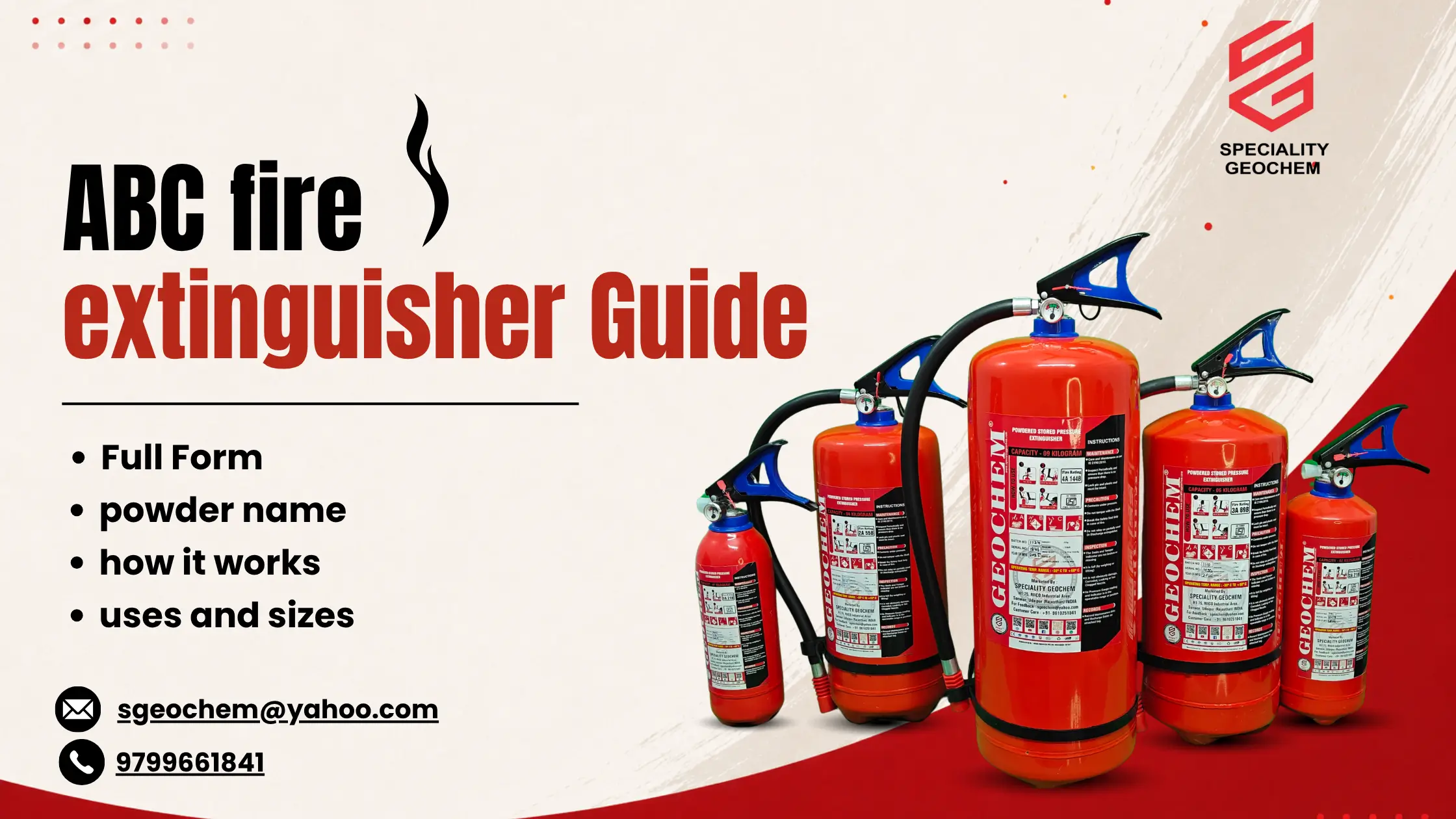
ABC fire extinguisher stands for Class A, Class B, and Class C fires. The powder inside is called monoammonium phosphate (MAP), chemical formula NH₄H₂PO₄, a dry chemical agent that works through three simultaneous mechanisms to extinguish fires involving solid combustibles, flammable liquids, and flammable gases. It is the most widely used fire extinguisher type in India, certified under BIS IS 15683:2018.
This guide covers the ABC full form, powder chemistry, all three working mechanisms, fire class coverage, sizes from 1kg to 100kg, colour coding, certification requirements, and the limitations that can make the wrong use of an ABC fire extinguisher more dangerous than no extinguisher at all. For a complete overview of all fire extinguisher types used in India, see the types of fire extinguisher guide.
ABC fire extinguisher full form: what A, B and C actually mean
ABC stands for:
- A: Class A fires: solid combustible materials (wood, paper, cloth, rubber, most plastics, cardboard)
- B: Class B fires: flammable and combustible liquids (petrol, diesel, kerosene, oil-based paints, solvents, lubricants)
- C: Class C fires: flammable gases (LPG, CNG, propane, butane, methane, natural gas)
The letters correspond to fire class classifications defined under IS 15683:2018 (Bureau of Indian Standards). Each class describes a specific type of fuel, and each requires a different suppression approach. An ABC extinguisher is designed to handle all three with a single agent.
The “E” question comes up often: can an ABC extinguisher handle electrical fires? An ABC fire extinguisher in dry powder form is electrically non-conductive. When it has passed the dielectric test specified in IS 15683:2018, it is rated suitable for Class E fires (live electrical equipment up to 1,000V). The label must state this Class E suitability explicitly.
ABC does not cover Class D (combustible metals, MAP reacts with some burning metals including magnesium and sodium) or Class F (cooking oils and animal fats, ABC powder will knock back the visible flame temporarily, but the oil mass remains above auto-ignition temperature and re-ignites when the powder cloud disperses).
For the complete explanation of all six fire classes in India, see our classes of fire guide.
| Letter | Fire Class | What is Burning | Does ABC Cover It? |
|---|---|---|---|
| A | Class A | Wood, paper, cloth, rubber, plastics | Yes |
| B | Class B | Petrol, diesel, kerosene, solvents, paint | Yes |
| C | Class C | LPG, CNG, propane, butane, natural gas | Yes |
| D | Class D | Combustible metals (magnesium, sodium, titanium) | No |
| E | Class E | Live electrical equipment | Yes, when IS 15683:2018 dielectric test is passed |
| F | Class F | Cooking oils and animal fats | No, re-ignition risk |
ABC fire extinguisher powder name: what is the yellow powder inside?
The powder inside an ABC fire extinguisher is monoammonium phosphate (MAP), chemical formula NH₄H₂PO₄. It is a pale yellow, fine, free-flowing dry chemical powder governed by BIS IS 14609 (Dry Chemical Powder for Fighting A, B, C Class Fires).
The yellow colour is a field identifier: ABC powder (MAP) is yellow; BC powder (sodium bicarbonate) is white. If you discharge an extinguisher and see yellow residue, it is MAP-based ABC powder doing its job.
MAP grade: MAP 90 vs MAP 40: the difference Indian buyers don’t know
ABC powder comes in grades defined by their monoammonium phosphate concentration. IS 14609 requires a minimum of 50% MAP content. Two grades dominate the Indian market:
| Grade | MAP Content | Performance | Typical Use in India |
|---|---|---|---|
| MAP 90 | 90% monoammonium phosphate | Highest, large fire rating per kg | Industrial, premium commercial, Indian Army, Railways |
| MAP 50 to 70 | 50 to 70% MAP + ammonium sulfate | Medium | Standard commercial, schools, hospitals |
| MAP 40 | ~40% MAP (minimum IS 14609 compliant) | Entry-level | Residential, light commercial |
When comparing two 4kg ABC extinguishers at different price points, the MAP grade is the primary difference. A 4kg MAP 90 unit will achieve a fire rating of 21A, 113B or higher; a 4kg MAP 40 unit may only reach 13A, 70B. Ask for the powder specification and IS 14609 compliance documentation when purchasing for commercial or industrial use, not just the price per unit.
Siliconisation: the anti-caking treatment
MAP powder is treated with silicone compounds before loading into the extinguisher cylinder. The silicone coating makes each particle hydrophobic (water-repellent), preventing moisture absorption and caking during storage. It also keeps the powder free-flowing so it discharges smoothly through the valve and hose.
IS 14609 requires ABC powder to pass water resistance and free-flow tests. Without adequate siliconisation, MAP powder in India’s humid climate, especially in coastal areas, kitchens, or locations near water sources, absorbs moisture and compacts into a solid mass. The extinguisher then fails silently: gauge reads green, seals intact, but no powder flows on discharge.
How does an ABC fire extinguisher work? Three mechanisms explained
An ABC fire extinguisher works through three simultaneous mechanisms, not one. This is why it outperforms single-mechanism agents like CO₂ (oxygen displacement only) or water (cooling only) on multi-class fires.
Mechanism 1: Chemical chain reaction interruption
Combustion is sustained by a chain reaction of free radicals. Monoammonium phosphate decomposes at fire temperature and releases phosphoric acid radicals (PO₄³⁻). These radicals combine with the hydrogen (H·) and hydroxyl (OH·) free radicals in the flame, breaking the self-sustaining chain reaction. This is the dominant mechanism on Class B fire (flammable liquids) and Class C (flammable gases) fires. It produces fast flame knockdown within seconds of discharge.
Mechanism 2: Oxygen displacement
The dense cloud of powder particles physically displaces oxygen from the fire zone, reducing the oxygen concentration available for combustion below the minimum threshold (~15% by volume). This reinforces and extends the chain reaction interruption, particularly around fuel surfaces where residual radicals might restart combustion.
Mechanism 3: Phosphoric acid glassy crust (Class A fires)
When MAP contacts a hot Class A fire fuel surface, burning timber, paper, cardboard, rubber, cloth, it melts and forms a glassy, sticky phosphoric acid coating. This coating seals the fuel surface from oxygen, preventing re-ignition after the powder cloud disperses. The yellow residue visible on wood, paper, or fabric after an ABC extinguisher discharge is this phosphoric acid crust doing its job.
This third mechanism is precisely what makes ABC powder superior to BC powder (sodium bicarbonate) on Class A fires. BC powder has mechanisms 1 and 2, but not mechanism 3. It cannot form the glassy crust and so cannot prevent Class A fuel re-ignition. This is the technical reason ABC extinguishers are rated for Class A and BC extinguishers are not.
These three mechanisms activate simultaneously on discharge. This is why a 6kg ABC extinguisher achieves a fire rating of 21A, 113B. It suppresses two fundamentally different fire chemistry types with different mechanisms at the same time.
Nitrogen propellant: why it matters
ABC fire extinguishers (stored-pressure type) are pressurised with dry nitrogen gas, not compressed air, not CO₂. Nitrogen is used because it contains zero moisture. Any moisture in the propellant gas causes MAP powder to absorb water and cake inside the cylinder, the single most common cause of ABC extinguisher failure in India’s humid climate. Nitrogen is also inert and does not react with MAP. It maintains stable discharge pressure across the IS 15683:2018 operating temperature range of -20°C to +60°C. A properly manufactured ABC extinguisher uses nitrogen propellant with siliconised MAP powder.
ABC fire extinguisher uses: where to use it and where not to
Where ABC fire extinguisher should be used in India
| Environment | Why ABC Works Here | Recommended Size |
|---|---|---|
| Home (Living Room, Bedroom, Garage) | Class A risk (furniture, textiles) + Class C (LPG) | 4 kg |
| Car / Vehicle | Class A (seating, trim) + Class B (fuel) | 1 kg or 2 kg |
| Office (General Areas) | Class A (paper, furniture) dominant | 4 kg or 6 kg |
| School / College | Class A dominant + Class E risk | 4 kg or 6 kg |
| Warehouse / Factory | Class A (packing, pallets) + Class B | 9 kg portable or 25 kg trolley |
| Petrol Station | Class B + Class C | 9 kg minimum |
| Hospital (General Corridors) | Class A dominant | 6 kg |
| LPG Storage / Gas Facilities | Class C + Class B | 9 kg or trolley |
Where ABC fire extinguisher should NOT be used
Cooking oil fires (Class F): This is the most dangerous misconception among Indian homeowners and small restaurant operators. ABC powder will temporarily knock back the visible flame of a cooking oil fire. The oil mass, however, remains at or above its auto-ignition temperature (340°C+). When the powder cloud disperses, the oil re-ignites, and the person who believed the fire was out may have already returned to the kitchen. Using ABC powder on a deep fryer can also disturb the burning oil surface and project burning oil droplets. The correct extinguisher for cooking oil fires is a wet chemical extinguisher (Class F). Every kitchen that uses cooking oil should have a wet chemical extinguisher or fire blanket in addition to the ABC unit, not instead of it.
Aircraft and aviation environments: ABC dry powder is not recommended for use in or around aircraft, aerospace facilities, airports, MRO workshops, or aviation labs (HAL, DRDO). MAP residue corrodes aluminium aircraft structures rapidly and damages aircraft engines and avionics. Aviation environments specify Halotron, CO₂, or clean agent extinguishers. This applies to any Indian facility serving aviation.
Class D fires (combustible metals): MAP reacts with some burning metals. Never use on magnesium, sodium, potassium, or titanium fires. A specialist Class D dry powder extinguisher (graphite or copper powder) is required.
Server rooms and sensitive electronics: ABC can extinguish the fire, but MAP residue corrodes circuit boards and electronics within hours of exposure in Indian humidity. CO₂ or clean agent extinguishers are the correct specification for server rooms, data centres, UPS rooms, and precision equipment environments. For complete guidance on extinguisher selection by environment, see the types of fire extinguisher in India guide.
ABC fire extinguisher sizes and capacities available in India
ABC fire extinguishers are available in India in portable sizes from 1kg to 9kg and in trolley-mounted configurations from 25kg to 100kg. Portable units are governed by IS 15683:2018. Trolley-mounted wheeled units are governed by IS 16018:2012.
| Capacity | Type | Fire Rating (Typical) | Best For |
|---|---|---|---|
| 1 kg | Portable | 5A, 21B | Car, motorbike, small vehicle |
| 2 kg | Portable | 8A, 34B | Car, caravan, small office room |
| 4 kg | Portable | 13A, 70B | Home, small office, shop |
| 6 kg | Portable | 21A, 113B | Medium office, school, restaurant |
| 9 kg | Portable | 27A, 144B | Large commercial, factory floor |
| 25 kg | Trolley (IS 16018) | 43A, 233B | Industrial, warehouse, petrol depot |
| 50 kg | Trolley (IS 16018) | High rating | Heavy industrial, LPG storage |
| 75 to 100 kg | Trolley (IS 16018) | Highest | Refineries, tanker bays |
Fire rating values are indicative and vary by manufacturer and MAP grade. Always verify the actual fire rating on the extinguisher label. It must be printed there per IS 15683:2018. NBC 2016 placement guidance: in a Class A risk zone, no point in the floor area should be more than 15 metres from a 13A-rated extinguisher (4kg ABC). Larger spaces require multiple 6kg or 9kg units to meet coverage requirements.
ABC fire extinguisher colour code in India
In India, the ABC fire extinguisher has a red body with a blue rectangular identification panel. The blue panel identifies it as a dry powder (ABC/DCP) type under the colour identification system referenced in IS 15683:2018. The blue panel is the fastest visual identifier in an emergency.
| Body Colour | Panel Colour | Extinguisher Type |
|---|---|---|
| Red | Blue | ABC dry powder / DCP |
| Red | Black | CO₂ |
| Red | Cream / Off-white | Foam (AFFF) |
| Red | Yellow | Wet chemical |
| Red | Red (no panel) | Water |
| Red | Purple / Grey | Clean agent |
If you see a red extinguisher with a blue panel, it contains dry powder. Confirm from the label that it is MAP-based ABC powder, not BC (sodium bicarbonate), if Class A fire coverage is required. BC powder is also white in colour; ABC powder is yellow. The powder colour inside the discharge stream is a secondary identifier after the panel colour.
Read Our fire extinguisher Colour code Guide for more info.
Stored-pressure vs cartridge-operated ABC fire extinguisher: which type is right for you?
Two design types of ABC fire extinguisher are available in India, and the distinction matters for both performance and suitability to environment.
In a stored-pressure extinguisher, dry nitrogen propellant is stored inside the same cylinder as the MAP powder. The pressure gauge gives continuous visibility of cylinder status. Operation is single-action( the Pass Method ): pull the pin, squeeze the lever. This is the standard type for homes, offices, schools, hospitals, and commercial spaces. It is simpler to inspect and faster to operate.
In a cartridge-operated extinguisher, the propellant (CO₂ or nitrogen) cartridge is stored separately from the powder cylinder and pierced by the operating lever at the moment of use. There is no gauge on the main cylinder. Operation requires two steps: pierce the cartridge, then direct and discharge. The advantage is field replaceability. The cartridge is replaced and the powder cylinder recharged without taking the unit out of service for an extended period. Cartridge-operated units also perform reliably across extreme temperature ranges and are the specification for Indian Army, Railways, and heavy industrial applications.
| Feature | Stored-pressure | Cartridge-operated |
|---|---|---|
| Propellant Location | Inside main cylinder | Separate cartridge |
| Pressure Gauge | Yes, continuous monitoring | No gauge on main cylinder |
| Operation | Single action (squeeze lever) | Two actions (pierce, then discharge) |
| Field Recharge | Not practical on-site | Yes, replace cartridge and recharge powder |
| Typical Use | Home, office, commercial | Industrial, Indian Army, Railways |
| IS 15683 Certified? | Yes | Yes |
| Cost | Lower | Higher |
Speciality Geochem manufactures both stored-pressure and cartridge-operated ABC powder fire extinguishers, supplied to the Indian Army, Indian Railways, and industrial clients since 1996. For most Indian homes and offices, stored-pressure is the right choice. For defence, industrial, and high-frequency-use environments, cartridge-operated is the professional specification.