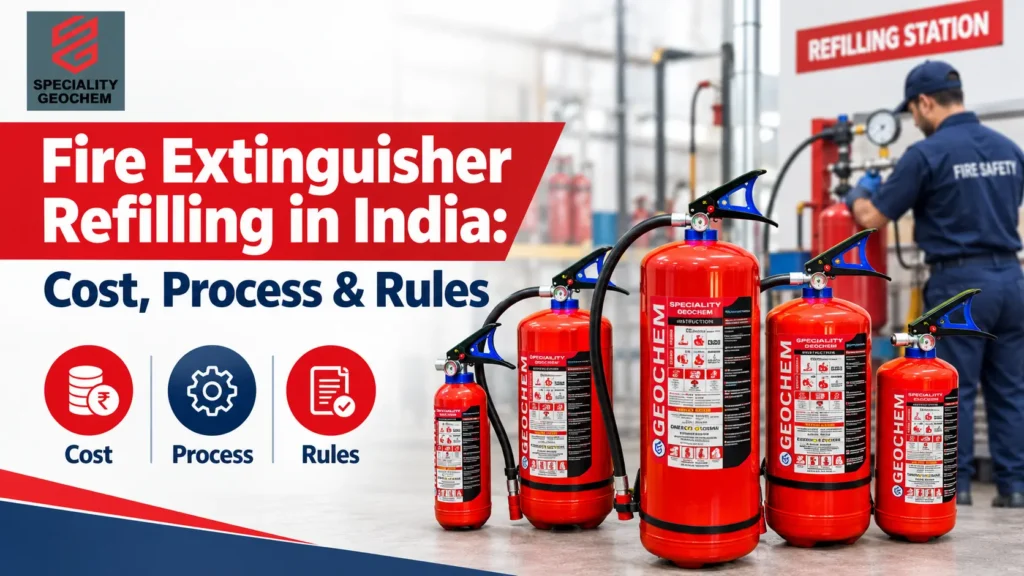
Fire extinguisher refilling is the step most owners forget until an audit or a fire. An extinguisher that has been used, lost pressure or missed its pressure test may not work when you pull the pin. In India, refilling and testing are guided by IS 2190, the code of practice for portable fire extinguishers.
This guide explains when a refill is due, what a proper refill involves, how ABC, CO2, foam and water units differ, and what fire extinguisher refilling cost to expect in 2026. It also covers when replacing the cylinder makes more sense than refilling it.
When an Extinguisher Must Be Refilled
An extinguisher needs refilling in five situations.
- After any use, even a short burst. IS 2190 asks for a refill immediately after use, even when only part of the agent was discharged. A fire extinguisher refill after use is not optional: the valve seal is broken and pressure leaks out over the following days.
- When the pressure gauge leaves the green zone. On stored-pressure ABC, foam and water units, a needle in the red means the cylinder cannot expel its agent properly.
- When a CO2 cylinder loses weight. CO2 units have no gauge, so they are weighed. A loss of more than 10% of the rated charge means the cylinder needs refilling.
- When the hydrostatic test falls due. The cylinder must be emptied to be tested, so every pressure test ends with a refill.
- When the seal or tag is broken, or the unit is damaged. A missing pin, broken tamper seal, blocked hose or caked powder all call for a service and recharge.
A quick monthly look at the gauge, seal and body catches most of these early. A trained person should do a detailed check once a year.
Our fire extinguisher cylinder guide covers the monthly checks in more detail.
Step-by-Step Refilling Process (Test, Recharge, Seal, Tag)
A proper refill takes more than topping up powder or gas. A reliable workshop follows these steps.
- Inspect and record. Note the type, capacity, manufacturing date, last test date and ISI details. Check the body for dents, rust and damaged threads.
- Discharge and depressurise. Release any remaining pressure safely and empty the old agent.
- Strip and check inside. Remove the valve, hose and siphon tube. Look inside the shell for corrosion and clean every part.
- Hydrostatic test, if due. Pressure-test the empty cylinder with water (see the hydrostatic testing section below). A cylinder that fails is condemned, not refilled.
- Dry completely. Powder cylinders must be bone dry before refilling. Moisture makes ABC powder cake and block the hose.
- Recharge. Fill fresh agent of the correct type and grade to the exact rated weight. Stored-pressure units are then pressurised with dry nitrogen to the service pressure; CO2 cylinders are filled by weight.
- Leak test. Check the valve, gauge and joints for leaks before the unit leaves the workshop.
- Seal and tag. Fit a new safety pin and tamper seal. Attach a service tag showing the refill date, test date, agency name and next due date.
Ask for a refill and test certificate for every cylinder. Fire NOC inspections and insurance audits often ask for these records.
ABC vs CO2 vs Foam vs Water Refilling Differences
Each type is refilled differently, and the wrong agent can make an extinguisher useless. IS 2190 colour bands help you identify the type at a glance.
| Type | Colour band (IS 2190) | What gets refilled | Key point |
| ABC dry powder | Blue | Fresh ABC powder of the same grade, then nitrogen pressure | Old powder is not reused once the unit is opened; cylinder must be dry |
| CO2 | Black | Liquid CO2 gas, filled by weight on a scale | Needs a high-pressure filling plant; refilled if weight drops more than 10% |
| Foam (AFFF / mechanical foam) | Cream | Foam concentrate mixed with water, then pressure | Foam solution degrades with age, so it is changed at every service |
| Water | Signal red | Clean water (sometimes with additives), then pressure | Simplest refill, but inside of shell must be checked for rust |
ABC fire extinguisher refilling. Ask which powder grade goes in. ABC powder is sold by its share of monoammonium phosphate (MAP), such as MAP 40, 50 or 90. A higher MAP grade puts out fires more effectively. Insist on the same grade as the original label, or higher.
CO2 cylinder refilling. CO2 extinguishers run at much higher pressure than powder units. Only a workshop with a proper CO2 transfer plant and scale should refill them. The gas weight after filling should match the rating stamped on the cylinder.
For more on what ABC powder can and cannot put out, read ABC dry powder fire extinguisher: uses, fire classes, sizes and limitations.
Refilling Cost Factors
Typical fire extinguisher refilling cost in India in 2026, based on dealer listings (before 18% GST unless stated):
| Service | Typical price (₹) |
| ABC powder refill | 300 – 450 per kg |
| CO2 refill, 2 kg cylinder | about 610 per unit |
| CO2 refill, 4.5 kg cylinder | 650 – 985 per unit |
| Clean agent refill, 4 kg | about 9,500 per unit |
At ₹300–450 per kg, a 2 kg ABC refill works out to roughly ₹600–900, and a 4 kg refill to ₹1,200–1,800. Quotes vary for these reasons.
- Agent type and quantity. CO2 and clean agents cost more than powder or water.
- Powder grade. MAP 90 powder costs more than MAP 40.
- Hydrostatic test. Tenders usually price it as a separate line item.
- Spare parts. A new hose, gauge, valve washer or safety pin is billed extra.
- Pickup and on-site service. Visiting charges apply for collection or on-site work.
- Volume. Housing societies, offices and factories with many cylinders get lower per-unit rates through an annual maintenance contract (AMC).
A rate far below these ranges is a warning sign. Cheap refills often use low-grade powder, skip drying or skip the pressure test.
To compare a refill quote with the cost of a new unit, see our fire extinguisher price in India (2026) guide.
Hydrostatic Testing & Cylinder Life
[Image 3 – hydrostatic testing]
A hydrostatic test checks that the cylinder shell can still hold pressure safely. The empty cylinder is filled with water and pressurised well above its working pressure. It must hold that pressure without leaks or permanent bulging.
IS 2190:2010 sets these intervals and test pressures:
| Extinguisher type | Hydrostatic test every | Test pressure | Maximum service life |
| Water, foam, dry powder (ABC/DCP) | 3 years | 3.5 MPa or 2× service pressure, whichever is higher | 10 years from manufacture |
| CO2 and clean agent | 5 years | 25 MPa (CO2) | 15 years from manufacture (CO2) |
A cylinder that fails the test must be destroyed, not repaired. Once a cylinder reaches its maximum life, it should be replaced even if it looks fine.
Always confirm intervals against the latest BIS edition of IS 2190 and your local fire department’s rules, as amendments can change them.
Refill or Replace? A Simple Decision Guide
Refilling is usually cheaper, but not always the right choice. Use this guide.
Refill when:
- the cylinder is within its service life and passes inspection;
- it was used, lost pressure or is due for its test;
- it is a CO2 unit, where a ₹650–985 refill costs far less than a new 4.5 kg cylinder.
Replace when:
- the cylinder has passed its maximum life (10 years for powder, foam and water; 15 years for CO2);
- it fails the hydrostatic test;
- the body is rusted, dented or has damaged threads;
- it has no ISI mark or readable manufacturing date;
- the refill plus test costs close to a new unit, which can happen with small 1–2 kg ABC cylinders.
For a 2 kg ABC cylinder that is 7 or more years old and due for testing, a new ISI-marked unit is often the better buy. Speciality Geochem manufactures ABC powder fire extinguishers and CO2 fire extinguishers in Udaipur.
How to Choose a Reliable Refilling Vendor
The vendor matters as much as the agent. A poor refill gives you a cylinder that looks ready but may fail. Check these points.
- Licence and approval. Prefer a BIS-licensed refill station or an agency approved by your state fire service.
- Hydrostatic test facility. Ask if they test in-house or send cylinders out.
- Agent details on the bill. The invoice should name the agent, grade and filled weight.
- Certificate and tag. Every cylinder should come back with a service tag and a refill and test certificate.
- Turnaround and loaners. For offices and factories, ask for spare extinguishers while yours are away.
- Records. A good vendor keeps a register of every cylinder’s location, refill dates and test dates.
For businesses with many cylinders, an AMC with one reliable vendor costs less than ad hoc refills and keeps your fire audit records in order.
Need New Cylinders or Expert Advice?
Speciality Geochem has manufactured fire safety equipment in Udaipur since 1996, including ABC, CO2, foam and water-based extinguishers. If your cylinders are past their life or failing tests, we can supply certified replacements across India.
Frequently Asked Questions
Q1. How much does fire extinguisher refilling cost?
In 2026, ABC powder refilling costs about ₹300–450 per kg, so a 2 kg unit costs roughly ₹600–900. A 4.5 kg CO2 refill costs about ₹650–985. Prices usually exclude 18% GST, hydrostatic testing and spare parts.
Q2. How often should a fire extinguisher be refilled?
Refill it immediately after any use, when the gauge leaves the green zone, or when a CO2 unit loses more than 10% of its weight. It is also refilled at every hydrostatic test: every 3 years for powder, foam and water types, and every 5 years for CO2.
Q3. Can an expired fire extinguisher be refilled?
It depends on what has expired. If only the service or refill date has passed, the cylinder can be inspected, tested and refilled. If the cylinder has passed its maximum life under IS 2190 (10 years for powder, 15 years for CO2), or fails the pressure test, it must be replaced.
Q4. Do I need to refill after partial use?
Yes. IS 2190 requires a refill after any discharge, even a short one. The seal is broken and the remaining pressure leaks away, so a partly used extinguisher may not work next time.
Q5. Where can I get my extinguisher refilled near me?
Look for a BIS-licensed refill station or a vendor approved by your local fire department. Ask for their hydrostatic test facility, agent details and refill certificate before handing over cylinders. For new ISI-marked replacements, contact Speciality Geochem in Udaipur for supply across India.