
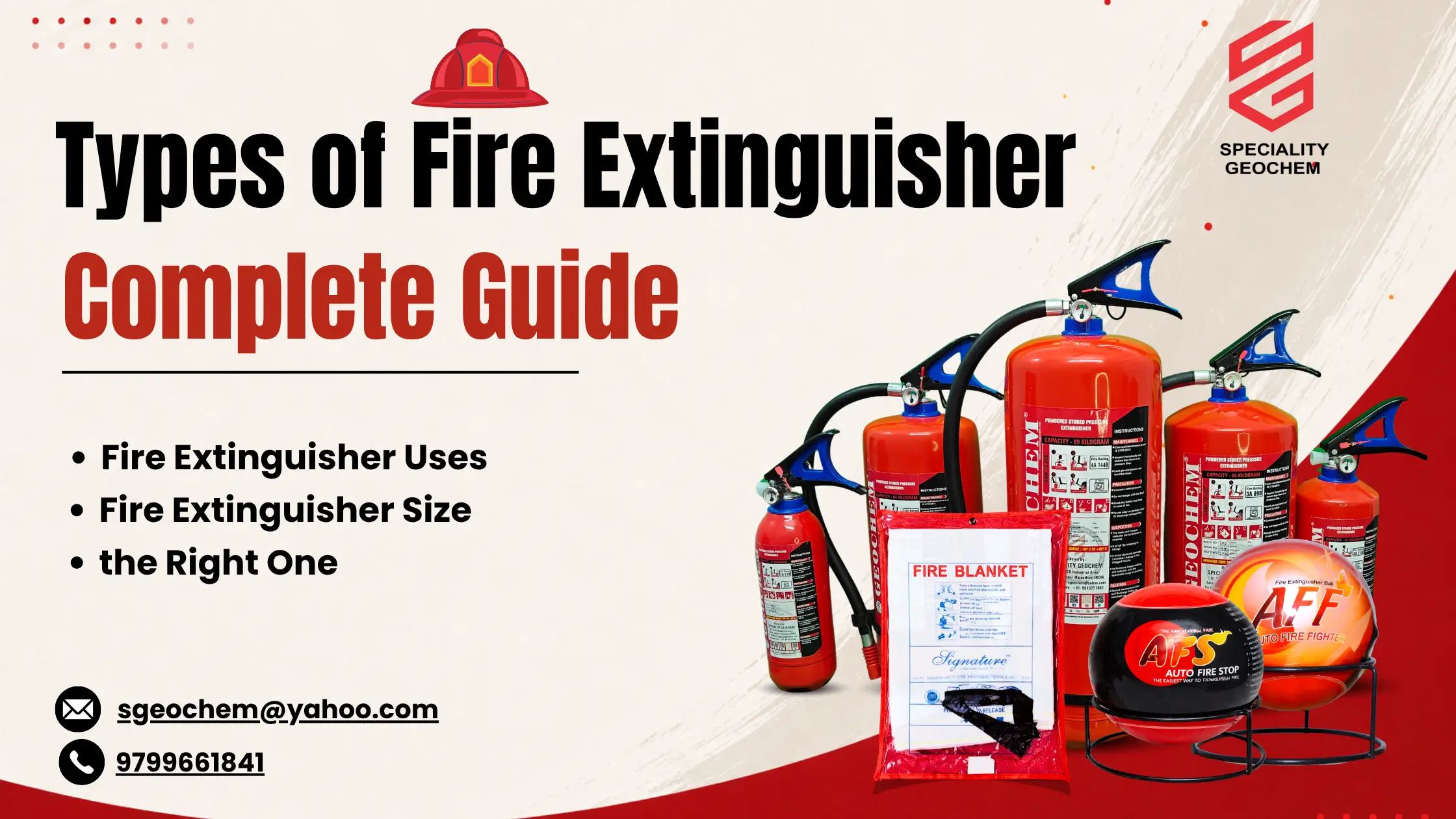
There are 9 types of fire extinguisher in common use: ABC dry powder, CO₂, DCP (dry chemical powder), foam (AFFF/AR-AFFF), wet chemical, water, water mist, clean agent, and automatic modular.
A 10th category Class D dry powder for combustible metal fires applies in specialist industrial settings. All portable types of fire extinguisher sold in India are governed by IS 15683:2018 and must carry the ISI Mark under the Fire Extinguishers Quality Control Order 2023.
A security guard at an Indian IT park reaches for the nearest extinguisher during a server room fire. He grabs the ABC powder unit. In 30 seconds, the powder coats every server in the rack. The fire is out. The servers ₹2 crore of equipment are destroyed not by the fire, but by the corrosive powder residue. A CO₂ extinguisher was mounted 4 metres away on the same wall. The wrong extinguisher in the right hands is still the wrong choice.
Understanding which fire extinguisher suits which fire starts with knowing the classes of fire, covered in our complete fire classification guide. This pillar covers every fire extinguisher type with fire ratings, correct environments, IS standards, size references, and a full selection matrix for homes, offices, server rooms, kitchens, factories, and vehicles.
How Many Types of Fire Extinguisher Are There?
9 types of fire extinguisher cover the full range of commercial, industrial, and residential fire risks in India, recognised under IS 15683:2018 (portable extinguishers) and IS 16018:2012 (wheeled/trolley units):
- ABC dry powder (multi-purpose)
- DCP dry chemical powder (Class B and C fires)
- CO₂ carbon dioxide
- Foam (AFFF / AR-AFFF)
- Wet chemical
- Water (stored pressure)
- Water mist
- Clean agent (FM200, Novec 1230)
- Automatic modular (ceiling-mounted, no operator required)
A 10th specialist category Class D dry powder covers combustible metal fires involving magnesium, titanium, and sodium. It is mandatory in metal fabrication, aerospace, and certain pharmaceutical manufacturing facilities.
Additionally, trolley-mounted or wheeled extinguishers governed by IS 16018:2012 form a distinct industrial category from 25 kg to 250 kg capacity, separate from portable units.
All fire extinguishers sold in India must carry the ISI Mark under the Fire Extinguishers Quality Control Order 2023. Any extinguisher without an ISI Mark is non-compliant with Indian law, regardless of who manufactured it.
ABC Dry Powder Fire Extinguisher India’s Most Widely Used Type
What It Contains and How It Works
ABC dry powder uses monoammonium phosphate as the extinguishing agent. It interrupts the chemical chain reaction, the fourth element of the fire tetrahedron, and is fast-acting across a wide range of fire classes. It does not cool the fuel mass, so re-ignition risk on deep-seated Class A fires is higher than with water or foam.
Which Fires It Works On and Which It Does Not
Works on: Class A (solid combustibles), Class B (flammable liquids), Class C (flammable gases), Class E (electrical equipment up to 1,000V when applied dry).
Does not work on: Class D (combustible metals), Class F fire (cooking oils, re-ignition certain), enclosed spaces where the powder cloud eliminates visibility and creates respiratory risk.
Sizes Available in India
Standard portable capacities: 1 kg, 2 kg, 4 kg, 6 kg, 9 kg.
Trolley-mounted under IS 16018: 25 kg, 50 kg, 75 kg, 100 kg.
For home use, 4 kg is the standard recommendation. For offices and commercial spaces, 6 kg or 9 kg. For industrial use, 9 kg portable or 25 kg+ trolley.
Fire Rating Explained
A typical 6 kg ABC fire extinguisher in India carries a rating of 21A, 113B, meaning it suppresses a 21A wood crib test fire and a 113-litre heptane test fire. Full guidance on fire rating numbers is in the ratings section below.
Speciality Geochem manufactures ISI-certified ABC powder fire extinguishers supplying the Indian Army, Indian Railways, and Maruti Suzuki.
CO₂ Fire Extinguisher The Right Choice for Electrical Fires
What It Contains and How It Works
CO₂ extinguishers store carbon dioxide as a liquid under high pressure, typically 55–60 bar. On discharge, it converts to gas and snow, displacing oxygen and removing heat. It leaves zero residue, equipment returns to service after discharge without cleaning.
Which Fires It Works On and Which It Does Not
Works on: Class B (flammable liquids in confined areas), Class C Fire (gas fires, limited), Class E (live electrical equipment, CO₂ is electrically non-conductive and the safest portable agent for live equipment).
Does not work on:
- Class A (no cooling, re-ignition risk)
- Class D (feeds magnesium and sodium fires)
- Class F (oil re-ignites as CO₂ dissipates)
- outdoor fires (CO₂ disperses too fast).
Sizes and Key Safety Rules
Standard capacities in India: 2 kg, 4.5 kg, 6.5 kg, 9 kg portable; 22.5 kg trolley.
CO₂ discharges at −78°C, never grip the horn with a bare hand. In enclosed spaces, evacuate before or during discharge. CO₂ displaces oxygen and the space becomes dangerous above 7% concentration.
Minimum safe standoff from live equipment: 1 metre.
Where to Use CO₂ in India
- Server rooms, data centres
- electrical panel rooms
- generator rooms
- UPS rooms
- laboratories with electronic equipment
- vehicle engine bays.
Browse Speciality Geochem’s CO₂ fire extinguisher range for ISI-certified options.
DCP Fire Extinguisher Full Form, Uses and Difference from ABC
DCP Full Form and Composition
DCP stands for Dry Chemical Powder. Standard DCP uses sodium bicarbonate or potassium bicarbonate, a different compound from ABC dry powder (monoammonium phosphate). The distinction matters because these two types of fire extinguisher perform differently across fire classes.
Difference Between DCP and ABC
ABC powder covers Class A, B, C, and E fires. DCP covers Class B and Class C only. It does not break down sufficiently to coat Class A fuel surfaces with the sticky residue needed for Class A extinguishment.
| Feature | ABC Powder | DCP |
|---|---|---|
| Agent | Monoammonium phosphate | Sodium / potassium bicarbonate |
| Class A Fires | Yes | No |
| Class B Fires | Yes | Yes |
| Class C Fires | Yes | Yes |
| Class E Fires | Yes (dry) | Yes (dry) |
| Best For | Multi-risk environments | Fuel and gas-specific risks |
Where DCP Is Used in India
Petrol stations, LPG storage, vehicle fuel systems, industrial gas storage. Many Indian industrial safety specifications call for DCP in Class B and C zones specifically to avoid Class A powder contamination in mixed-use areas.
Foam Fire Extinguisher (AFFF / AR-AFFF) For Flammable Liquid Fires
How It Works
Foam extinguishers contain Aqueous Film Forming Foam (AFFF) or Alcohol-Resistant AFFF (AR-AFFF). Foam blankets the burning liquid surface, cuts off oxygen, and seals vapour. The water content simultaneously cools the fuel surface below ignition temperature.
Which Fires It Works On and Which It Does Not
Works on: Class A (water content cools solid combustibles), Class B (primary use, petrol, diesel, solvents).
Does not work on: Class C (cannot address the gas fuel source), Class D Fire (water content reacts violently with burning metals), Class E (water content conducts electricity), Class F (AFFF breaks down above 250°C, cooking oil fires exceed this).
AFFF and the Fluorine-Free Transition
AFFF foam contains PFAS compounds, persistent environmental pollutants now being phased out globally. Fluorine-free foam (F3) alternatives are entering the Indian market. Facilities planning long-term fire safety infrastructure should specify F3-compatible systems now to avoid replacement cost when AFFF is fully regulated out.
Where Foam Extinguishers Are Used in India
Petrol stations, fuel storage depots, paint shops, vehicle workshops, chemical storage warehouses, airports.
Wet Chemical Fire Extinguisher The Only Correct Choice for Class F Kitchen Fires
How It Works
Wet chemical extinguishers contain a potassium-based solution, potassium acetate, potassium carbonate, or potassium citrate. Applied to burning cooking oil, it does two things simultaneously: the water content cools the oil surface from above 340°C toward auto-ignition point, and the potassium compounds react through saponification, forming a non-flammable soapy crust that seals the surface against re-ignition.
Which Fires It Works On
Rated specifically for: Class F fires, cooking oils and animal fats, the auto-ignition fire no other types of fire extinguisher handles safely.
Also rated for: Class A solid combustibles as a secondary use.
Not for: Class B, C, D, or Class E fires.
Why Nothing Else Works on Class F Fires
CO₂ extinguishes the visible flame, but the oil stays above 340°C. Re-ignition is certain once the gas dissipates. ABC powder provides no saponification. Water causes a steam explosion that projects burning oil across the room.
Where Wet Chemical Extinguishers Are Required in India
Commercial restaurant kitchens, hotel kitchens, institutional canteens, cloud kitchens, food court cooking stations. NBC 2016 recommends wet chemical protection for all commercial cooking environments.
Water Mist Fire Extinguisher A Distinct Technology from Standard Water
How Water Mist Differs from Standard Water Extinguishers
Water mist is a separate types of fire extinguisher, not a variant of the standard water extinguisher. It discharges deionised water through a fine nozzle that produces microscopic droplets at high pressure. Standard water extinguishers produce a solid stream or jet. The difference in droplet size changes everything about how the agent performs.
The fine mist absorbs heat far more efficiently per litre than a solid stream because the droplets vaporise on contact, converting to steam and absorbing 2,260 kJ/kg in the phase change, far more than the sensible heat cooling of a solid jet. The vaporised steam also displaces oxygen locally around the fire.
Which Fires It Works On
Deionised water mist is dielectrically safe up to 35 kV at 1 metre standoff distance, making it safe to use near live electrical equipment when deionised. This gives it a coverage profile no other water-based type achieves:
Works on: Class A (cooling), Class B (surface cooling and vapour suppression), Class C (limited gas fires), Class E (when deionised, safe at distance), Class F (cooling oil below auto-ignition with far lower steam explosion risk than standard water).
Where Water Mist Extinguishers Are Used in India
Hospitals, care facilities, clean rooms, pharmaceutical manufacturing, hotel rooms and corridors, heritage buildings, data centres where CO₂ oxygen-displacement risk is a concern, and residential settings where ABC powder residue is unacceptable. Ceasefire and Kanex both supply water mist units in India, availability is growing.
Clean Agent Fire Extinguisher For Data Centres and Sensitive Equipment
What Clean Agents Are and How They Work
Clean agent extinguishers contain halogenated agents, FM200 (HFC-227ea) or Novec 1230 (FK-5-1-12). They suppress fire by interrupting the chemical chain reaction, not by displacing oxygen. This means they are safe in occupied spaces, no reduction in breathable air during the suppression event.
Key Advantage Over CO₂ in Occupied Spaces
CO₂ suppresses by displacing oxygen, the room must be evacuated. Clean agents work at concentrations safe for human occupancy. Both leave zero residue and both are electrically non-conductive. For manned server rooms, control rooms, and precision instrument environments, a clean agent fire extinguisher is the correct specification.
Novec 1230 vs FM200
Novec 1230 (generic: FK-5-1-12) carries significantly lower Global Warming Potential than FM200 and is increasingly the preferred specification for new Indian data centre and telecom installations.
ABC Powder vs CO₂ vs Clean Agent Head-to-Head Comparison
| Feature | ABC Powder | CO₂ | Clean Agent |
|---|---|---|---|
| Residue Left | Yes, corrosive | None | None |
| Safe in Occupied Space | No, respiratory risk | No, evacuate first | Yes |
| Class E (Electrical) Rated | Yes | Yes | Yes |
| Class A Rated | Yes | No | Yes |
| Cost Tier | Lowest | Medium | Highest |
| Best For | Multi-risk general use | Unmanned electrical rooms | Manned sensitive equipment rooms |
Where Clean Agent Extinguishers Are Used in India
Data centres, telecom towers, UPS rooms, medical equipment rooms, museum and archive storage, clean rooms in pharmaceutical manufacturing.
Class D Fire Extinguisher For Combustible Metal Fires
What It Is and How It Works
Class D fire extinguishers contain specialist dry powder agents matched to specific combustible metals, graphite-based powder, sodium chloride (Met-L-X), or copper powder, depending on the metal involved. Standard extinguishing agents, ABC powder, CO₂, foam, water, either fail on combustible metal fires or, in the case of water, react violently to make the fire worse.
The key principle: no single Class D agent suppresses all combustible metals. The agent must be specified for the metal present in the facility. A sodium-chloride-based agent works on magnesium but not on sodium metal. A graphite-based agent works on titanium turnings. Getting the agent wrong is dangerous.
Which Fires It Works On
Class D fires involving: magnesium swarf and castings, titanium machining residue, sodium and potassium metal (pharmaceutical and chemical processes), aluminium swarf in machining concentrations, lithium metal (distinct from lithium-ion batteries, see the lithium-ion section below).
Where Class D Extinguishers Are Required in India
Metal fabrication facilities machining magnesium or titanium, aerospace component manufacturing, pharmaceutical API production facilities handling sodium or potassium metal, university and industrial research laboratories, and defence manufacturing. NBC 2016 and IS 2190 both require specialist extinguishing media where Class D risks are present.
Lithium-Ion Battery Fire Extinguisher An Emerging and Critical Type
Why Lithium-Ion Battery Fires Are Different
Lithium-ion battery fires are not a standard fire class. They involve thermal runaway, an internal electrochemical chain reaction where overheating cells generate their own heat and oxygen, independent of the surrounding air. The battery does not need external oxygen to keep burning. Smothering the flames does not stop the reaction inside the cells.
A standard ABC powder extinguisher will suppress the visible flame, but the cells remain hot enough to re-ignite, sometimes minutes or hours later. CO₂ similarly fails. It extinguishes the flame without cooling the battery pack. Neither type prevents thermal runaway from continuing internally.
Lithium-ion battery fires are not Class D fires, a common misconception. Class D applies to lithium metal. Lithium-ion batteries use lithium compounds in an electrolyte, not solid lithium metal, and require a fundamentally different suppression approach.
What Works on Lithium-Ion Battery Fires
Water mist (deionised): The most effective initial-response agent. Fine droplets cool the battery cells, disrupting the thermal runaway chain reaction at the source. The deionised water reduces electrical conductivity risk. Used by airport rescue teams and EV fire response protocols globally.
AVD Aqueous Vermiculite Dispersion: A specialist agent that encapsulates the burning cells in a heat-proof vermiculite barrier. It stops heat transfer between cells, contains the reaction, and prevents re-ignition. It is the highest-performing agent for lithium-ion battery fires and is entering the Indian market through specialist fire safety suppliers.
Fluorine-free foam (F3/AFFF-FT): Provides cooling and surface sealing. More effective than standard ABC powder. Less effective than AVD or water mist for deep-seated thermal runaway events.
Where This Risk Is Present in India
Electric vehicles and e-bikes charging in residential and commercial parking areas, laptop and mobile device charging stations in offices and hotels, industrial UPS battery banks, solar battery storage in commercial buildings, data centre battery backup systems, and EV charging infrastructure, all of which are growing rapidly across Indian cities. India’s EV adoption trajectory makes lithium-ion battery fire capability a facility-level requirement, not a specialist concern.
What to Specify
For commercial facilities with EV charging, solar battery banks, or server UPS systems: specify a dedicated water mist or AVD extinguisher unit alongside the standard fire safety equipment complement. Consult the facility’s fire safety consultant to confirm the correct agent for the specific battery chemistry and installation.
Automatic Modular Fire Extinguisher Suppression Without a Person in the Room
What It Is and How It Works
Automatic modular extinguishers, ceiling-mounted automatic extinguishers, are self-activating units installed in enclosed spaces. A glass bulb or fusible link breaks when ambient temperature reaches a set threshold, typically 57°C, 68°C, or 93°C. On activation, the unit discharges ABC powder, CO₂, or clean agent directly onto the fire below. No human action required.
Automatic Fire Extinguisher Ball Activation Without Mounting
The AFS Auto Fire Stop fire extinguisher ball is a variant of the automatic extinguisher category that requires no ceiling mounting. The ball self-activates on contact with flame at 80–130°C and can be placed in a fire-prone area, mounted on a shelf, or rolled toward a fire zone from a safe distance. It is particularly effective in vehicles, enclosed server rack bases, transformer rooms, and residential settings where ceiling mounting is not practical.
Where Automatic Extinguishers Are Used in India
- Electrical panels
- LV/HV switchgear rooms
- generator rooms, server racks
- server room ceilings
- warehouses with high-rack storage
- enclosed vehicle engine compartments
- enclosed space where a person cannot respond quickly enough
Key Advantage
They activate within seconds of reaching trigger temperature, faster than any human response. For a server room fire that starts at 2am in an unmanned facility, the automatic modular unit or fire extinguisher ball is the only fire safety equipment that will respond.
Trolley-Mounted Fire Extinguishers For Industrial and High-Risk Environments
What They Are
Trolley-mounted extinguishers, wheeled extinguishers, are large-capacity units from 25 kg to 250 kg DCP or 25 to 100 litres foam/water, mounted on wheeled trolleys for industrial mobility. They are governed by IS 16018:2012 and are a distinct category from portable types of fire extinguisher under IS 15683.
Where They Are Required in India
Petroleum refineries, LPG bottling plants, chemical storage depots, large warehouses, airport fuel handling, tanker loading bays, and any NBC-specified high-hazard industrial zone where a 9 kg portable unit is insufficient.
Capacity Comparison
A 25 kg DCP trolley unit contains approximately 2.7 times the agent of the largest standard portable (9 kg). For fuel storage and tanker fires, that capacity difference is the difference between control and escalation.
How Fire Extinguisher Ratings Work What 21A and 55B Mean on the Label
Every fire extinguisher carries a fire rating, a number followed by a letter. Most buyers ignore it. It is the most actionable performance specification on the label.
Class A Ratings Explained
The number before “A” indicates the size of a standardised wood crib fire the extinguisher suppressed in testing under IS 15683/EN 3. A higher number = a larger test fire extinguished.
Class A Ratings Explained
| Rating | Test Fire Size | Suitable For |
|---|---|---|
| 13A | Small | Small offices, retail units, homes |
| 21A | Medium | Medium offices, schools, restaurants |
| 34A | Large | Warehouses, large commercial spaces |
| 55A | Very Large | Industrial facilities, large warehouses |
Class B Ratings Explained
The number before “B” represents the volume of heptane (test fuel) in litres that the extinguisher successfully suppressed.
| Rating | Test Fire Volume | Suitable For |
|---|---|---|
| 34B | Small | Domestic garage, small vehicles |
| 55B | Medium | Workshops, commercial vehicles |
| 89B | Large | Industrial, fuel handling |
| 144B | Very Large | Fuel storage, refineries |
A typical 6 kg ABC fire extinguisher in India carries a rating of 21A, 113B, rated for medium Class A fires and large Class B fires.
NBC 2016 Part 4 placement rule: In a Class A risk zone, no point in the floor area should be more than 15 metres from a 13A-rated extinguisher or 22.5 metres from a 21A-rated unit.
How to Choose the Right Fire Extinguisher By Environment
Choose by the fire risk present in the environment, not by what is cheapest or most available.
| Environment | Fire Risk | Recommended Type | Size | Standard |
|---|---|---|---|---|
| Home | Class A, C (LPG), F | ABC powder | 4 kg | IS 15683 |
| Home Kitchen | Class F (cooking oil) | Wet chemical + fire blanket | 1–2 litre | IS 15683 |
| Car / Vehicle | Class A, B, C | ABC powder or CO₂ | 1–2 kg | IS 15683 |
| Office | Class A, E | CO₂ + ABC | 2 kg CO₂, 4 kg ABC | IS 15683 |
| Server Room / Data Centre | Class E | CO₂ or clean agent | 4.5 kg CO₂ or clean agent | IS 15683 |
| Hospital | Class A, E | Water mist or ABC + CO₂ | 4 kg + 2 kg per zone | IS 15683 / NBC |
| Hotel Kitchen | Class F | Wet chemical | 6–9 litre | IS 15683 / NBC |
| Warehouse | Class A, B | DCP (ABC) + foam | 25 kg trolley DCP | IS 15683 |
| Electrical Panel Room | Class E | CO₂ | 4.5 kg or 6.5 kg | IS 15683 |
| EV Charging / Battery Storage | Lithium-ion (thermal runaway) | Water mist or AVD | Per installation | IS 15683 |
| Vehicle Workshop | Class B, A | DCP + CO₂ | 9 kg DCP, 4.5 kg CO₂ | IS 15683 |
| Petrol Station | Class B | DCP + foam trolley | 9–25 kg DCP | IS 15683 |
| Pharmaceutical Plant | Class A, B, D | ABC + Class D specialist | Depends on metal risk | IS 15683 |
Facilities with multiple fire risk zones, electrical rooms, kitchen, warehousing, and fuel storage under one roof, need a fire safety assessment mapping types of fire extinguisher, capacity, and placement to each zone. NBC 2016 Part 4 is the placement compliance reference.
For the fire class in each environment, see the classes of fire guide.
When Not to Use a Fire Extinguisher The Evacuation Decision
A fire extinguisher is designed for small, contained, early-stage fires only. Before picking one up, check three things:
Is the fire larger than a wastepaper basket? Is the room filling with smoke? Is your exit behind you and clear?
If any answer is no, evacuate immediately, close the door, activate the alarm, call the fire brigade. IS 2190:2010 states that untrained individuals should not attempt extinguisher use, they should raise the alarm and evacuate. Using an extinguisher in a large or spreading fire delays evacuation and increases injury risk.
A fire extinguisher in the hands of an untrained person on a growing fire is not a safety tool. It is a delay tactic that costs lives.
BIS Certification, ISI Mark and What the QCO 2023 Means for Buyers
Since the Fire Extinguishers Quality Control Order 2023, all fire extinguishers manufactured or sold in India must conform to IS 15683:2018 (portable) or IS 16018:2012 (wheeled) and carry the ISI Mark from the Bureau of Indian Standards. Selling or purchasing a fire extinguisher without the ISI Mark is non-compliant under Indian law.
IS Standards by types of fire extinguisher
| Standard | Covers |
|---|---|
| IS 15683:2018 | All portable fire extinguisher performance requirements |
| IS 16018:2012 | Wheeled / trolley-mounted extinguishers |
| IS 2190:2010 | Selection, installation, and maintenance code |
| QCO 2023 | Makes ISI Mark mandatory on all extinguishers sold in India |
What Buyers Must Check Before Purchase
- ISI Mark visible on the extinguisher body
- BIS licence number on the label
- IS 15683:2018 cited on the product specification
- Manufacturer name, address, and contact details
- Date of manufacture and next service due date
Avoid extinguishers sold without an ISI Mark, imported units without BIS certification for the Indian market, and refilled extinguishers returned without a signed service certificate.
Speciality Geochem’s complete range, all 9 types of fire extinguisher plus trolley units, is manufactured under BIS/ISI certification at its Udaipur facility, supplying the Indian Army, Indian Railways, BSF, Maruti Suzuki, Honda, JK Tyre, Dabur, and Shalby Hospitals since 1996.
Fire Extinguisher Sizes, Capacities and Service Requirements
| Type | Available Sizes (India) | Service Interval | Monthly Check |
|---|---|---|---|
| ABC Powder | 1 kg, 2 kg, 4 kg, 6 kg, 9 kg; 25–100 kg trolley | Annual | Pressure gauge, green zone |
| CO₂ | 2 kg, 4.5 kg, 6.5 kg, 9 kg; 22.5 kg trolley | Annual | Pressure gauge, green zone |
| DCP | 5 kg, 9 kg, 25 kg | Annual | Pressure gauge, green zone |
| Foam (AFFF) | 6 L, 9 L; 50 L trolley | Annual | Pressure gauge, green zone |
| Wet Chemical | 1 L, 2 L, 6 L, 9 L | Annual | Visual inspection |
| Water | 9 L | Annual | Pressure gauge, green zone |
| Water Mist | 2 L, 3 L, 6 L | Annual | Pressure gauge, green zone |
| Clean Agent | 2 kg, 5 kg, 10 kg | Annual | Pressure gauge, green zone |
| Class D | 9 kg, 25 kg | Annual | Pressure gauge, green zone |
Monthly Pressure Gauge Check 10 Seconds, Every Month
On stored-pressure types of fire extinguisher, ABC, CO₂, foam, water, water mist, check that the gauge needle sits in the green zone. If it has shifted to the red zone in either direction, undercharged or overcharged, the unit needs professional service before it is next needed.
This check takes 10 seconds. It is the most practical maintenance action any building occupant can perform and no competitor or safety guide explains it clearly enough to act on.
Service Rules per IS 2190:2010
• Monthly: Pressure gauge in green zone; seals and hose undamaged; label readable
• Annual: Professional inspection and service by an authorised technician
• After any use: Immediate refilling, even if only partially discharged
• Replacement: 10–15 years from manufacture date, or on any failed inspection
Frequently Asked Questions Types of Fire Extinguisher
Q1: How many types of fire extinguisher are there?
There are 9 types of fire extinguisher in common use: ABC dry powder, CO₂, DCP, foam (AFFF/AR-AFFF), wet chemical, water, water mist, clean agent, and automatic modular. A 10th specialist type, Class D dry powder, covers combustible metal fires. Trolley-mounted units from 25 kg to 250 kg are a separate industrial category governed by IS 16018:2012. All portable types are governed by IS 15683:2018 under the Bureau of Indian Standards.
Q2: Which type of fire extinguisher is most commonly used?
ABC dry powder is the most widely used types of fire extinguisher in India. It covers Class A, B, C, and E fires, the broadest coverage of any standard portable type, making it the default choice for homes, offices, vehicles, and general commercial spaces.
Q3: What does the colour panel on a fire extinguisher indicate?
The coloured panel on the red cylinder body identifies the extinguishing agent. Red = water; cream/off-white = foam; blue = ABC or DCP; black = CO₂; yellow = wet chemical; white/silver = water mist; purple/grey = clean agent. This fire extinguisher colour code system is defined under IS 15683:2018 and uses the panel colour, not the body, as the identifier.
Q4: Which fire extinguisher is best for home use?
A 4 kg ABC dry powder extinguisher covers the most common home fire risks, solid combustibles, LPG gas (Class C), and electrical fires. Homes with a gas cooking hob should also keep a 1–2 litre wet chemical extinguisher and a fire blanket in the kitchen for cooking oil fires (Class F). If an e-bike or EV charges at home, add a water mist unit for the charging area.
Q5: Which fire extinguisher should be used for electrical fires?
CO₂ is the safest choice for live electrical equipment (Class E fires). It is non-conductive and leaves zero residue. ABC dry powder also works on Class E fires but leaves corrosive residue that damages electronics. Water mist (deionised) is also safe on electrical equipment up to 35 kV at 1 metre distance. Always maintain a minimum 1-metre standoff from live equipment during any discharge.
Q6: Can one fire extinguisher be used for all types of fire?
No single types of fire extinguisher covers all fire classes. ABC dry powder covers Class A, B, C, and E, the broadest portable coverage available. Wet chemical handles Class F. CO₂ or clean agent handles Class E without residue damage. Class D requires a specialist agent. Lithium-ion battery fires require water mist or AVD. Multi-risk facilities always need more than one extinguisher type.
Q7: What is the difference between ABC and DCP fire extinguisher?
ABC dry powder (monoammonium phosphate) works on Class A, B, C, and E fires. DCP, Dry Chemical Powder, uses sodium or potassium bicarbonate and covers Class B and C fires only. DCP does not extinguish Class A fires. ABC is the multi-purpose choice for general environments; DCP suits fuel and gas-specific installations such as petrol stations and LPG storage.
Q8: Which fire extinguisher is used in hotel and restaurant kitchens?
Wet chemical extinguishers are the only correct choice for commercial and hotel kitchens. The potassium-based agent cools burning cooking oil and forms a non-flammable saponified crust through saponification, preventing re-ignition. NBC 2016 recommends wet chemical protection for all commercial cooking environments. Standard size: 6–9 litre.
Q9: What is a clean agent fire extinguisher and where is it used?
Clean agent extinguishers use FM200 or Novec 1230 to interrupt the fire’s chemical chain reaction at concentrations safe for human occupancy. They leave zero residue and are non-conductive. Used in data centres, telecom rooms, UPS rooms, medical equipment areas, pharmaceutical clean rooms, and archive storage, any environment where ABC residue or CO₂ oxygen displacement would cause secondary damage or occupant risk.
Q10: What is the ISI Mark and why is it mandatory on fire extinguishers?
The ISI Mark is Bureau of Indian Standards (BIS) certification confirming conformance to the relevant IS standard. Under the Fire Extinguishers Quality Control Order 2023, all fire extinguishers sold in India must carry the ISI Mark under IS 15683:2018 (portable) or IS 16018:2012 (wheeled). An extinguisher without the ISI Mark is non-compliant under Indian law, it cannot be legally sold or installed.
Q11: What is IS 15683:2018 and how does it apply to fire extinguishers?
IS 15683:2018 is the Bureau of Indian Standards performance specification for portable fire extinguishers, covering design, construction, fire testing procedures, discharge efficiency, and marking requirements. Every portable types of fire extinguisher sold in India must conform to IS 15683:2018. Manufacturers must hold a BIS licence under this standard to legally supply extinguishers in the Indian market.
Q12: What is the monthly maintenance check for a fire extinguisher?
Check that the pressure gauge needle sits in the green zone, not shifted to the red zone. This applies to all stored-pressure types of fire extinguisher: ABC, CO₂, foam, water, and water mist. Also check the hose and seals for visible damage and confirm the label is legible. This takes 10 seconds once a month and is the one maintenance action that does not require a technician.
Q13: How long does a fire extinguisher last?
Most fire extinguishers have a service life of 10–15 years from the manufacture date per the manufacturer’s specification. Annual professional servicing is mandatory under IS 2190:2010. Any unit that fails an annual inspection must be replaced regardless of age. Check the manufacture date and the last service date on the service tag before every use.
Q14: What fire extinguisher should I keep in my car?
A 1 kg or 2 kg ABC dry powder extinguisher is the standard vehicle recommendation. It covers Class A (upholstery, plastics), Class B (fuel), and Class C (LPG or CNG). Mount within reach of the driver, typically under the front seat or secured in the boot. For electric vehicles, a compact water mist unit is the better choice given the lithium-ion battery fire risk.
Read Fire extinguisher for cars for more info.
Q15: What is a trolley-mounted fire extinguisher and when is it required?
A trolley-mounted types of fire extinguisher is a large-capacity wheeled unit, 25 kg to 250 kg DCP or 25 to 100 litres foam, governed by IS 16018:2012. Required in petroleum refineries, LPG plants, chemical storage depots, airports, tanker loading bays, and large warehouses where a 9 kg portable unit provides insufficient agent for the fire risk present.
Q16: What is an automatic modular fire extinguisher?
An automatic modular types of fire extinguisher is a ceiling-mounted unit that self-activates when a glass bulb or fusible link reaches a set temperature, 57°C, 68°C, or 93°C. It discharges directly onto the fire below without any human action. Used in electrical panels, server racks, generator rooms, and any enclosed space where human response time is insufficient.
Q17: What does the fire rating 21A, 113B mean on a fire extinguisher?
21A means the unit suppressed a wood crib test fire of size 21 in IS 15683/EN 3 standardised testing, suitable for medium-sized commercial spaces including offices, schools, and restaurants. 113B means it suppressed a 113-litre heptane test fire, suitable for large industrial Class B risks. A higher number always means a larger test fire was controlled.
Q18: What is the PASS method for using a fire extinguisher?
- Pull the safety pin.
- Aim the nozzle at the base of the fire, not the flames.
- Squeeze the handle to discharge the agent.
- Sweep from side to side across the base until the fire is extinguished.
Q19: Where should fire extinguishers be placed as per NBC 2016?
NBC 2016 Part 4 specifies that in a Class A risk area, no point in the floor area should be more than 15 metres from a 13A-rated extinguisher, or 22.5 metres from a 21A-rated unit. Extinguishers must be mounted at visible, accessible wall positions with operating instructions facing outward. Travel distance, not floor area, is the governing placement criterion.
Q20: Is a water fire extinguisher suitable for electrical fires?
No. Water conducts electricity and presents a fatal electrocution risk on live electrical equipment. Standard water extinguishers must never be used on Class E, B, C, D, or F fires. For electrical fires use CO₂ or ABC dry powder. For environments where residue is unacceptable, deionised water mist is safe on electrical equipment. Standard water extinguishers are suitable only for Class A solid combustible fires.
Q21: Which fire extinguisher is used for LPG gas fires?
LPG fires are Class C fires, flammable gas. ABC dry powder or DCP is the correct choice. Both interrupt the combustion chain reaction on LPG and CNG. Do not use water or foam. If the gas supply can be safely isolated before applying the extinguisher, always isolate first. Extinguishing the flame without stopping the gas creates an explosion and re-ignition risk.
Q22: Can a CO₂ fire extinguisher be used in a kitchen?
CO₂ can knock down a kitchen fire temporarily but is not safe for Class F cooking oil fires. The oil remains above its auto-ignition temperature of 340°C after the CO₂ dissipates, re-ignition is certain. The correct kitchen types of fire extinguisher is a wet chemical unit. CO₂ is appropriate in a kitchen only for Class E electrical equipment fires, not the cooking hob or fryer.
Q23: What fire extinguisher does a data centre or server room need?
CO₂ (minimum 4.5 kg) or a clean agent fire extinguisher (FM200 or Novec 1230) is correct. Both leave zero residue and are non-conductive. Clean agent is preferred in manned server rooms, no oxygen displacement risk. CO₂ requires evacuation in enclosed spaces. For data centres with UPS battery banks, add a water mist unit specifically for the lithium-ion battery fire risk.
Q24: What is the difference between CO₂ and clean agent fire extinguishers?
CO₂ suppresses by displacing oxygen, evacuate the room before or during discharge in enclosed spaces. Clean agents, FM200 or Novec 1230, interrupt the chemical chain reaction at concentrations safe for human occupancy. Both leave zero residue and are non-conductive. Clean agent is the correct types of fire extinguisher for manned occupied spaces. CO₂ suits unmanned electrical rooms and enclosed equipment enclosures.
Q25: How do I know if my fire extinguisher needs refilling?
Check the pressure gauge. If the needle has moved from the green zone into the red zone, the unit needs professional service immediately. For CO₂ extinguishers, compare current weight to the full weight printed on the label. CO₂ has no pressure gauge. Any unit that has been discharged, even partially, must be refilled before being returned to service. Do not rely on visual inspection alone.
Q26: What fire extinguisher is used for lithium-ion battery fires?
Standard ABC powder and CO₂ extinguishers are insufficient for lithium-ion battery fires. They suppress visible flames but cannot stop thermal runaway inside the cells, and re-ignition is likely. The most effective options are water mist (deionised), which cools the cells and disrupts thermal runaway, and AVD (Aqueous Vermiculite Dispersion), which encapsulates the cells in a heat-proof barrier.
For facilities with EV charging, solar battery banks, or large UPS systems, specify a dedicated water mist or AVD unit. Note: lithium-ion battery fires are not Class D fires. Class D applies to lithium metal only.
Q27: When should I not use a fire extinguisher?
Do not use a fire extinguisher if the fire has grown beyond one object, the room is filling with smoke, or your exit is behind the fire. In these situations: evacuate immediately, close the door, activate the alarm, call the fire brigade. IS 2190:2010 states that only trained individuals should operate extinguishers. Untrained occupants should evacuate and alert others. A fire extinguisher is not a rescue tool for a spreading fire.
The Right Extinguisher, in the Right Place, Serviced on Schedule
The right types of fire extinguisher in the right location, gauge-checked monthly and serviced annually, is the difference between a small incident and a catastrophe. Most Indian buildings have fire safety equipment installed. Fewer have the correct extinguisher type for each fire risk zone. Fewer still have them serviced on schedule.
India’s fire risk profile is changing. EV charging areas, solar battery banks, and lithium-ion-heavy data centre UPS systems are now common across commercial buildings that were never designed with these fire classes in mind. A fire safety assessment that maps types of fire extinguisher, capacities, and placement to each zone is no longer optional for any multi-use facility.
Speciality Geochem manufactures BIS/ISI-certified fire extinguishers across all types, ABC powder, CO₂, DCP, foam, wet chemical, water, clean agent, and automatic modular, as a BIS-certified fire extinguisher manufacturer in India since 1996. Clients include the Indian Army, Indian Railways, BSF, Maruti Suzuki, Honda, JK Tyre, Dabur, and Shalby Hospitals.
For volume procurement, Annual Maintenance Contracts (AMC), or project-specific fire extinguisher selection, contact Speciality Geochem directly.