
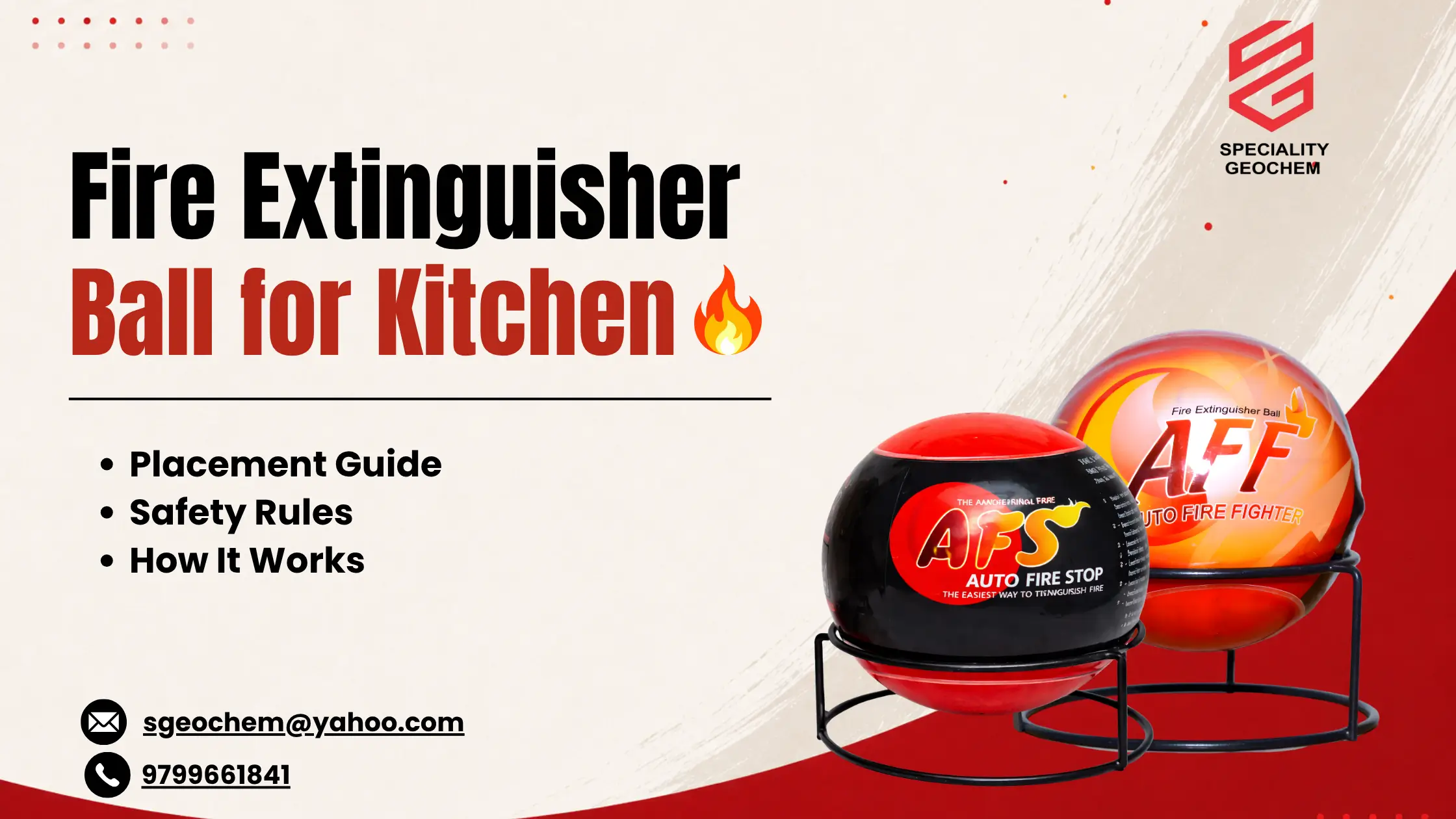
Kitchen fires are the leading cause of accidental house fires in India, according to the National Crime Records Bureau (NCRB). LPG leaks and electrical appliance faults are the two most common triggers. A fire extinguisher ball for kitchen use solves one problem a traditional extinguisher cannot: it activates on its own when no one is in the room.
This guide covers where to mount Fire Extinguisher Ball for Kitchen, correct heights, which fire classes it handles, and where its limits are. For full product specifications, visit the fire extinguisher ball manufacturer page.
Why Every Indian Kitchen Needs a Fire Extinguisher Ball
Over 320 million Indian households use LPG connections, as per Petroleum Planning and Analysis Cell (PPAC) data. Every one of those kitchens has a pressurised gas source within metres of an open flame.
Three ignition sources drive most kitchen fires. Gas stove leaks produce Class B fire and C fires. Electrical faults from microwaves, induction cooktops, and refrigerator compressors cause Class C fires. Unattended cooking oil overheating causes Class F fires, a category that needs a wet chemical extinguisher, not an automatic ball.
A fire extinguisher ball covers two of these three fire classes. Knowing which ones, and which one it does not, is the foundation of a correct kitchen fire safety plan.
Kitchen Fire Sources and Coverage
| Fire Source | Fire Class | Ball Covers It? | Risk Level |
|---|---|---|---|
| LPG / Gas Stove Leak | Class B + C | Yes | Critical |
| Electrical Appliance Fault | Class C | Yes | High |
| Cooking Oil Overheating | Class F | No, needs wet chemical | High |
| Paper or Cloth Near Stove | Class A | Yes | Medium |
Class F limitation: Cooking oil fires ignite above 340°C and require saponification chemistry to suppress. For the full explanation, read: What is a Class F fire?
Can You Use a Fire Extinguisher Ball for Kitchen Fires?
Yes. A fire extinguisher ball for kitchen use is effective against Class A fire, B, and C fires, the gas stove, electrical, and solid-fuel fire types most common in Indian kitchens. It activates automatically on direct flame contact in 3 to 8 seconds, with no human intervention needed. It does not cover Class F cooking oil fires.
The ball contains mono ammonium phosphate (MAP). MAP interrupts the combustion chain reaction chemically. It is non-toxic, leaves a fine white powder residue after activation, and releases no harmful gases.
Why the Kitchen Is the Highest Priority Room for Passive Fire Suppression
Kitchen fires regularly start when no one is watching, an unattended stove, a gas leak overnight, an appliance left running. A passive ball mounted in the right position responds to that gap.
It does not wait for a person to pull a pin. This is what separates it from every manual suppression option and an automatic fire extinguisher ball for kitchen would work best.
Does a Fire Extinguisher Ball Work on LPG and Gas Stove Fires?
Direct Answer: Yes. LPG fires are Class C fires, pressurised flammable gas. The ball contains MAP powder rated for Class B and C fires. It interrupts combustion at the molecular level and suppresses gas stove and LPG leak fires when mounted correctly in the flame zone.
One limitation applies honestly. The device handles small to medium LPG ignitions, a burner flame that has spread, or a small leak that has ignited near the cylinder valve. A full cylinder rupture or large-scale gas explosion produces a fire volume beyond what any passive device suppresses alone. In that event, shut the cylinder valve and evacuate immediately.
The fire extinguisher ball for kitchen buys critical seconds. It does not replace safe gas handling practices.
For manual backup on the same fire classes, an ABC powder fire extinguisher gives you direct control over Class B and C fires.
Where to Place a Fire Extinguisher Ball for Kitchen Safety
Mount a fire extinguisher ball for kitchen stove coverage at 1.2 to 1.5 metres above the floor, directly over the gas burner. This is the single highest-priority position in any Indian kitchen. A second unit goes above the LPG cylinder storage at 1.0 to 1.2 metres. A third covers the electrical appliance cluster if budget allows.
Placement determines whether the ball activates in time. Too high and it activates too late. Too close to normal cooking heat and it triggers falsely. The heights below come directly from IS 15683:2018 activation parameters.
Fire Extinguisher Ball for Kitchen 4-Point Placement Guide
- Above the gas stove burner (Priority 1): Mount at 1.2 to 1.5 metres directly above the primary burner. Orient the ball toward the flame zone, not toward the wall or chimney exhaust.
- Above LPG cylinder storage (Priority 2): If the cylinder sits in a floor cabinet or under the counter, place the ball at 1.0 to 1.2 metres from the floor, directly above the cylinder cap. Gas leaks ignite at the valve first.
- Near the electrical appliance cluster (Priority 3): Induction cooktops, microwaves, and refrigerator compressors are Class C sources. Position the ball within 1 metre of the highest-density appliance area at standard mounting height.
- Inside modular kitchen panels (Priority 4): Modular kitchens route wiring inside sealed panels. A fire inside a closed panel has no human access. A passively mounted ball is the only response available in that scenario.
Do not place the Fire Extinguisher Ball for Kitchen on the stove shelf, on the oven top, or near any exhaust vent. Normal cooking heat must not reach the outer shell during daily use.
Mounting Height Quick Reference
| Placement Zone | Correct Height | Priority |
|---|---|---|
| Above Gas Stove Burner | 1.2 to 1.5 m from floor | #1 Critical |
| Above LPG Cylinder Storage | 1.0 to 1.2 m from floor | #2 High |
| Electrical Appliance Cluster | 1.2 to 1.5 m from floor | #3 High |
| Inside Modular Kitchen Panels | Top of cabinet interior | #4 Medium |
How High Should the Ball Be Mounted Above a Kitchen Stove?
Mount a fire extinguisher ball for kitchen stove placement at 1.2 to 1.5 metres above the floor. This positions it close enough to the burner flame zone to activate within 3 to 8 seconds, while staying clear of normal cooking heat that could cause a false trigger.
Measure from floor to ball, not from stove surface to Fire Extinguisher Ball for Kitchen. Most Indian kitchen counters sit at 70 to 85 cm. At 1.2 metres from the floor, the ball sits 35 to 50 cm above the burner, squarely within the activation zone for a stove fire.
How to Install a Fire Extinguisher Ball for Kitchen Use
- Choose your first mounting position using the priority guide above. For most Indian kitchens, start above the gas stove burner.
- Use only the wall bracket or cradle supplied with the ball. String, tape, or improvised fixings shift it out of the activation zone.
- Mark the wall at the correct height, 1.2 to 1.5 metres from the floor for stove coverage, 1.0 to 1.2 metres for LPG cylinder storage.
- Fix the bracket using standard wall plugs. No specialist tools are needed for most Indian kitchen wall types.
- Set the ball into the cradle. It must sit loosely, flames need to contact the outer shell directly. Do not wrap or encase it.
- Rotate the cradle so the fire extinguisher ball for kitchen faces the burner zone directly. A ball aimed at the wall will not suppress a stove fire effectively.
- Record the installation date. The ball is maintenance-free for 5 years under IS 15683:2018.
For broader kitchen fire coverage as a package, the fire safety combo 3 in 1 pairs the ball with complementary devices.
What Happens When the Ball Activates in an Empty Kitchen?
This is the scenario a fire extinguisher ball for kitchen placement is specifically built for.
You put a pressure cooker on the stove and step out. A seal fails. Gas escapes and ignites at the burner. The outer shell reaches activation temperature. Within 3 to 8 seconds, it ruptures. MAP powder disperses across 1.80 cubic metres in a full 360-degree spread. The fire suppresses. A 120 dB alarm sounds simultaneously, audible from adjacent rooms and the floor above.
You return to a kitchen with white powder residue on the stove. The fire is out.
Three steps follow. Clean the MAP residue with a dry cloth or mild soap and water, it is non-toxic and food-safe. Replace the unit with a new one before cooking again. If the fire started from a gas source, call a licensed gas technician to inspect the connection before using the stove.
The Fire Extinguisher Ball for Kitchen is a single-use passive device. It cannot be reset or refilled.
Is the Ball Safe to Use Near Food in a Kitchen?
Yes. A fire extinguisher ball for kitchen food-preparation areas uses MAP (mono ammonium phosphate), a non-toxic, food-grade compound. After activation it leaves a white powder residue that cleans off with a dry cloth or mild soap and water. It releases no toxic gases on dispersal. A 120 dB alarm warns anyone nearby to evacuate even when the kitchen is unattended.
MAP is the same base compound used in agricultural fertilisers. No hazardous fumes, no toxic residue, no risk to food preparation surfaces beyond the powder clean-up.
Fire Extinguisher Ball for Kitchen vs Traditional Cylinder, Which Scenario Needs Which?
This table is kitchen-specific only. It is not a general product comparison.
| Kitchen Scenario | Automatic Ball | Traditional ABC Cylinder |
|---|---|---|
| Unattended Stove Fire | Activates automatically, no person needed | Requires someone present to operate |
| Gas Burner Flare-up | Covers Class B and C fires | Also covers Class B and C fires |
| Electrical Appliance Fault | Covers Class C fires | CO₂ cylinder is more effective here |
| Cooking Oil Fire (Class F) | Does NOT cover. Wet chemical extinguisher required. | Standard ABC extinguisher does NOT cover Class F fires either. |
| Elderly or Child User | No training, no safety pin, operates passively | Requires pin removal and proper aiming under stress |
| Fire Starts at 3 AM | Responds automatically without human presence | No response unless a person is available to operate it |
The two products cover different failure scenarios. The ball handles unattended and surprise fires. The fire extinguisher cylinder gives a person direct control over a fire they can see and reach.
If your kitchen has a deep-fat fryer or heavy frying setup, add a wet chemical extinguisher for Class F alongside the ball. They are complementary. See the Class F fire guide for why oil fires need a completely different solution.
For pairing the right manual cylinder with your ball, the fire extinguisher for home page covers the complete combination setup.