
Classes of Fire: All 6 Types of Fire Explained (A, B, C, D, E, F/K)
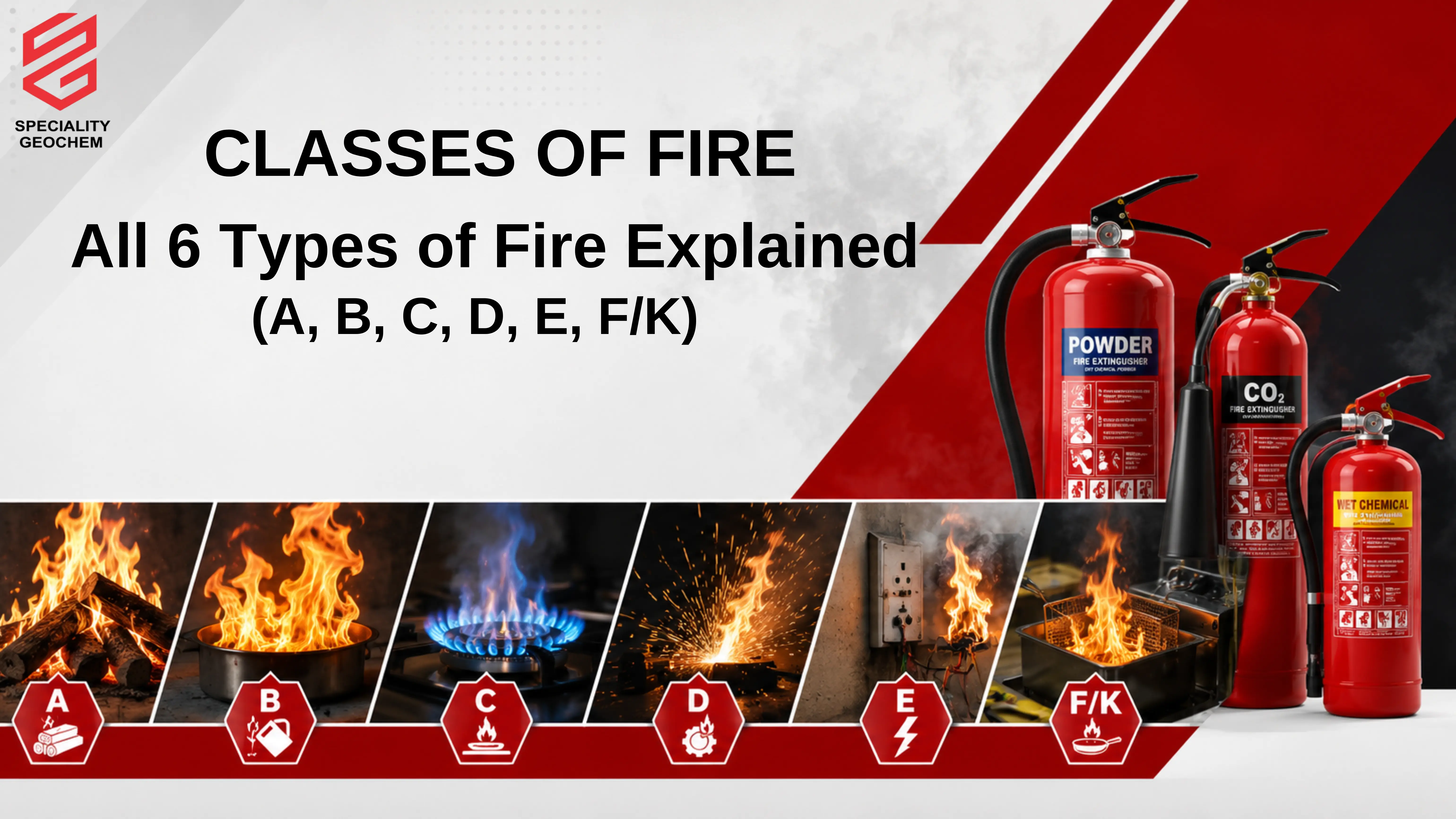
There are 6 classes of fire recognised under Indian standard IS 15683:2018 and most international fire safety systems: Class A (solids), Class B (flammable liquids), Class C (flammable gases), Class D (combustible metals), Class E (electrical equipment), and Class F/K (cooking oils). Every type of fire behaves differently because the fuel behaves differently under heat, and using the wrong extinguisher on any of them can turn a controllable fire into a catastrophic one.
Pouring water on a burning deep fryer does not extinguish the flames. It detonates them. The water flashes instantly into steam, expands nearly 1,700 times in volume, and launches burning oil across the room like a liquid firebomb. The same principle applies across all classes of fire. The wrong extinguishing agent can spread flames, intensify chemical reactions, or electrocute the person holding the extinguisher.
Most people know they need a fire extinguisher. Far fewer know whether that extinguisher is actually suitable for the fire in front of them.
This guide explains all 6 classes of fire, the correct extinguisher for each, how international fire classification systems differ, and why understanding fire behaviour matters long before an emergency begins.
Quick reference: all 6 classes of fire at a glance
| Class | Fuel Type | Common Examples | Correct Extinguisher | Never Use |
|---|---|---|---|---|
| A | Solid combustibles | Wood, paper, cloth, rubber, plastics | Water, foam, ABC dry powder | — |
| B | Flammable liquids | Petrol, diesel, alcohol, solvents | Foam, DCP, CO₂ | Water |
| C | Flammable gases | LPG, methane, propane, butane | ABC/DCP powder | Water, foam |
| D | Combustible metals | Magnesium, sodium, titanium | Class D powder only | Water, CO₂, foam |
| E | Live electrical equipment | Switchboards, UPS, motors | CO₂, DCP | Water, foam |
| F/K | Cooking oils and fats | Deep fryer oil, vegetable oil | Wet chemical only | Water, foam |
The fire triangle and fire tetrahedron
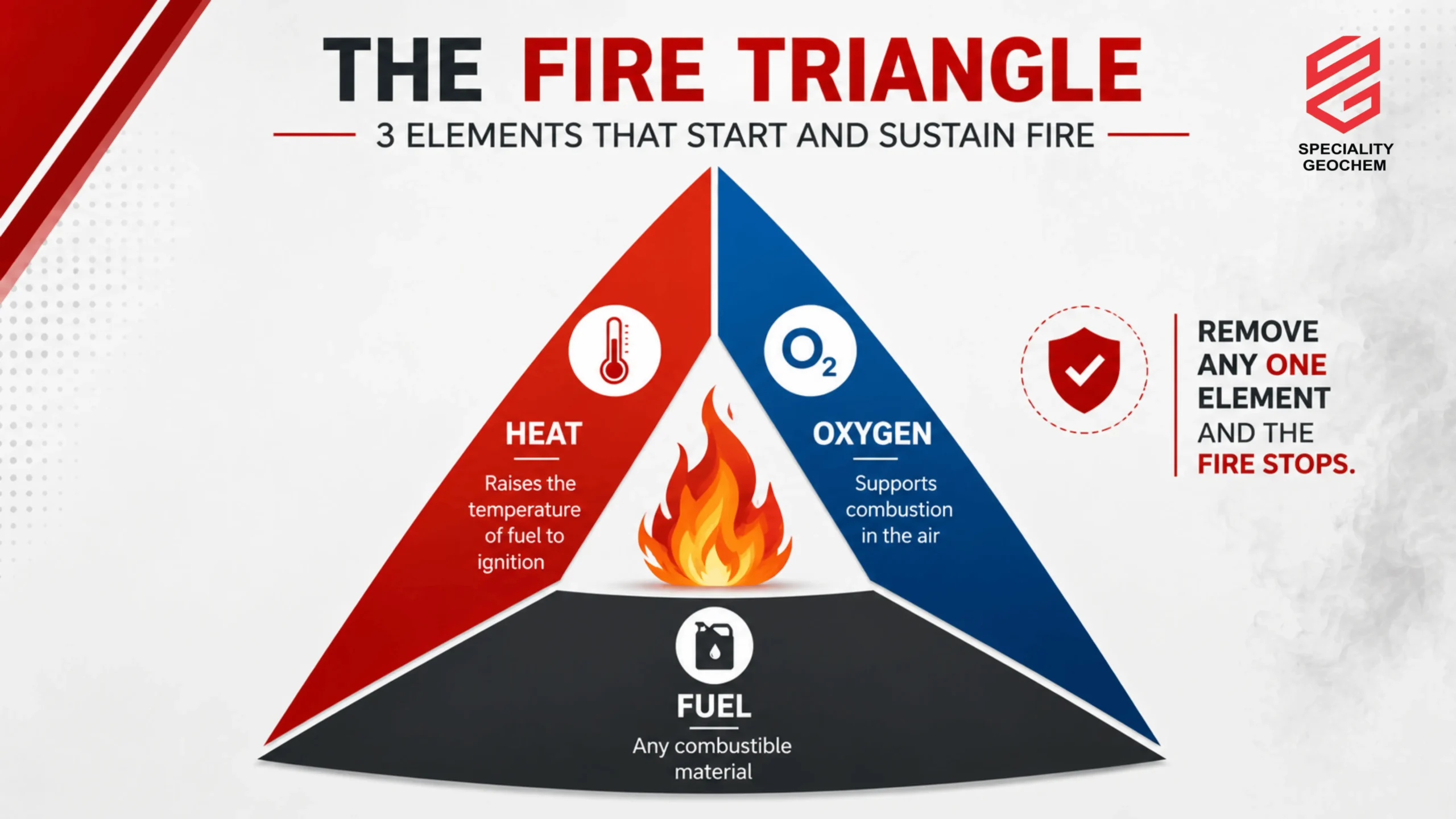
Every fire needs 3 things to survive:
- Heat
- Fuel
- Oxygen
This is called the fire triangle.
Remove any one of those elements and combustion stops.
Water removes heat. Foam blocks oxygen. Shutting a gas valve removes fuel.
But the fire triangle does not fully explain why some extinguishing agents work so effectively across multiple fire classes. That is where the fire tetrahedron comes in.
The fire tetrahedron adds a fourth element: the chemical chain reaction.
Once combustion starts, highly reactive molecules continuously generate new combustion inside the flame zone. ABC dry powder extinguishers interrupt this molecular chain reaction directly. That is why they rapidly suppress Class A, B, and C fires even before substantial cooling occurs.
Understanding the tetrahedron explains why different classes of fire require different extinguishing chemistry. Some fires need cooling. Some require oxygen displacement. Others require chemical interruption or complete isolation from reactive materials.
Class A fire: solid combustible fires
What is a Class A fire?
A Class A fire involves ordinary combustible materials such as wood, paper, cardboard, textiles, rubber, and most plastics.
These are the most common types of fire worldwide because these materials exist in homes, offices, factories, schools, warehouses, and commercial buildings everywhere.
What fuels a Class A fire?
Class A fires are commonly caused by:
- Faulty electrical wiring
- Overheated equipment
- Smoking materials
- Open flames
- Hot work activities like welding or grinding
The defining characteristic is deep-seated combustion. A stack of cardboard may continue smouldering internally even after visible flames disappear. Timber beams, cotton bales, and rubber stockpiles can reignite hours later if internal heat remains trapped inside the material.
How to extinguish a Class A fire correctly
Cooling is the primary extinguishing method for Class A fires.
Water works effectively because it penetrates the burning material and lowers temperature throughout the fuel mass. Foam extinguishers also provide reliable suppression because they combine cooling with oxygen isolation.
An ABC dry powder extinguisher is widely used for mixed-risk environments because it rapidly interrupts the combustion chain reaction.
What NOT to use on a Class A fire
CO₂ fire extinguishers are not ideal for deep-seated Class A fires.
They displace oxygen temporarily but provide very little cooling. The flames disappear, but internal heat remains. Once oxygen returns, reignition becomes likely.
Class B fire: flammable liquid fires
What is a Class B fire?
A Class B fire involves flammable liquids such as:
- Petrol
- Diesel
- Kerosene
- Paint thinners
- Solvents
- Alcohols
- Aviation fuel
Unlike Class A fires, combustion occurs primarily at the liquid surface where fuel vapours mix with oxygen.
Common causes and locations of Class B fires
Class B fires commonly occur in:
- Petrol stations
- Chemical storage facilities
- Paint shops
- Vehicle workshops
- Printing plants
- Industrial manufacturing units
- Fuel loading areas
Why water makes Class B fires worse
Water is denser than most flammable liquids.
When thrown onto burning petrol or solvent, the water sinks beneath the fuel surface and instantly converts into steam at temperatures far above 100°C. That steam expands roughly 1,700 times in volume and launches burning fuel outward.
Instead of suppressing the fire, water spreads it violently across floors, equipment, and nearby people.
Correct extinguishers for Class B fires
The correct strategy is surface suppression.
Foam extinguishers create a blanket over the fuel surface and separate oxygen from vapours. DCP and ABC powder extinguishers interrupt the combustion chain reaction rapidly. CO₂ extinguishers displace oxygen and work well in enclosed spaces.
Class C fire: flammable gas fires
What is a Class C fire?
Class C fires involve flammable gases including:
- LPG
- Propane
- Methane
- Butane
- Acetylene
- Hydrogen
These fires burn at the point of release itself: leaking valves, ruptured pipes, fractured cylinders, or damaged fittings.
The golden rule for Class C fires
Shut off the gas supply first whenever safely possible.
This is the most important rule in gas-fire control.
Extinguishing the visible flame without stopping the gas leak creates a much greater danger. Unburned gas continues escaping, accumulates invisibly, and may reignite explosively once it reaches an ignition source.
A controlled flame is often safer than an uncontrolled gas cloud.
Which extinguisher should be used on Class C fires?
ABC dry powder extinguishers are the preferred option because they provide rapid flame knockdown while responders isolate the fuel source.
Never use water on a gas fire. Water does not stop the gas release and may create additional hazards around pressurised systems.
Class D fire: combustible metal fires
What is a Class D fire?
Class D fires involve combustible metals such as:
- Magnesium
- Sodium
- Potassium
- Titanium
- Zirconium
- Lithium metal
These fires burn at extremely high temperatures ranging from approximately 1,000°C to over 3,000°C depending on the metal involved.
Where Class D fires occur
Class D fires are typically found in:
- Aerospace manufacturing
- Metal grinding facilities
- Chemical plants
- Research laboratories
- Pyrotechnic manufacturing
- Pharmaceutical processing
Fine metal dust significantly increases ignition risk because of its enormous exposed surface area.
Why standard extinguishers fail on Class D fires
Water reacts violently with burning sodium and potassium, generating hydrogen gas that ignites immediately.
CO₂ fails on magnesium fires because magnesium strips oxygen directly from the CO₂ molecule and continues burning.
Foam and standard dry powder extinguishers may intensify reactions under extreme temperatures.
The only correct extinguisher for Class D fires
Only specialist Class D dry powder extinguishers should be used.
These powders form heat-absorbing crusts that isolate burning metal from atmospheric oxygen while reducing thermal energy.
Different metals may require different powder formulations. A sodium fire may need a different extinguishing agent than a titanium or lithium-metal fire.
Class E fire: electrical fires
What is a Class E fire?
A Class E fire involves energised electrical equipment such as:
- Switchboards
- UPS systems
- Server racks
- Distribution panels
- Electric motors
- Generators
- Transformers
The main danger is not only the fire itself but the presence of live electrical current.
Why some standards disagree about electrical fire classification
This area causes major international confusion.
Under Indian BIS standards and several Asian systems, electrical fires are classified as Class E.
Under NFPA standards in the United States, electrical fires are classified as Class C.
European EN 2 standards do not classify electricity separately at all because electricity is considered an ignition source rather than a fuel.
Once electrical power is disconnected, the fire usually becomes a standard Class A or Class B fire depending on the material burning.
CO₂ vs DCP on electrical fires
A CO₂ fire extinguisher is generally the preferred option for electrical fires because it leaves no residue and does not damage sensitive electronic equipment.
CO₂ extinguishers are ideal for:
- Server rooms
- Data centres
- Electrical panels
- Laboratories
- UPS systems
ABC powder extinguishers also suppress electrical fires effectively, especially in industrial emergencies. However, powder residue may permanently damage electronics.
The most important rule in electrical firefighting
De-energise the equipment first whenever safely possible.
Never use water or foam on live electrical equipment because both conduct electricity and create severe electrocution hazards.
Class F fire (Class K fire): cooking oil and fat fires
What is a Class F fire?
Class F fires involve high-temperature cooking oils and fats such as:
- Deep fryer oil
- Vegetable oil
- Ghee
- Animal fats
These fires are especially common in restaurants, hotels, industrial kitchens, and food courts.
Class F and Class K: same fire, different names
Class F and Class K refer to the same fire category.
The difference is regional terminology.
The NFPA system in the United States uses “Class K.”
Indian BIS standards, ISO standards, and European systems use “Class F.”
Why cooking oil fires are uniquely dangerous
Cooking oil reaches auto-ignition temperatures around 360°C. At that point, the oil ignites without any external spark.
The real danger begins when water contacts the burning oil.
A single litre of water instantly converts into approximately 1,700 litres of steam beneath the oil surface. The steam eruption launches burning oil outward in an expanding fireball.
This is why kitchen fires cause severe burn injuries so frequently.
Why wet chemical extinguishers are the only correct option
A wet chemical extinguisher works through 2 simultaneous mechanisms:
- Rapid cooling of the oil surface
- Chemical saponification
The potassium-based solution reacts with burning oil to form a soap-like foam layer that seals oxygen away while reducing temperature below the auto-ignition point.
What should never be used on a Class F fire?
Never use:
- Water
- Standard foam
- CO₂ alone
- Standard ABC powder
These agents either fail to cool the oil sufficiently or create violent steam explosions.
Lithium-ion battery fires: the emerging fire type
Lithium-ion battery fires do not fit neatly into traditional fire classifications.
Class D applies to lithium metal fires, but lithium-ion batteries behave differently. Their main hazard is thermal runaway: a self-sustaining internal chemical reaction that generates heat and releases flammable gases.
Battery cells may reignite repeatedly even after visible flames disappear.
Electric vehicle battery packs intensify the problem because thousands of interconnected cells can transfer heat between modules.
Current international guidance recommends:
- Large-volume water cooling for small lithium-ion battery fires
- AVD (Aqueous Vermiculite Dispersion) systems
- F-500 encapsulating agents
- Thermal containment systems
- Battery fire containment bags
CO₂ and standard dry powder extinguishers provide poor cooling performance against thermal runaway.
Fire classification standards: India vs NFPA vs EN 2
| Standard | Region | Electrical Fires | Cooking Oil Fires | Notes |
|---|---|---|---|---|
| IS 15683:2018 | India | Class E | Class F | BIS standard |
| NFPA 10 | USA | Class C | Class K | Different naming system |
| EN 2 | Europe | Not separate | Class F | Electricity treated as ignition source |
| ISO 3941 | International | Not separate | Class F | Similar to EN 2 |
| AS/NZS 1841 | Australia/NZ | Class E | Class F | Similar to Indian system |
India’s IS 15683:2018 system aligns closely with ISO and European standards.
The biggest source of confusion globally is the NFPA use of “Class C” for electrical fires, while international systems use Class C for flammable gases.
Class K in the NFPA system and Class F internationally both describe cooking oil and fat fires.
For official standards references, see Bureau of Indian Standards and NFPA 10.
Aag ke prakar kitne hote hain? (Types of fire in Hindi)
Indian BIS standards ke hisaab se aag ke 6 main prakar hote hain. Class A mein lakdi, kagaz aur kapda aata hai. Class B petrol aur diesel jaise flammable liquids ko cover karta hai. Class C LPG aur gases ke liye hota hai. Class D metal fires ke liye use hota hai. Class E electrical equipment fires ko classify karta hai. Class F kitchen oil aur deep fryer fires ke liye hota hai. Har type ki aag ke liye alag extinguisher zaroori hota hai. Galat extinguisher fire ko aur dangerous bana sakta hai.
Frequently asked questions about classes of fire
How many classes of fire are there?
There are 6 internationally recognised classes of fire: Class A, B, C, D, E, and F/K. Some standards classify electrical fires differently depending on the country and standard system used.
What is the difference between Class A, B, C, D, E and F fire?
Each fire class is based on the fuel burning. Class A involves solids, Class B involves flammable liquids, Class C involves gases, Class D involves combustible metals, Class E involves electrical equipment, and Class F/K involves cooking oils and fats.
What class of fire is an electrical fire in India?
Under Indian BIS standards IS 15683:2018, electrical fires are classified as Class E fires.
Why should you never use water on a Class B or Class F fire?
Water instantly converts into steam beneath burning liquid or oil surfaces. The rapid expansion throws burning fuel outward violently and spreads the fire.
What extinguisher should be used for electrical fires?
CO₂ extinguishers are preferred for electrical fires because they leave no residue and do not damage electronic equipment.
What extinguisher should be kept at home?
An ABC dry powder extinguisher is suitable for most homes because it covers Class A, B, and C risks. Kitchens with heavy oil cooking should also keep a wet chemical extinguisher.
What is the PASS method for fire extinguishers?
PASS(PASS Method) stands for Pull, Aim, Squeeze, and Sweep. Pull the pin, aim at the base of the fire, squeeze the handle, and sweep side to side.
What is a Class D fire and why is it dangerous?
Class D fires involve combustible metals that react violently with standard extinguishing agents. Water, foam, and CO₂ can intensify reactions instead of suppressing them.
Conclusion
Knowing the classes of fire is only useful if the correct extinguisher is already in place before the emergency starts.
The worst time to discover you have the wrong extinguisher is while standing in front of a spreading fire.
Factories, warehouses, offices, kitchens, workshops, and homes all carry different fire risks. The safest facilities are not the ones with the most extinguishers. They are the ones with the correct extinguishers positioned for the actual hazards present.
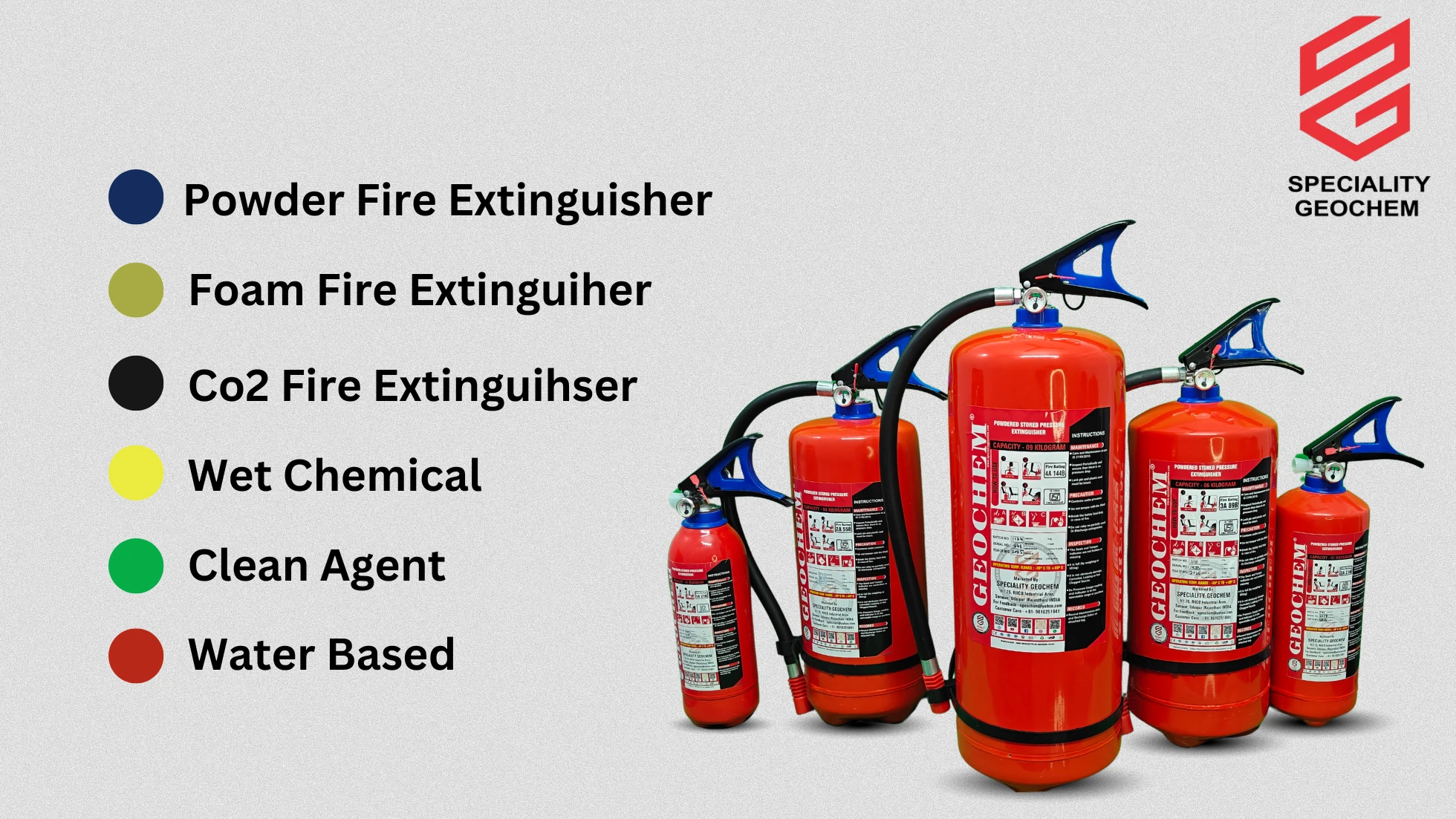
BIS-certified fire extinguishers from Speciality Geochem include ABC powder, CO₂, foam, wet chemical, and clean agent variants suitable for multiple fire classes and industrial applications.
For bulk supply, industrial procurement, OEM requirements, or fire safety consultation, contact Speciality Geochem directly.


19 Responses