Most people have used a fire extinguisher at some point. Very few can name its parts or explain what happens when one fails. That gap matters more than it seems.
This guide breaks down every part of fire extinguisher, how each component works, what to check during inspection, and what failure actually looks like in real-world use. It’s written for buyers, safety officers, facility managers, and anyone responsible for keeping extinguishers functional, not just present.
Why Knowing Fire Extinguisher Parts Actually Matters
A fire extinguisher is not a decorative red cylinder. It’s a pressure system that depends on multiple components working together in sequence.
If even one part fails, the system fails.
A pressure gauge sitting in the red zone means the extinguisher won’t discharge effectively. It may look intact, feel heavy, and still fail to push agent far enough to reach the fire. By the time someone realizes this, the fire has already grown beyond control.
A blocked nozzle turns a working extinguisher into dead weight. A missing tamper seal raises a simple question: has this unit already been used?
In India, standards like BIS certification and IS 15683 exist to prevent such failures. But compliance only guarantees manufacturing quality. Ongoing reliability depends on inspection and understanding.
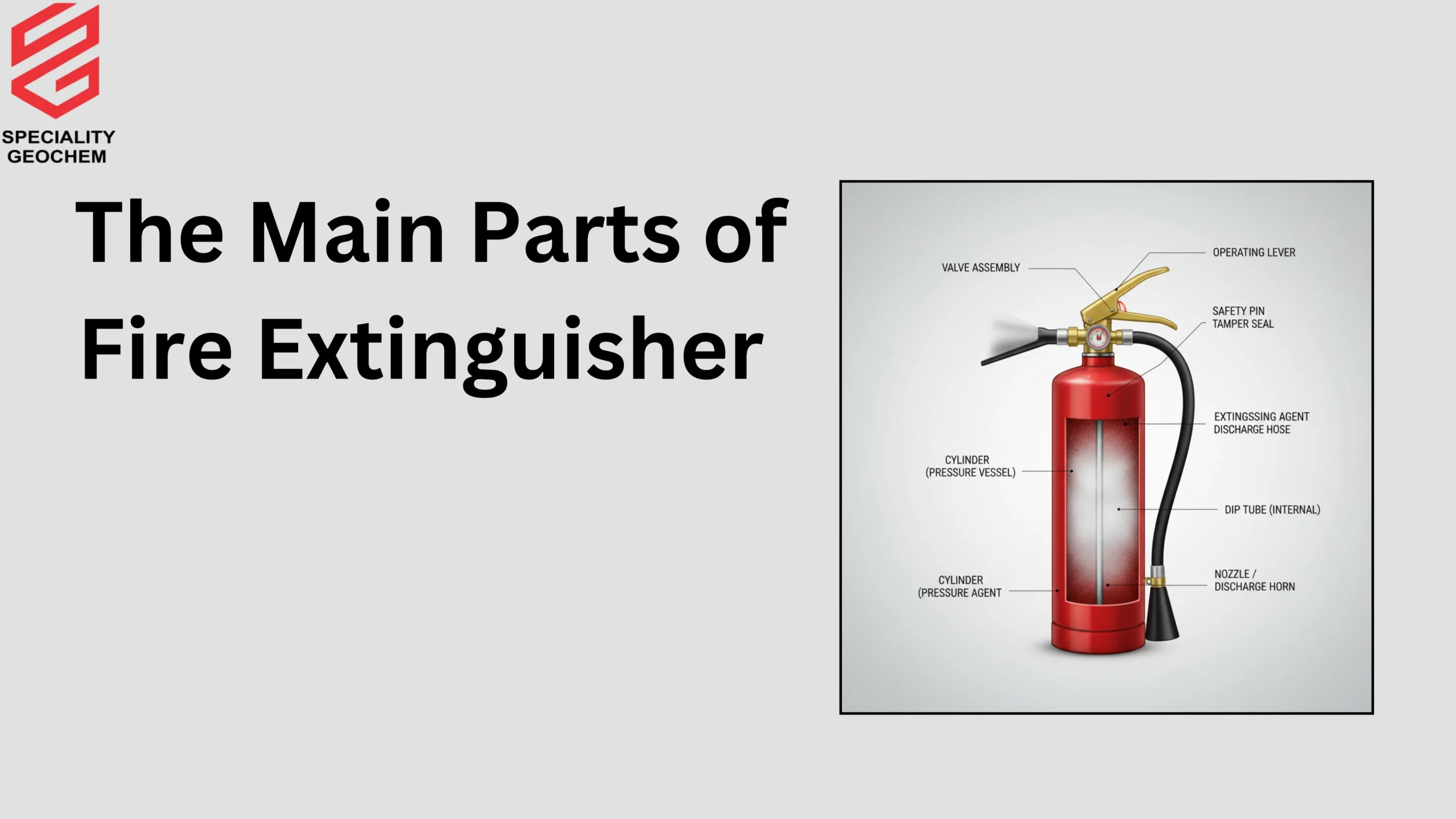
The Main Parts of Fire Extinguisher (With Names & Functions)
1. Cylinder (Pressure Vessel / Body)
This is the backbone of the extinguisher. Everything else depends on it.
The cylinder stores the extinguishing agent along with the propellant under pressure. It is typically made from seamless steel, stainless steel, or aluminum. In India, compliant cylinders follow IS 15683 or IS 2878 standards.
A properly manufactured cylinder is hydraulic pressure tested, usually at 1.5 times its working pressure. This ensures it can handle internal stress without rupture.
At Speciality Geochem, cylinder manufacturing includes controlled forming and pressure testing to eliminate weak points, especially at the base where failures typically start.
What to check:
Look for dents, corrosion, rust patches, or bulging at the base.
Failure signs:
Any deformation weakens structural integrity. A compromised cylinder is unsafe and must be replaced immediately.
2. Valve Assembly
This is the control center. Without it, the extinguisher cannot regulate discharge.
The valve assembly includes the valve body, valve seat, and spring mechanism. When activated, it allows controlled release of the extinguishing agent.
High-quality extinguishers use brass valve bodies. Cheaper variants often use zinc alloy or plastic, which degrade faster under pressure and temperature changes.
What to check:
Ensure smooth operation and no leakage around the valve.
Failure signs:
Leaking valve, delayed discharge, or inability to stop flow.
3. Operating Lever (Discharge Handle)
This is the part you physically press to activate the extinguisher.
The lever pushes against the valve mechanism, opening it to release pressure and agent. It only works after the safety pin is removed.
What to check:
Check for stiffness, bending, or cracks.
Failure signs:
A bent or jammed lever prevents discharge entirely.
4. Safety Pin (Pull Pin / Locking Pin)
This is a simple but critical safety feature.
The pull pin prevents accidental discharge during transport or handling. It must be removed before operation.
What to check:
Ensure the pin is original, properly fitted, and not loose.
Failure signs:
Missing pin increases risk of accidental discharge. Loose pin may fall out unnoticed.
5. Tamper Seal
A small plastic seal that holds the safety pin in place.
It acts as a visual indicator. If broken, it suggests the extinguisher may have been used or tampered with.
What to check:
Seal must be intact in a ready-to-use extinguisher.
Failure signs:
Broken seal requires inspection before trusting the unit.
6. Pressure Gauge
This shows the internal pressure status of the extinguisher.
The gauge has zones, usually green for normal, red for undercharged or overcharged.
CO2 extinguishers do not have pressure gauges because CO2 is stored as a liquid under vapor pressure. Its readiness is measured by weight, not pressure.
What to check:
Gauge needle should sit in the green zone.
Failure signs:
Stuck needle, cracked glass, or reading in red zone.
7. Discharge Hose
The hose directs the extinguishing agent toward the fire.
Typically found on extinguishers above 3 kg capacity, it allows better aiming and reach.
What to check:
Inspect for cracks, blockages, or stiffness.
Failure signs:
A damaged hose restricts or misdirects flow.
8. Nozzle / Discharge Horn
This is where the agent exits.
Different extinguishers have different nozzle types:
ABC dry powder extinguihser uses a standard nozzle
CO2 uses a discharge horn to prevent frostbite and control gas expansion
Foam extinguishers use aspirating nozzles to mix air and create foam
What to check:
Ensure nozzle is clear and undamaged.
Failure signs:
Blocked nozzle prevents agent discharge.
9. Dip Tube (Siphon Tube)
This is an internal component.
The dip tube draws the extinguishing agent from the bottom of the cylinder and directs it upward during discharge.
CO2 extinguishers do not use dip tubes because gas expands naturally.
What to check:
Internal inspection during servicing.
Failure signs:
If damaged, the extinguisher releases gas instead of agent.
10. Extinguishing Agent (The Fire Suppressant)
This is the substance that actually puts out the fire.
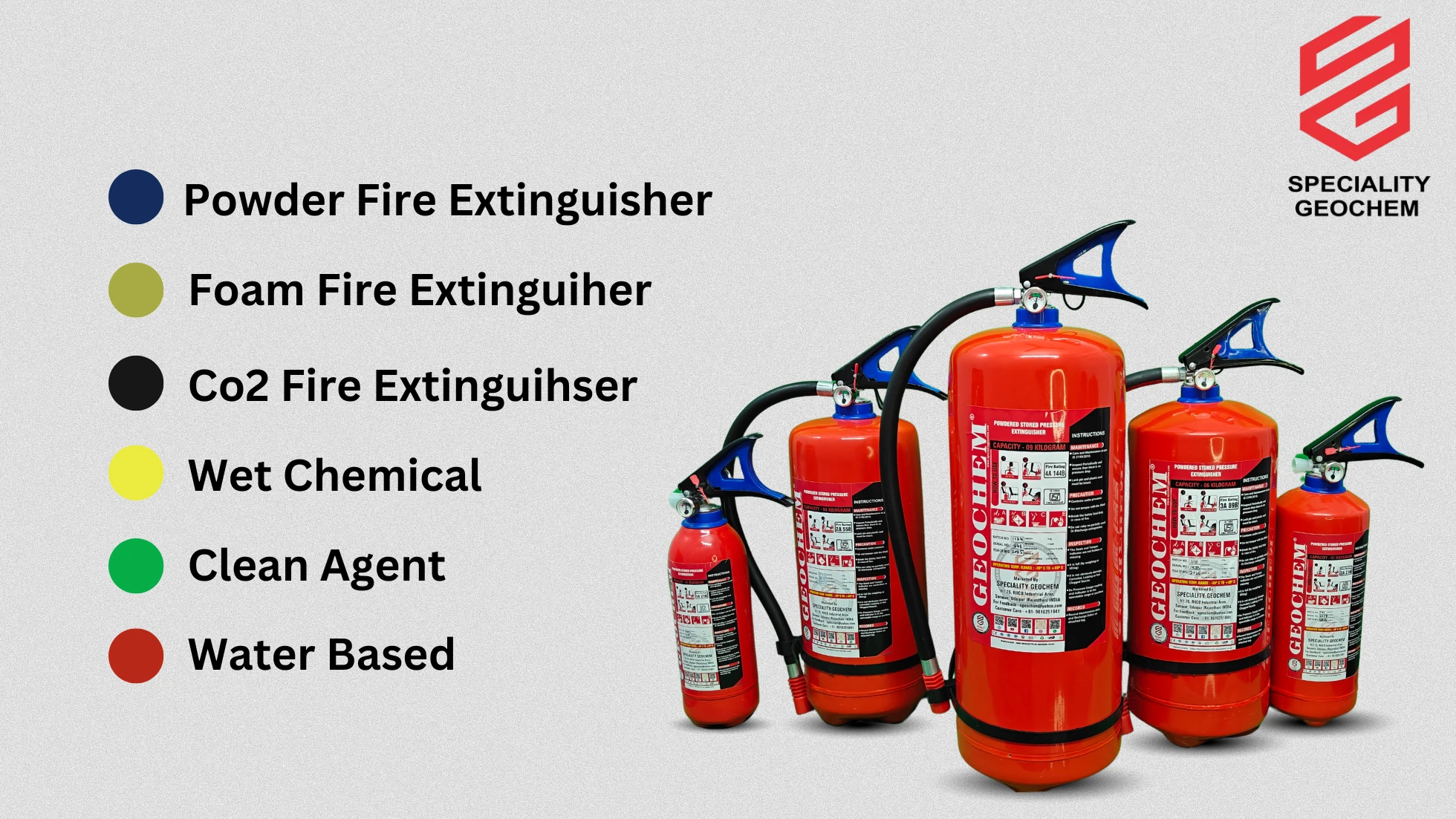
Types include ABC powder, CO2, foam, and water-based agents.
Each is designed for specific fire classes.
| Agent Type | Fire Class | Application |
|---|---|---|
| ABC Powder | A, B, C | General-purpose |
| CO2 | B, Electrical | Electrical fires |
| AFFF Foam | A, B | Liquid fires |
| Water | A | Solid combustibles |
11. Propellant
This creates the pressure needed to expel the agent.
Stored-pressure extinguishers use nitrogen or dry air. Cartridge-operated types use a separate CO2 cartridge.
What to check:
Ensure pressure consistency.
Failure signs:
Loss of propellant results in weak or no discharge.
12. Mounting Bracket / Wall Bracket
This keeps the extinguisher accessible and properly positioned.
IS guidelines require specific mounting heights for safety and accessibility.
What to check:
Ensure bracket is secure and not loose.
Failure signs:
Fallen or misplaced extinguishers during emergencies.
13. Instruction Label / Safety Label
This label provides usage instructions and compliance information.
It includes fire class ratings, PASS method, recharge date, and manufacturer details.
What to check:
Label must be readable.
Failure signs:
Faded or missing label leads to misuse and compliance issues.
14. Inspection Tags (Monthly + Annual)
These track inspection history.
Monthly checks are done internally. Annual inspections are done by certified professionals.
What to check:
Verify latest inspection date.
Failure signs:
Outdated tags indicate neglect.
Parts of a Fire Extinguisher — Comparison Table by Type
| Part | ABC Powder | CO2 | AFFF Foam | Water |
|---|---|---|---|---|
| Cylinder | Yes | Yes | Yes | Yes |
| Valve | Yes | Yes | Yes | Yes |
| Pressure Gauge | Yes | No | Yes | Yes |
| Hose | Yes | Yes | Yes | Yes |
| Nozzle Type | Standard | Horn | Aspirating | Jet |
| Dip Tube | Yes | No | Yes | Yes |
| Propellant | Nitrogen | Self-pressurized | Nitrogen | Air |
What Happens When Each Part Fails? (Troubleshooting Table)
| Part | Failure Sign | Meaning | Action |
|---|---|---|---|
| Pressure Gauge | Red zone | Low charge | Refill |
| Tamper Seal | Broken | Possible use | Inspect |
| Hose | Cracked | Flow issue | Replace |
| Nozzle | Blocked | No discharge | Clean |
| Cylinder | Rust/dent | Unsafe | Replace |
How Fire Extinguisher Parts Are Made (Manufacturing Quality Markers)
Quality begins at the cylinder.
Seamless cylinders are stronger than welded ones because they eliminate joint weaknesses. Hydraulic testing ensures the cylinder can handle pressure beyond operating limits.
Valve quality matters just as much. Brass valves offer durability and resistance to corrosion, especially in Indian environments where humidity fluctuates.
Surface finishing is another differentiator. Powder coating provides better corrosion resistance compared to basic paint.
BIS-certified extinguishers follow strict manufacturing and testing standards. Non-certified units often skip pressure testing, use inferior materials, and compromise safety.
Manufacturers with long-standing experience focus on consistency, not shortcuts. That difference shows only when the extinguisher is actually used.
Fire Extinguisher Parts Name List (Quick Reference)
Complete fire extinguisher parts name list:
Cylinder / Pressure Vessel
Valve Assembly
Operating Lever
Safety Pin (Pull Pin)
Tamper Seal
Pressure Gauge
Discharge Hose
Nozzle / Discharge Horn
Dip Tube (Siphon Tube)
Extinguishing Agent
Propellant
Mounting Bracket
Instruction Label
Inspection Tags
How to Inspect Fire Extinguisher Parts (Monthly Checklist)
Pull pin intact and tamper seal unbroken
Pressure gauge in green zone
Cylinder free of dents, rust, corrosion
Hose unblocked and intact
Nozzle clear
Label readable
Inspection date within 12 months
Bracket secure and accessible
FAQs About Fire Extinguisher Parts
What are the main parts of a fire extinguisher?
Cylinder, valve assembly, lever, safety pin, pressure gauge, hose, nozzle, and extinguishing agent.
What is the pull pin on a fire extinguisher?
A safety lock that prevents accidental discharge.
Why doesn’t a CO2 extinguisher have a pressure gauge?
Because CO2 pressure depends on temperature, not fill level. Weight indicates charge.
What does the tamper seal tell you?
Whether the extinguisher has been used or tampered with.
What is the dip tube inside a fire extinguisher?
A tube that draws agent from the bottom during discharge.
How often should fire extinguiser parts be inspected?
Monthly visual checks and annual professional servicing.
What is the difference between a nozzle and a discharge horn?
A nozzle directs flow; a horn controls CO2 expansion and prevents injury.
Can I replace fire extinguisher parts myself?
Only minor parts like pins or seals. Internal components require certified service.
What BIS standard applies to fire extinguisher cylinders in India?
IS 15683 and IS 2878.
How long do fire extinguisher parts last?
Typically 5–15 years depending on usage and maintenance.
Final Thoughts
A fire extinguisher is only as reliable as its weakest part.
Understanding the parts of a fire extinguisher turns routine inspection into meaningful safety. It helps you spot problems before they become failures.
For buyers and facility managers, this knowledge separates compliant equipment from dependable equipment.
If you’re sourcing fire extinguisher cylinders or components, look beyond price. Material quality, testing standards, and manufacturing discipline define real safety performance.
Because in an emergency, every part has to work. Not most of them. All of them.