
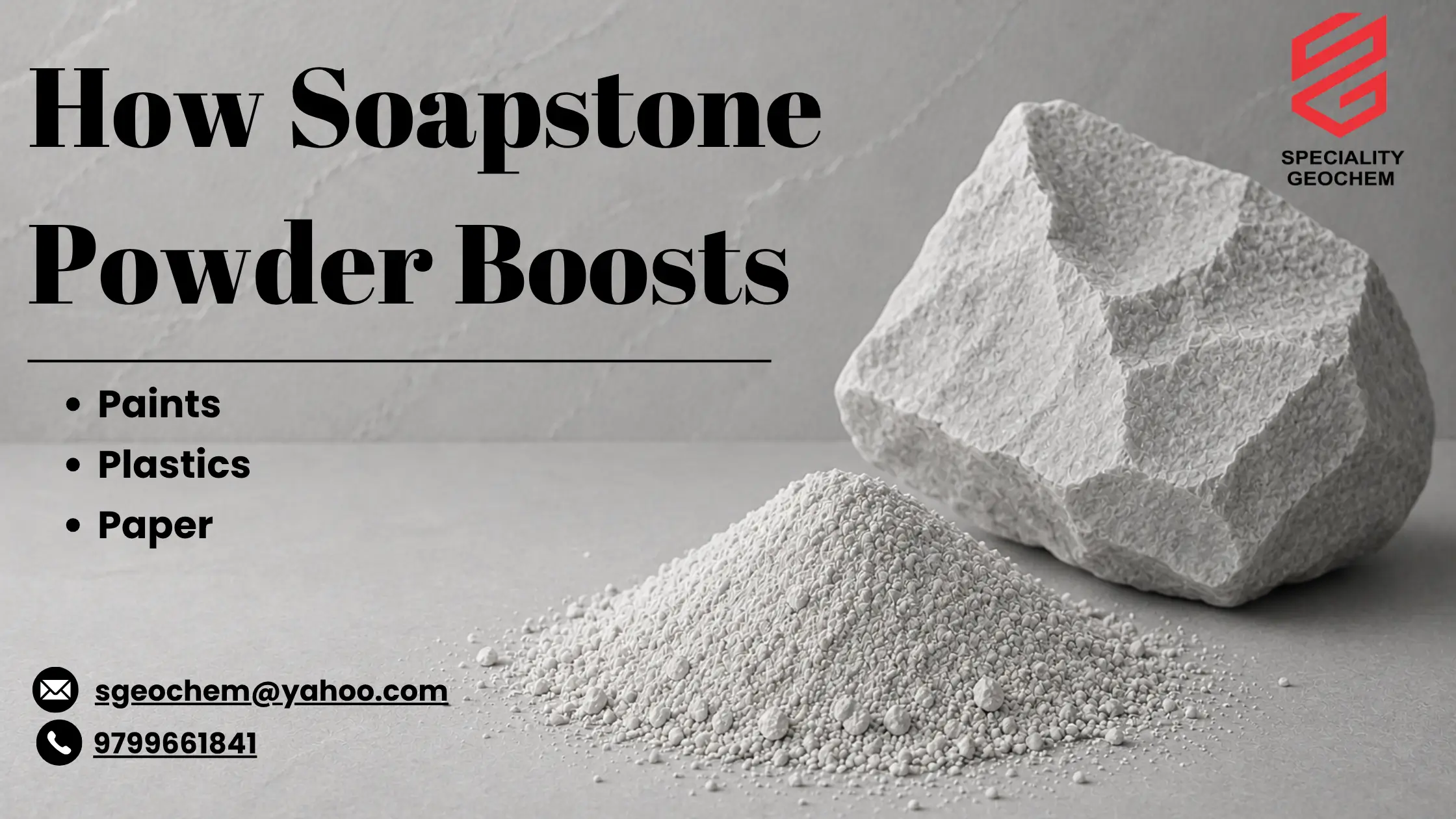
Soapstone powder is one of the most cost effective functional fillers available to manufacturers today. Paint producers use it to improve durability and surface finish. Plastics compounders use it to raise tensile strength and reduce polymer costs. Paper mills use it to improve printability, brightness, and dimensional stability.
This guide covers exactly how soapstone powder performs in each of these three industries, with the technical detail that procurement teams, R&D managers, and formulation engineers actually need to make decisions.
Speciality Geochem has manufactured and supplied soapstone powder (also known as talc powder or steatite powder) from Udaipur, Rajasthan since 1996. All grades are processed from verified mineral sources and tested for purity, whiteness, and particle size consistency before dispatch.
What Does Soapstone Powder Do in Paints, Plastics, and Paper?
Soapstone powder (magnesium silicate, Mg₃Si₄O₁₀(OH)₂) acts as a functional extender filler in all three industries:
- In paints, it extends pigment, improves adhesion, adds moisture resistance, and delivers a smooth finish
- In plastics, it raises stiffness, tensile strength, and heat resistance while reducing raw polymer consumption
- In paper, it improves brightness, smoothness, ink retention, and moisture resistance
Its low hardness (Mohs 1), lamellar particle shape, chemical inertness, and high whiteness make it suitable across all three without requiring chemical modification.
Soapstone Powder: Key Properties at a Glance
| Property | Value / Description |
|---|---|
| Chemical Name | Hydrated magnesium silicate |
| Formula | Mg₃Si₄O₁₀(OH)₂ |
| Hardness (Mohs) | 1 (softest mineral) |
| Specific Gravity | 2.7 to 2.8 g/cm³ |
| Whiteness | High, varies by grade and source |
| Particle Shape | Lamellar (platy) |
| Chemical Nature | Inert, non-reactive |
| Heat Resistance | Up to 800°C+ depending on grade |
| Moisture | Hydrophobic, repels water |
| Toxicity | Non-toxic, chemically stable |
What Is Soapstone Powder?
Soapstone powder is derived from soapstone, a metamorphic rock composed primarily of talc with varying amounts of chlorite, magnesite, and other silicate minerals. The rock is mined, crushed, ground, and classified into powders of specific mesh sizes for industrial use.
The name “soapstone” comes from the material’s smooth, soap like feel, a result of its lamellar crystal structure and extreme softness. In industrial settings it is interchangeable with the terms talc powder and steatite powder, though steatite specifically refers to dense, homogeneous grades used in electrical insulation and ceramics.
Its key functional advantages across industries are:
- Lamellar particle shape, flat, plate like particles that orient parallel to surfaces, improving barrier properties and surface smoothness
- Chemical inertness, it does not react with acids, alkalis, or most solvents at normal processing temperatures
- Hydrophobic surface, it naturally repels water, which benefits both paint durability and paper moisture resistance
- Low oil absorption, it requires less binder to wet out compared to many other fillers, reducing formulation costs
- High whiteness, it can substitute for or extend expensive white pigments like TiO₂
See full product specifications and available grades on our soapstone powder manufacturer page.