Dolomite Powder for Agriculture and Construction: Uses, Benefits, and How to Apply

Dolomite Powder for Agriculture and Construction: Uses, Benefits, and How to Apply

Quick answer: Dolomite powder for agriculture corrects acidic soil, raises pH into the 6.0–7.0 range crops need, and directly supplies calcium and magnesium. In construction, the same powder strengthens cement, concrete, and asphalt. One mineral, two industries, measurable results in both.

What Is Dolomite Powder?

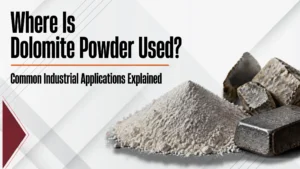
Dolomite powder is finely ground dolomite rock, a naturally occurring mineral made of calcium magnesium carbonate (CaMg(CO₃)₂). It contains roughly equal parts calcium and magnesium, which is exactly why dolomite powder for agriculture outperforms single mineral liming materials.

India holds over 7,500 million tonnes of dolomite reserves, according to the Indian Bureau of Mines (2023 edition). Major deposits sit in Rajasthan, Odisha, and Himachal Pradesh, making Indian manufactured dolomite powder one of the most cost accessible options globally for both agricultural and industrial buyers.

The powder comes in several mesh sizes: 100, 200, 325, and 400. Finer mesh reacts faster. The right grade depends on what you are using it for, more on that in the mesh size section below.

Dolomite Powder Uses in Construction

Before covering dolomite powder for agriculture, it helps to understand the full picture of what this material does across industries. In construction, dolomite powder is a high value mineral filler used in four key applications:

Cement and concrete

Adding dolomite powder to cement fills the microscopic gaps between cement particles. This lowers porosity, reduces water absorption, and produces denser, stronger concrete. Research in construction materials science shows that replacing 10–15% of standard cement filler with dolomite powder reduces water demand by up to 8% while holding compressive strength. That is a meaningful efficiency gain on large infrastructure projects.

Road surfaces and asphalt

Highway grade asphalt needs a filler that binds tightly to bitumen. Dolomite powder does this better than many alternatives because of its angular particle shape and low moisture absorption. Roads built with dolomite blended asphalt show longer service life and better resistance to rutting in high temperature conditions, a real advantage in India’s climate.

Wall plaster and exterior paint

Dolomite powder gives wall plaster a smoother finish and better adhesion to masonry surfaces. In paint formulations, it acts as a low cost extender that replaces part of the titanium dioxide without reducing opacity. Paint manufacturers typically specify 200–400 mesh for this application.

Glass and steel manufacturing

Steel producers use dolomite as a flux to draw out silica and other impurities from molten iron. Glass manufacturers use it to improve the hardness and chemical resistance of finished glass. The high combined CaO and MgO content, both above 19% in quality grade powder, is what makes it effective in these high temperature processes.

Dolomite Powder for Agriculture: Why Farmers Use It

Dolomite powder for agriculture solves three problems at once: soil acidity, mineral deficiency, and poor soil structure. Most liming materials address only one. Here is how dolomite powder works on all three simultaneously.

It corrects soil pH, and that unlocks everything else

Most crops grow best in soil with a pH between 6.0 and 7.0. When pH drops below 5.5, nutrients like phosphorus, calcium, and magnesium bond to soil particles and become chemically unavailable, even if those nutrients are physically present in the ground.

Using dolomite powder for agriculture raises pH by neutralising excess hydrogen ions in the soil. The reaction is gradual: you see measurable change within 4–8 weeks and full effect after 3–6 months. This slow, steady correction is an advantage, not a disadvantage. It avoids the pH spike that quicklime causes, which can stress roots and kill beneficial soil microbes.

The Indian Council of Agricultural Research (ICAR) estimates that approximately 49 million hectares of Indian farmland is acidic, concentrated in the northeastern states, Chhattisgarh, and parts of Madhya Pradesh. ICAR lists dolomite powder application as a primary recommended treatment for acidic soil reclamation.

It directly feeds crops calcium and magnesium

Standard NPK fertilisers do not include calcium or magnesium. Farmers who use only NPK create a slow deficiency of these two minerals over time, especially in intensively cropped fields.

Dolomite powder for agriculture delivers both in a single application:

  • Calcium builds strong cell walls, supports root tip development, and improves the shelf life and firmness of fruit. Calcium deficient soil produces hollow tomatoes, tip burn in lettuce, and blossom end rot in capsicum.
  • Magnesium is the central atom in every chlorophyll molecule. Without enough magnesium, photosynthesis slows, leaves yellow between the veins (a condition called interveinal chlorosis), and overall crop output drops. Magnesium also activates over 300 plant enzymes involved in energy transfer and protein synthesis.

A single application of dolomite powder for agriculture typically provides 3–4 kg of calcium and 1.5–2 kg of magnesium per 100 kg of powder applied, quantities that are genuinely meaningful at field scale.

It improves soil structure for better root growth

Compacted clay soil restricts root penetration and holds water in ways that cause root rot and anaerobic conditions. Sandy soil drains so fast that roots cannot absorb nutrients before they leach away.

Dolomite powder for agriculture improves both extremes. In clay soil, calcium ions cause fine clay particles to clump (a process called flocculation), which opens up pore space for roots, water movement, and beneficial soil organisms. In sandy soil, calcium and magnesium help bind particles enough to slow drainage and retain moisture longer.

Better structure means deeper roots, better drought resistance, and less need for irrigation.

It reduces the need for chemical pesticides

Plants with adequate calcium and magnesium build thicker, harder cell walls. These are physically more resistant to insect penetration and fungal infection. Fungal pathogens like Fusarium and Pythium thrive in acidic conditions. When you raise pH with dolomite powder for agriculture, you reduce the conditions those pathogens need to spread.

Fewer disease and pest problems mean fewer pesticide applications, lower input costs, and a farming system that is easier to move toward organic certification.

Dolomite Powder for Agriculture: Application Rates by Soil Type

The right dose depends on your current soil pH and soil texture. Always run a soil test before applying, do not estimate by eye.

Soil TypeCurrent pHRecommended Rate
Sandy SoilBelow 5.51.5–2.0 tonnes / hectare
Sandy Soil5.5–6.00.8–1.2 tonnes / hectare
Loamy SoilBelow 5.52.0–2.5 tonnes / hectare
Loamy Soil5.5–6.01.2–1.8 tonnes / hectare
Clay SoilBelow 5.52.5–3.5 tonnes / hectare
Clay Soil5.5–6.01.5–2.5 tonnes / hectare

How to apply dolomite powder for agriculture correctly:

  • Test your soil pH, know your starting point before you spend anything.
  • Spread dolomite powder evenly across the field using a mechanical spreader or by hand on small plots.
  • Incorporate it into the top 10–15 cm of soil with a cultivator or rotavator.
  • Water the field lightly after incorporation to start the chemical reaction.
  • Retest pH after 6–8 weeks to measure the change.

One application of dolomite powder for agriculture typically lasts 2–3 years before you need to reapply, depending on rainfall, crop type, and irrigation intensity.

Important: Never apply more than 3.5 tonnes per hectare in a single application without a soil test confirming you need it. Over application raises pH above 7.5, which locks up phosphorus, zinc, and iron, creating new deficiencies in place of the old ones.

Dolomite Powder vs Agricultural Limestone vs Calcite: The Key Differences

These three liming materials are often confused. The difference matters because choosing the wrong one for your soil can create new nutrient imbalances.

MaterialChemical FormulaCalciumMagnesiumBest Use
Dolomite PowderCaMg(CO₃)₂~30% CaO~20% MgOSoil low in both Ca and Mg
Agricultural Limestone (Calcite)CaCO₃~55% CaOTraceSoil adequate in Mg, deficient in Ca
QuicklimeCaOHighNoneFast industrial pH correction

Use dolomite powder for agriculture when:

  • Your soil test shows magnesium below 50 ppm.
  • Crops show interveinal chlorosis, yellow leaves with green veins, a classic magnesium deficiency signal.
  • You want steady, season long pH correction that will not shock your crop mid cycle.
  • You are correcting acidic soils in the northeastern states, Assam, or Meghalaya where magnesium deficiency is widespread.

Use agricultural limestone when:

  • Soil magnesium is already at 80 ppm or above.
  • You only need calcium without pushing magnesium higher.
  • Excess magnesium is already causing potassium uptake issues.

What Mesh Size Should You Use?

Mesh SizeParticle SizeReaction SpeedBest Use
100 Mesh~150 micronsSlowRoad base, construction aggregate
200 Mesh~75 micronsModerateGeneral agriculture, cement additive
325 Mesh~44 micronsFastPremium agriculture, paint extender
400 Mesh~38 micronsFastestSpecialty coatings, steel flux

For dolomite powder for agriculture, 200 mesh is the practical standard. It reacts fast enough to shift pH within one growing season and is coarse enough to handle with standard farm spreaders without excessive dust.

Frequently Asked Questions

What is dolomite powder used for in agriculture?

Dolomite powder for agriculture is used to raise the pH of acidic soil into the 6.0–7.0 range where most crops grow best. At the same time, it delivers calcium and magnesium, two minerals that standard NPK fertilisers do not provide. It also improves soil structure by loosening compacted clay, which helps roots grow deeper and absorb more water.

How does dolomite powder differ from regular limestone?

Regular agricultural limestone (calcite) provides only calcium. Dolomite powder provides both calcium and magnesium in roughly equal amounts. If your soil test shows magnesium below 50 ppm, dolomite is the right choice. If magnesium is already adequate, calcite is more appropriate and will not push magnesium to levels that interfere with potassium uptake.

Is dolomite powder for agriculture safe for organic farming?

Yes. Dolomite powder is a naturally occurring mineral and is approved for certified organic farming under India’s National Programme for Organic Production (NPOP) and most international organic standards. It contains no synthetic chemicals, additives, or processed compounds.

How long does dolomite powder take to raise soil pH?

When you use dolomite powder for agriculture, expect a measurable pH increase within 4–8 weeks. Full effect develops over one complete growing season, approximately 3–6 months. The gradual action avoids the pH shock that fast acting quicklime causes, making it the safer choice for crops already in the ground.

What happens if you apply too much dolomite powder?

Over application, generally above 3.5 tonnes per hectare without soil testing, raises pH above 7.5. At that level, phosphorus, iron, manganese, and zinc become less available. Crop performance drops, and you have to spend money correcting a problem you created. Always test your soil first and follow the application rate table above.

Can you use dolomite powder in cement?

Yes. Dolomite powder is an established mineral filler in cement and concrete mixes. At 10–15% replacement, it reduces water demand, improves workability, and maintains compressive strength. It is also used in asphalt, wall plaster, and exterior paint as a cost efficient extender material.

How does dolomite powder improve crop yield?

Dolomite powder for agriculture improves yield through three mechanisms: it makes existing soil nutrients available by correcting pH, it directly supplies calcium and magnesium that NPK fertilisers leave out, and it improves soil structure so roots grow deeper and access more of both water and nutrients. ICAR documented field trials on acidic soils in northeastern India show yield increases of 15–30% in rice and maize after dolomite powder application at recommended rates.

Why the Quality of Dolomite Powder for Agriculture Matters

Not all dolomite powder delivers the same results. Effectiveness depends on:

  • Purity: Agricultural grade dolomite powder should contain minimum 19% MgO and 30% CaO. Lower grades carry higher silica and iron impurities that reduce the neutralising value per tonne.
  • Mesh consistency: Uniform particle size gives predictable reaction rates across the field. Inconsistent grinding produces uneven pH correction, some patches overcorrected, others unchanged.
  • Moisture content: Excess moisture causes clumping that blocks spreaders and shortens shelf life.
  • Heavy metal testing: Good quality dolomite powder for agriculture is tested for lead, arsenic, and cadmium, trace elements that accumulate in soil over repeated applications.

At Speciality Geochem, we produce dolomite powder tested batch by batch against Indian Standards IS 4289, with minimum 99% purity, consistent mesh grades from 100 to 400, and documented heavy metal levels available for every shipment. Our facility operates in Udaipur, Rajasthan, in the heart of one of India’s highest quality dolomite belts.