
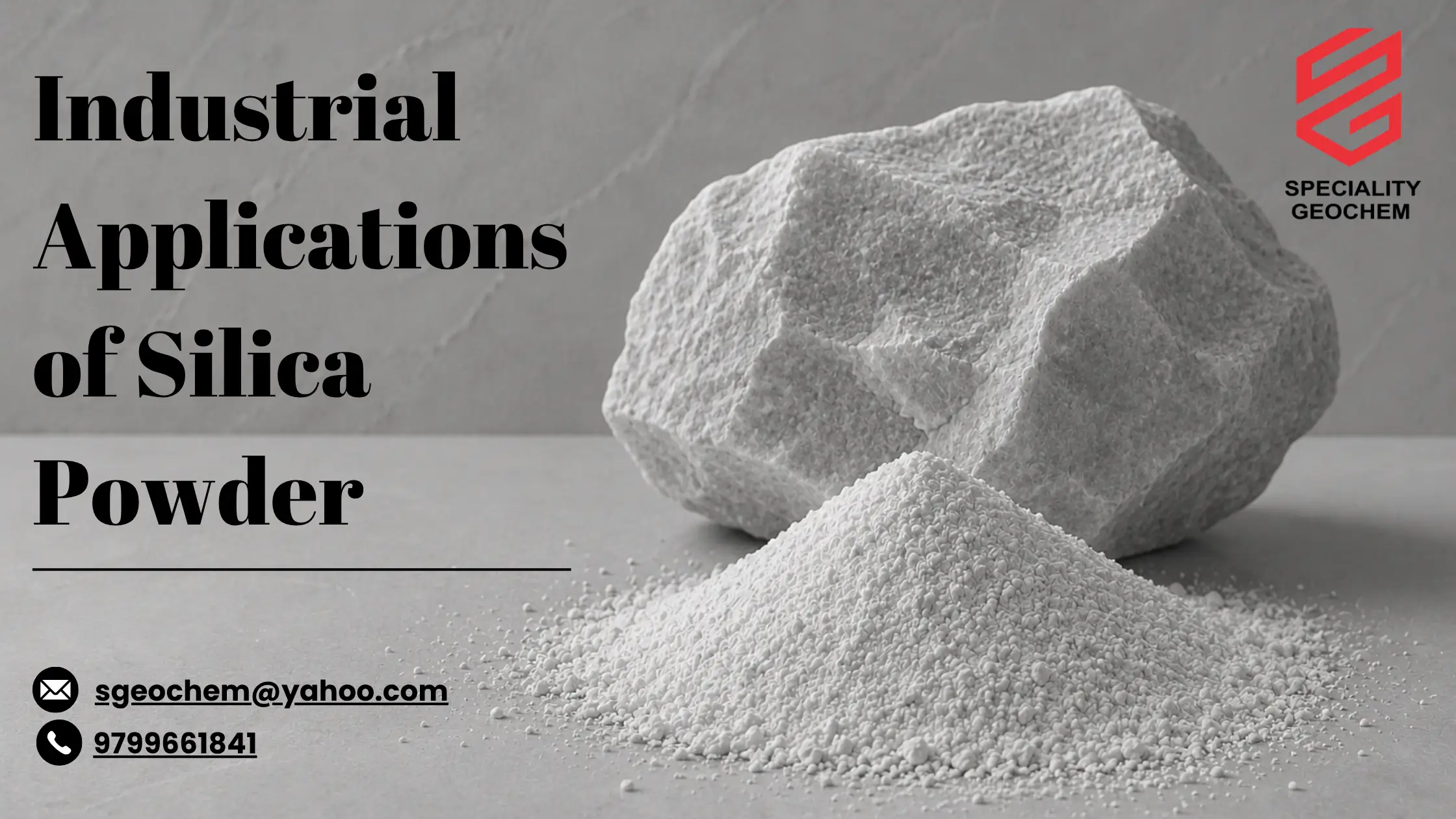
Silica in powder form, also called powdered silica or silicate powder, is one of the most versatile industrial minerals used in modern manufacturing. Chemically known as silicon dioxide (SiO₂), it accounts for approximately 59% of the Earth’s crust and is refined into fine silica powders used across construction, glass, electronics, paints, and rubber industries. Speciality Geochem has manufactured and supplied high purity silica powder from Udaipur, Rajasthan since 1996, serving industries that demand consistent mesh size, chemical stability, and controlled SiO₂ content above 99%.
Properties of Silica Powder
Silica powder is a silica compound (SiO₂) with a unique combination of physical and chemical properties that make it indispensable across industries:
| Property | Value |
|---|---|
| Chemical Formula | SiO₂ (Silicon Dioxide) |
| Purity (Industrial Grade) | 98.5% – 99.9% SiO₂ |
| Melting Point | 1,710°C |
| Mohs Hardness | 7 (highly abrasion resistant) |
| Specific Gravity | 2.65 g/cm³ |
| Refractive Index | 1.544 |
| pH (Aqueous Suspension) | 6.5 – 7.5 |
| Available Mesh Sizes | 100, 200, 300, 400, 500 mesh |
These properties of silica, especially its thermal resistance, chemical inertness, and mechanical hardness, drive its use in modern silica technology applications ranging from semiconductor fabrication to cement reinforcement.
5 Industrial Applications of Silica Powder
1. Construction Industry: Strengthening Foundations
Silica powder is an essential element in the building industry greatly improving the durability and strength of construction materials. One of its main applications is in cement and concrete production, in which it works as a pozzolanic component. When it reacts with the calcium hydroxide, silica produces calcium silicate solution (C-S-H) which improves the mechanical properties of concrete, decreases porosity and improves the strength of concrete over the long term.
Furthermore, silica is extensively used for high performance concrete (HPC) and self-compacting concrete (SCC). The size of the fine particles improves the flowability and workability, which allows for quicker construction as well as lower cost of construction. Furthermore, it increases the durability of concrete against extreme environmental conditions like extreme temperatures and chemical corrosion. It makes silica dust a vital element in contemporary construction, as it ensures that structures are more durable long-lasting, durable and long-lasting.
2. Glass Manufacturing: A Transparent Revolution
it is a fundamental ingredient in the glass industry. As the primary source of silicon dioxide (SiO2), it forms the backbone of glass production. Its high purity ensures the production of clear, high-quality glass used in a variety of applications, including windows, bottles, and decorative items.
Beyond traditional glassmaking, silica powder is also critical for the production of specialized glass types such as borosilicate and tempered glass. These are widely used in industries like pharmaceuticals, laboratories, and construction. For instance, borosilicate glass, known for its resistance to thermal shock, is commonly used in scientific apparatus and cookware. The consistent quality and chemical properties of silica powder make it a vital resource for advancing glass manufacturing technologies.
3. Electronics and Semiconductors: The Core of Modern Innovation
Silica powder with high purity plays a important part in the semiconductor and electronics industries, and is an important component for the creation of silicon wafers. These wafers constitute the base of microchips and semiconductors that power vital devices like laptops, smartphones medical equipment, advanced robotics.
Silica powder’s remarkable electrical and thermal characteristics make it essential for the exact and sensitive processes that are required to manufacture semiconductors. As technology improves, the need for silica powder will continue to grow, resulting in advances in artificial intelligence as well as technology such as the Internet of Things (IoT) and sustainable energy sources. Its vital contribution to these advanced technology ensures that silica remains at the cutting edge of the latest industrial advances.
4. Paints and Coatings: Enhancing Performance and Longevity
In the paints and coatings industry, silica powder is an essential additive that enhances the performance and durability of products. It improves scratch resistance, increases hardness, and enhances the overall texture of coatings. This is particularly beneficial for industrial and automotive applications where surfaces are exposed to heavy wear and tear.
Silica powder also contributes to the thermal stability and UV resistance of coatings, making them suitable for outdoor applications. Additionally, its ability to reduce the gloss of surfaces enables manufacturers to create matte finishes, catering to diverse aesthetic preferences. These properties make silica powder indispensable for achieving superior quality in modern paints and coatings.
5. Plastics and Rubber: Reinforcing Strength and Flexibility
The plastics and rubber industries utilize silica powder as a reinforcing filler to enhance the mechanical properties of their products. In rubber manufacturing, silica powder improves tensile strength, tear resistance, and abrasion resistance. This makes it a preferred material for producing durable tires, seals, and conveyor belts.
In the plastics sector, silica powder is added to polymers to improve rigidity, reduce shrinkage, and enhance resistance to chemicals and heat. It also contributes to the production of lightweight composite materials, which are increasingly used in the automotive and aerospace industries for fuel efficiency and structural integrity.
What is Silica Used For? Key Industrial Uses
Silica powder is used for more than 700 documented industrial purposes globally. The primary uses of silica across sectors include:
Construction & Infrastructure
Used as a pozzolanic admixture in cement and concrete. Concrete with silica fume shows 20 to 30% higher compressive strength (ACI 234R, American Concrete Institute).
Glass Manufacturing
Silicon dioxide (SiO₂) is the fundamental glass forming oxide. Over 90% of all manufactured glass uses silica as its primary raw material.
Electronics & Semiconductors
High purity silica (99.99% SiO₂) is the starting material for silicon wafers that power microchips. The global semiconductor grade silica market was valued at USD 1.2 billion in 2023.
Paints & Surface Coatings
What silica is used for in coatings: as a matting agent, anti sag additive, and scratch resistance enhancer. Typical loading: 2 to 8% by weight.
Rubber & Plastics
Silica replaces carbon black as a reinforcing filler in “green tyres”, reducing rolling resistance by up to 20% and improving fuel economy (European Tyre & Rubber Manufacturers’ Association).
Handling Silicate Dust Safely in Industrial Settings
The Future of Silica Powder in Industry
With constant advances in the field of materials science, the applications of silica are expanding across numerous industries. Its remarkable flexibility makes it an essential participant in the emerging fields like biomedical research, nanotechnology as well as energy storage. Researchers are examining the potential of silica powder to develop high-performance materials, enhancing treatments for medical conditions, and increasing the efficiency of batteries. As technology advances Silica powder is predicted to play a greater part in shaping the future of industrial growth.
Conclusion
It is a powerhouse material driving progress across diverse industries. From strengthening concrete to enabling the production of high-tech semiconductors, its applications are both foundational and transformative. Speciality Geochem remains at the forefront of supplying high-quality silica powder to meet the needs of these dynamic industries.
Whether you are in construction, electronics, or any other sector leveraging silica powder, Speciality Geochem understands the applications and can provide valuable insights into its critical role in modern technology and industrial processes. As innovation continues, silica powder will undoubtedly remain a cornerstone of industrial progress.