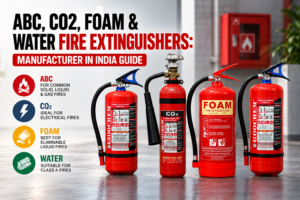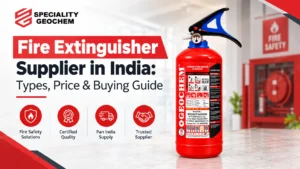
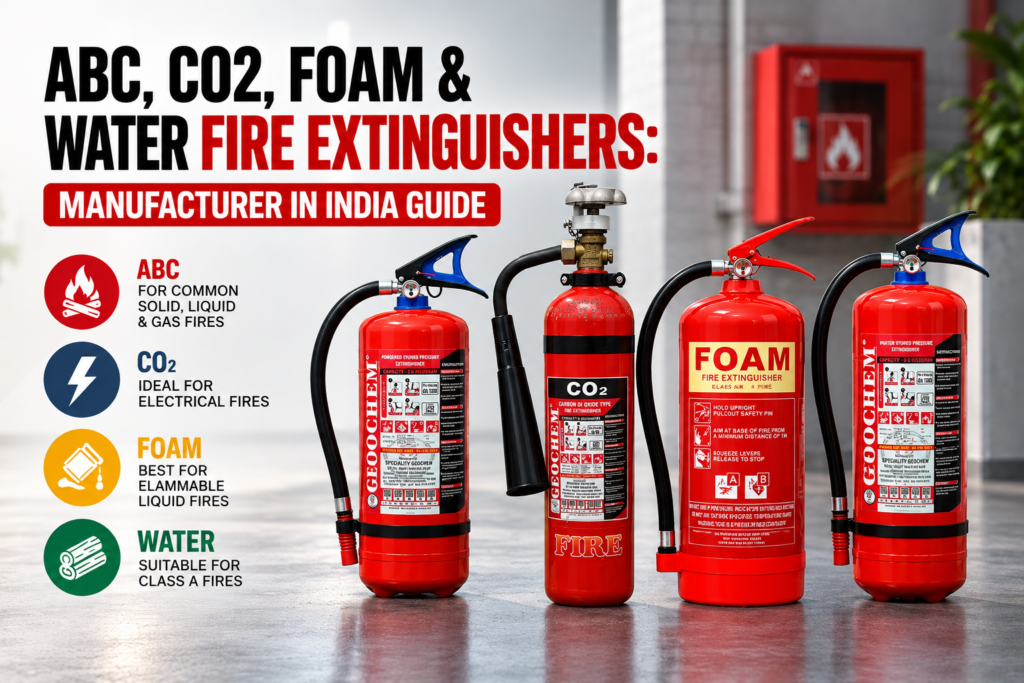
The wrong cylinder in the wrong place can do more harm than good: a water unit next to an electrical panel, or a powder unit beside sensitive machinery. Written by a fire extinguisher manufacturer in India that makes all four common types, this guide starts from the fire risk in front of you and works back to the right extinguisher, covering the ABC fire extinguisher, CO2 fire extinguisher, fire fighting foam and water based fire extinguisher.
Quick answer: Use an ABC fire extinguisher where several kinds of fire are possible, such as homes, shops and offices. Use a CO2 fire extinguisher near electrical panels and delicate machinery. Use fire fighting foam (AFFF) where petrol, oil or solvents are stored. Use a water based fire extinguisher only for wood, paper and textile fires, never on electrical or oil fires.
Start with the risk, not the cylinder
Every extinguisher is built to stop certain classes of fire. Ask two questions before you buy:
- What is most likely to burn here? Solids like wood and paper, flammable liquids, gases, or live electrical equipment.
- What must not be damaged? Powder leaves residue; CO2 does not.
| What is at risk | Choose | Why |
|---|---|---|
| Mixed risks: furniture, wiring, LPG, paper | ABC dry powder | Covers Class A, B, C and electrical fires in one cylinder |
| Electrical panels, server racks, delicate machines | CO2 | Non-conductive and leaves no residue |
| Petrol, diesel, oil, paint and solvent storage | Mechanical foam (AFFF) | Forms a blanket over burning liquid |
| Wood, paper, textile and jute stores | Water type | Suits Class A solid fires only |
ABC fire extinguisher: the all-rounder
This is the multipurpose choice. It handles Class A, B and C fires, from wood, paper and cloth to flammable gas, petrol, paints and solvents, plus fires that start in electrical equipment. Its monoammonium phosphate powder smothers the burning material, cuts off oxygen and interrupts the chemical reaction that keeps a fire going.
We make ABC units in 1, 2, 4, 6 and 9 kg sizes. Discharge time ranges from 6–8 seconds on the smaller units to 12–18 seconds on the 9 kg, with a jet length of 6–7 metres from 4 kg upwards. Every unit is tested at 35 kgf/cm².
Where it falls short: the powder leaves a residue that can damage electronics, it is not recommended for cooking oil fires, and it is not for metal fires. Compare sizes on our ABC fire extinguisher page.
CO2 fire extinguisher: for electrical and delicate equipment
Carbon dioxide is the type for Class B and C risks: oil, gas, live electrical equipment and sensitive machinery. It is non-conductive and leaves no residue, so it is the preferred choice for server rooms, UPS rooms, control panels and laboratories.
We make CO2 units in 2 kg and 4.5 kg sizes, with discharge times of 6–8 seconds and 10–18 seconds. CO2 is stored at high pressure, so each cylinder is tested at 250 kgf/cm², far higher than powder units.
Where it falls short: CO2 is not usually the first choice for deep-seated Class A fires in wood or paper, and its jet length is about 1 metre. See the full range of our CO2 fire extinguisher models.
Fire fighting foam: for flammable liquids
Foam is the answer where flammable liquids and petroleum products are stored, because it spreads a blanket over the burning surface. Our mechanical foam (AFFF) extinguisher is a stored-pressure unit suitable for Class A and B fires.
The 9-litre AFFF unit discharges for 50–60 seconds with a jet length of 6–8 metres, and is tested at 35 kgf/cm². It suits garages, workshops, fuel storage and parking areas.
Read more about our fire fighting foam range.
Water based fire extinguisher: for ordinary solid fires
This type is meant for Class A fires only, in organic solids such as wood, paper, textiles and jute. It is a stored-pressure unit with a 50–60 second discharge and a 6–8 metre jet, tested at 35 kgf/cm².
Keep water away from electrical and oil fires. Water conducts electricity and can spread burning oil. That is why a water unit belongs in a paper store or textile area, not next to a switchboard or a kitchen. See our water based fire extinguisher page.
Mixing types in one building
Most buildings need more than one type, because the risk changes from room to room. A typical setup:
| Area | Extinguisher |
|---|---|
| Offices, corridors, shops | ABC dry powder |
| Server room, UPS room, main panel | CO2 |
| Fuel store, workshop, parking | Mechanical foam (AFFF) |
| Record room, textile or jute store | Water type |
Whatever the mix, keep each extinguisher near an exit and along escape routes, visible and unblocked, so you can reach it without walking deeper into the fire.
What to ask any manufacturer about these four types
- Is every unit ISI marked under IS 15683, and what is the licence number?
- How long does each size discharge, how far does it reach, and what pressure is it tested at?
- Which fire classes is each type rated for?
- Do you refill and service all four types?
All four types are made under one ISI licence, CM/L 2533146 (IS 15683), at our own units in RIICO industrial areas at Sanwar (Udaipur) and Parbatsar (Kuchaman-Didwana). We also hold ISO 9001:2015, ISO 14001:2015, ISO 45001:2018, ISO/IEC 17025:2017, CE and MSME ZED Bronze certification. Learn more about us as a fire extinguisher manufacturer in India.
Get the right mix from one manufacturer
Speciality Geochem makes ABC, CO2, foam and water based extinguishers under one ISI licence, so you can equip every room with the right type from a single source. Call +91-9799661841 or +91-9680211841, or email sales@specialitygeochem.com for a quote.
Frequently asked questions
Q1. What is the difference between an ABC and a CO2 fire extinguisher?
An ABC fire extinguisher uses dry powder and covers Class A, B and C fires, including electrical fires, but leaves a residue. CO2 covers Class B and C fires, is non-conductive and leaves no residue, so it suits electrical panels and delicate machinery.
Q2. Where should a CO2 fire extinguisher be used?
Use it near electrical panels, server rooms, UPS rooms, control rooms, laboratories and delicate machinery, where powder residue would cause damage. It is not usually the first choice for deep-seated wood or paper fires.
Q3. What is fire fighting foam used for?
AFFF foam is used on Class A and B fires in petrol, oil and other flammable liquids, where the burning surface needs to be blanketed. A 9-litre mechanical foam extinguisher discharges for 50–60 seconds with a 6–8 metre jet.
Q4. Can a water based fire extinguisher be used on electrical fires?
No. It is for Class A fires in wood, paper, textiles and jute only. Water conducts electricity and can spread burning oil, so never use it on electrical or oil fires.
Q5. Which fire extinguisher is best for an office?
ABC dry powder units for general areas, plus a CO2 unit near the server room, UPS room and main electrical panels.
Q6. How do I choose a fire extinguisher manufacturer in India?
Check that every unit is ISI marked under IS 15683 with a verifiable licence number, that discharge time, jet length and test pressure are published for each size, and that the manufacturer refills and services the types it sells.