
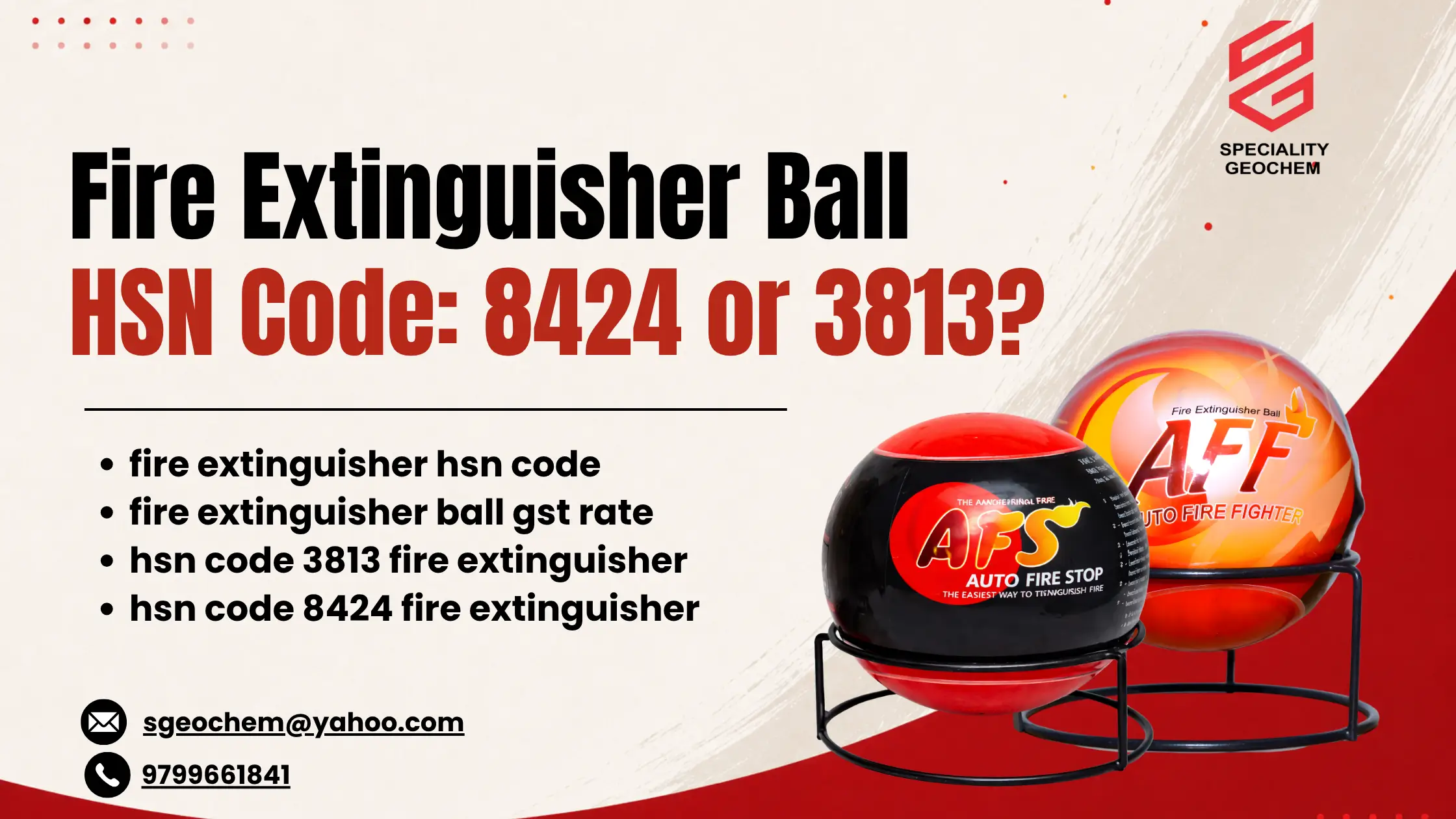
Fire Extinguisher Ball HSN Code: 8424 or 3813

Fire Extinguisher Ball HSN Code: 8424 or 3813

If you need the fire extinguisher ball HSN code, the most commonly used classification for a complete fire extinguisher ball is HSN 8424 10 00. Global trade data shows this code is widely used for fire extinguishing devices. However, HSN 3813 may apply when a business invoices the fire-extinguishing chemical charge or preparation rather than the complete device.

What Does Fire Extinguisher Ball HSN Code 8424 Cover ?

HSN stands for Harmonized System of Nomenclature. Businesses use it to classify goods for Goods and Services Tax (GST), customs, imports, and exports.

HSN code 8424 10 00 falls under heading 8424, which covers fire extinguishers and equipment used to project, disperse, or spray liquids or powders. In practice, this is the classification most often used for complete fire extinguisher balls sold as ready-to-use fire suppression devices.

According to global trade data, HSN 8424 10 00 appears in more than seven million shipment records involving fire extinguishing equipment. This makes it the most commonly reported classification for complete fire extinguisher ball products.

A fire extinguisher ball generally fits under fire extinguisher ball HSN 8424 when:

  • The product is sold as a complete device.
  • The extinguishing agent is already contained inside the ball.
  • The product functions as a self-contained fire suppression unit.
  • The invoice describes the finished fire extinguisher ball rather than the chemical compound inside it.

Many manufacturers, exporters, and importers use HSN 8424 because customs authorities typically view the product as a complete fire extinguishing apparatus rather than a standalone chemical preparation.

For most commercial transactions involving finished fire extinguisher balls,  Fire Extinguisher Ball HSN Code 8424 10 00 is the starting point for classification. Businesses should still verify the classification against current GST and customs guidance before issuing invoices or export documents.

When Does HSN Code 3813 Apply Instead?

HSN code 3813 covers preparations and charges for fire extinguishers, along with charged fire-extinguishing grenades. This classification focuses on the extinguishing substance rather than the complete fire-fighting device.

The confusion starts because a fire extinguisher ball contains a fire-extinguishing agent inside it. Some businesses assume the entire product should therefore fall under Fire Extinguisher Ball HSN Code 3813. That is not always the case.

HSN 3813 generally applies when the transaction relates to:

  • Fire-extinguishing chemical preparations.
  • Extinguishing charges supplied separately.
  • Refill materials or extinguishing compounds.
  • Products primarily sold as fire suppression chemicals rather than complete devices.

For example, if a supplier invoices only the extinguishing powder or chemical formulation used inside a fire extinguisher ball, HSN 3813 may be the more suitable classification.

By contrast, when the same chemical is packaged inside a finished, self-contained fire extinguisher ball and sold as a complete product, many businesses classify it under Fire Extinguisher Ball HSN Code 8424 10 00.

This distinction matters because GST treatment and compliance requirements can differ depending on the classification selected. Businesses should classify the product based on what the invoice actually represents.

A simple way to think about it is:

  • Finished fire extinguisher ball = usually HSN 8424 10 00
  • Fire-extinguishing chemical preparation or charge = potentially HSN 3813

The product description on the invoice, technical specifications, and the nature of the supply all play a role in determining the correct code.

HSN 8424 vs HSN 3813 Comparison

FactorHSN 8424 10 00HSN 3813
CoversFire extinguishers and fire extinguishing devicesFire-extinguishing preparations and charges
Product TypeComplete self-contained deviceChemical preparation or extinguishing charge
Typical UseFinished fire extinguisher ballExtinguishing compound supplied separately
GST RateVerify with the latest CBIC GST schedule and notifications28% GST (subject to government notification changes)
Invoice DescriptionFire extinguisher ballFire-extinguishing chemical preparation
Common Use CaseExport and sale of complete fire suppression productsSale of extinguishing agent or refill material

The key question is not what chemical sits inside the product. The key question is whether the invoice covers a complete extinguishing device or a fire-extinguishing preparation.

What GST Rate Applies to Fire Extinguisher Balls?

GST stands for Goods and Services Tax. The applicable GST rate depends on the HSN classification used for the product.

For products classified under Fire Extinguisher Ball HSN Code 3813, the current GST rate is 28%, according to Central Board of Indirect Taxes and Customs (CBIC) notifications. GST rates can change through future government notifications, so businesses should always verify the latest schedule before invoicing.

For products classified under HSN 8424 10 00, businesses should confirm the current GST rate from the latest CBIC GST rate schedule rather than relying on outdated online listings or competitor invoices.

When determining GST treatment, businesses should:

  1. Confirm the correct HSN classification first.
  2. Check the latest GST rate schedule issued by CBIC.
  3. Verify treatment with their chartered accountant or GST practitioner.
  4. Use the same classification consistently across invoices and returns.

Using the correct HSN code before calculating GST helps avoid disputes during audits and assessments.

Why Getting the HSN Code Right Matters

Choosing the correct Fire Extinguisher Ball HSN Code is not just a paperwork exercise. It affects GST compliance, customs clearance, export benefits, and audit outcomes.

A wrong classification can create problems during GST assessments or customs reviews. If authorities determine that the product falls under a different heading, the business may need to pay additional tax, interest, or penalties.

Impact on GST Compliance

GST returns rely on accurate HSN reporting. When businesses use inconsistent classifications, authorities can question the tax treatment applied to the product.

Common issues include:

  • Incorrect GST calculation.
  • Mismatched invoice records.
  • Disputes during GST audits.
  • Delays in resolving tax notices.

Using one verified classification across invoices, returns, and accounting records helps reduce compliance risk.

Impact on Exports

Exporters face an additional challenge. Customs authorities use HS Codes and HSN codes to determine eligibility for various export-related benefits and schemes.

Using the wrong classification can lead to:

  • Loss of export benefits.
  • Rejection of export incentive claims.
  • Incorrect duty assessment.
  • Delays in customs processing.

These issues can increase costs and affect shipment timelines.

Duty and Customs Risks

Customs departments examine product classifications during import and export transactions. If a classification appears incorrect, authorities may review supporting documents and product specifications.

Misclassification can result in:

  • Higher duties being levied.
  • Recovery of wrongly claimed benefits.
  • Customs disputes.
  • Litigation related to duty evasion or improperly claimed export benefits.

The risk increases when businesses copy classifications from competitors without checking whether the products are actually identical.

Better Record Keeping

A clear classification policy helps everyone involved in the transaction.

This includes:

  • Accounts teams.
  • GST practitioners.
  • Customs brokers.
  • Procurement departments.
  • Export documentation teams.

When every stakeholder uses the same verified Fire Extinguisher Ball HSN Code, compliance becomes much easier to manage.

A Note on Classification Decisions

Businesses should base classification on the actual product supplied and how it appears on the invoice. The fact that another seller uses a particular code does not automatically make that code correct for every transaction.

Disclaimer

This article provides general information only. HSN classification and GST rates can vary based on product specifications, invoice structure, and government notifications. Before filing GST returns, issuing invoices, or completing customs documentation, businesses should confirm the final classification with a GST practitioner, chartered accountant, or customs broker. No HSN code or GST rate discussed here should be treated as legally binding advice.

Common Mistakes Businesses Make When Classifying Fire Extinguisher Balls

Many classification errors happen because businesses rush the invoicing process or rely on information from unreliable sources. Most mistakes are avoidable with a simple verification process.

1. Copying a Competitor’s Fire Extinguisher Ball HSN Code

This is one of the most common mistakes.

A business sees a competitor using a particular Fire Extinguisher Ball HSN Code and assumes the same code applies to its own product. The problem is that two products that look similar may not be classified the same way.

Before using any code, businesses should review:

  • Product specifications.
  • Invoice descriptions.
  • Technical characteristics.
  • The nature of the supplied item.

A competitor’s invoice is not a legal classification reference.

2. Using HSN 3813 for Every Fire Extinguisher Ball Transaction

Some businesses assume that because a fire extinguisher ball contains extinguishing chemicals, every transaction belongs under Fire Extinguisher Ball HSN Code 3813.

This approach can create problems when the supplied item is actually a complete fire extinguishing device.

The classification should reflect what is being sold:

  • Complete device → review Fire Extinguisher Ball HSN Code 8424.
  • Chemical preparation or charge → review Fire Extinguisher Ball HSN Code 3813.

The distinction matters for both GST and customs purposes.

3. Failing to Review Classification After Regulatory Changes

GST rates and classification guidance can change over time.

Many businesses select an Fire Extinguisher Ball HSN Code once and never review it again. This creates risk if government notifications modify tax treatment or classification interpretations.

Businesses should periodically:

  • Review GST schedules.
  • Check CBIC updates.
  • Verify product classifications.
  • Update accounting systems when needed.

4. Using Different HSN Codes for the Same Product

A product may be sold by different branches, dealers, or regional offices.

Sometimes each location starts using a different HSN code for the same item. This creates inconsistencies across GST returns and accounting records.

A central classification policy helps prevent this issue.

5. Ignoring Export Documentation Requirements

Exporters sometimes focus only on GST invoices and overlook customs classification requirements.

A mismatch between:

  • GST invoices.
  • Shipping documents.
  • Export declarations.
  • Customs filings.

can trigger questions during customs reviews.

Export businesses should ensure that the same classification logic appears across all trade documents.

6. Not Keeping Classification Support Documents

A business should be able to explain why it selected a particular HSN code.

Helpful records include:

  • Product specifications.
  • Technical literature.
  • Internal classification notes.
  • Professional advice from tax or customs experts.

These documents can support the classification if authorities request clarification later.

Fire Extinguisher Ball HSN Code for Exports

Exporters should pay special attention to HSN classification because customs systems rely heavily on HS and HSN codes during international trade.

An incorrect classification can affect more than GST compliance. It can also influence export documentation, customs processing, and eligibility for trade-related benefits.

Why Export Classification Matters

Customs authorities use HS Codes to identify products moving across borders.

The selected code can affect:

  • Export declarations.
  • Customs clearance.
  • Duty assessments.
  • Trade statistics.
  • Export benefit calculations.

Even a small classification error can create delays if customs authorities require additional verification.

Impact on Export Benefits

Many export-related benefits and incentive schemes depend on accurate product classification.

Using the wrong Fire Extinguisher Ball HSN Code can lead to:

  • Loss of export benefits.
  • Rejection of claims.
  • Delayed processing.
  • Additional document reviews.

Businesses should ensure the classification used on export documents accurately reflects the supplied product.

Duty Drawback and Refund Claims

Exporters often apply for duty drawback or other trade-related benefits where classification plays an important role.

If customs authorities determine that the product was classified incorrectly, they may:

  • Recalculate benefits.
  • Deny claims.
  • Request supporting documentation.
  • Initiate compliance reviews.

Accurate classification helps reduce these risks.

Customs Litigation Risk

Misclassification can also create customs disputes.

Authorities may question whether:

  • Duties were calculated correctly.
  • Export benefits were claimed correctly.
  • Product declarations accurately reflect the goods shipped.

In some cases, disputes can develop into customs litigation involving allegations of duty evasion or improperly claimed export benefits.

The best protection is a well-documented classification process supported by product specifications and professional advice.

Export Best Practices

Before exporting fire extinguisher balls:

  1. Confirm whether the product is a complete device or a chemical preparation.
  2. Verify the appropriate Fire Extinguisher Ball HSN Code classification.
  3. Ensure invoices and shipping documents match.
  4. Maintain supporting product documentation.
  5. Obtain advice from a customs broker when required.

Following these steps helps reduce delays and improves compliance across international shipments.

Frequently Asked Questions (FAQ)

1. What is the HSN code for a fire extinguisher ball?

The most commonly used Fire Extinguisher Ball HSN Code for a complete fire extinguisher ball is 8424 10 00. This classification covers fire extinguishers and related fire-fighting devices. Global trade data shows extensive use of this code in international trade.

2. Is a fire extinguisher ball classified under HSN 8424 or 3813?

The answer depends on what is being supplied. A complete fire extinguisher ball is commonly classified under HSN 8424 10 00, while HSN 3813 may apply when the transaction involves a fire-extinguishing preparation or charge rather than the complete device.

3. What GST rate applies to HSN code 3813?

Fire Extinguisher Ball HSN Code 3813 currently attracts 28% GST according to applicable CBIC classifications. Businesses should verify the latest GST schedule because tax rates can change through future government notifications.

4. What is the GST rate for Fire Extinguisher Ball HSN Code 8424?

Businesses should verify the current GST rate for Fire Extinguisher Ball HSN Code 8424 using the latest CBIC GST rate schedule. Tax rates can change over time, and businesses should avoid relying on outdated online information.

5. Can two suppliers use different HSN codes for the same fire extinguisher ball?

Yes, this can happen in practice. However, the correct classification should depend on the nature of the product supplied and not on the supplier’s preference. Businesses should verify the classification independently rather than copying another company’s invoice.

6. Does the HSN code change between AFF and AFS fire extinguisher ball models?

No. Classification generally follows the product itself and its function. Dealer arrangements, branding differences, or distribution channels do not normally change the HSN classification of the same product.

7. Why is correct HSN classification important for exporters?

Exporters use HSN and HS Codes in customs declarations and export documentation. An incorrect classification can lead to loss of export benefits, customs delays, incorrect duty assessments, or disputes during compliance reviews.

8. Can I use a competitor’s invoice to determine my HSN code?

No. A competitor’s invoice should not be treated as a classification authority. Businesses should review product specifications, invoice descriptions, and professional advice before selecting an Fire Extinguisher Ball HSN Code.

9. Can a wrong HSN code result in penalties?

Using an incorrect Fire Extinguisher Ball HSN Code can create GST and customs compliance issues. Depending on the circumstances, authorities may recover unpaid taxes, question claimed benefits, or initiate proceedings related to classification disputes.

10. Who should verify the final HSN classification?

Businesses should confirm the final classification with a qualified GST practitioner, chartered accountant, or customs broker before issuing invoices, filing GST returns, or completing export documentation.