
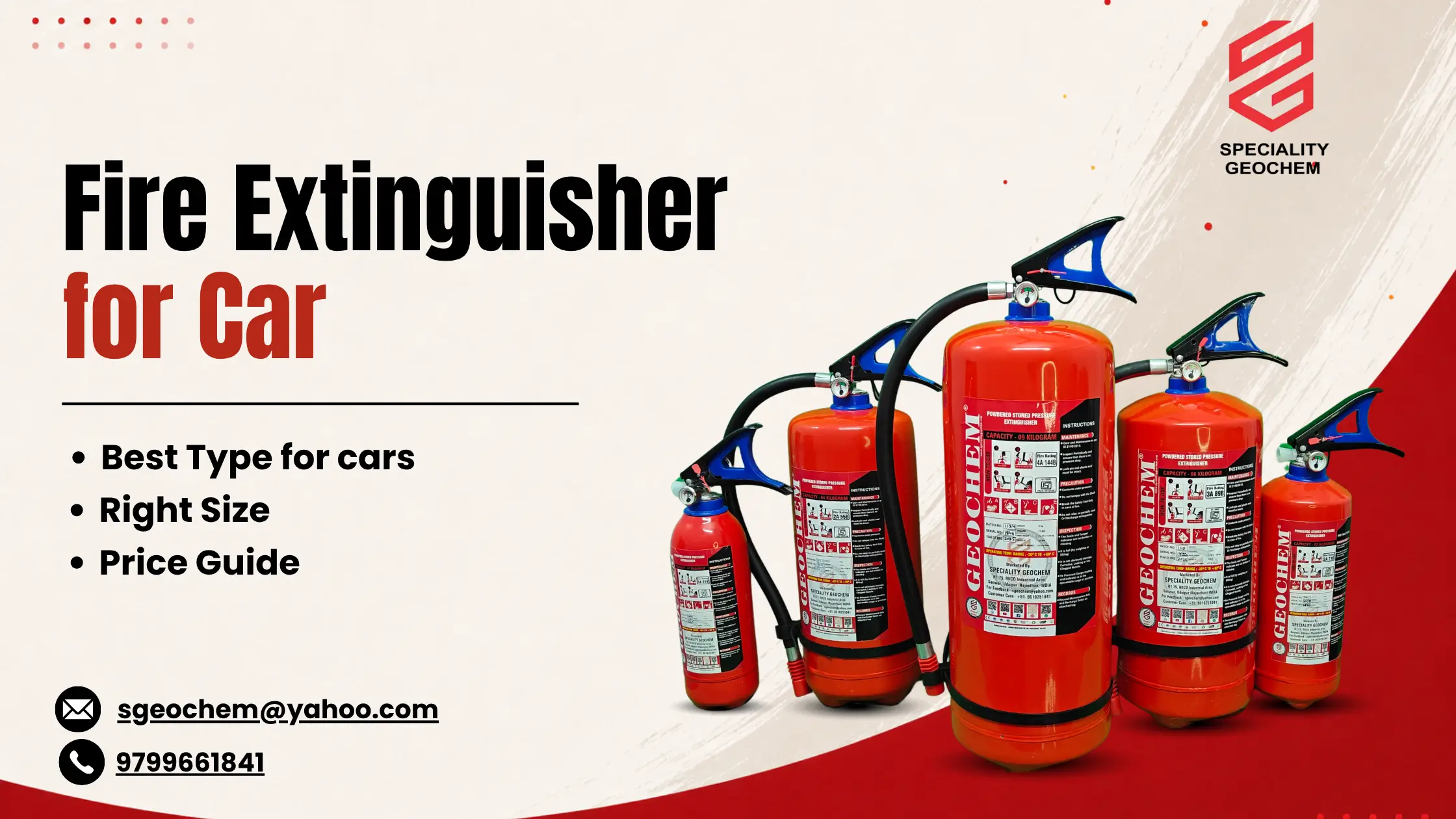
Fire Extinguisher for Car: Best Type, Size & Price Guide (2026)

Fire Extinguisher for Car: Best Type, Size & Price Guide

A 1 kg or 2 kg ABC dry powder fire extinguisher is the best fire extinguisher for car use. It is small, ISI-certified, and works on fuel fires, electrical fires, and fires from solid materials like plastic or fabric. CO2 extinguishers are a good second choice if you want no residue, especially for electric cars. Keep it under your seat or in the door pocket. Never put it in the boot. Check the pressure gauge every month.

Car fires move fast. A frayed wire, a fuel leak, or an engine that gets too hot can turn into flames in seconds. By the time help arrives, the damage is already done.

That is why more car owners in India now keep a fire extinguisher for car, even though it is not yet a legal requirement for private cars.

This guide tells you everything you need to pick the right fire extinguisher for car: the best type, the right size, where to put it, how much it costs, and how to use it correctly.

Why Choose Speciality Geochem for Your Car Fire Extinguisher?

When it comes to fire safety, the brand behind the extinguisher matters as much as the extinguisher itself.

Speciality Geochem (SGC) is a BIS-certified fire extinguisher manufacturer based in India. We make ABC dry powder, CO2, and fire extinguisher ball units. All products are tested and certified to Indian Standards (IS 15683:2018 and IS 4308).

Here is why thousands of car owners, fleet managers, and businesses across India trust SGC:

  • BIS/ISI certified: Every unit meets Indian Standards. You get a product that works when it matters, not just one that looks good on a shelf.
  • Made in India: Our extinguishers are manufactured and quality checked in India. They are not imported and rebranded.
  • Full range for every car type: Whether you drive a hatchback, an SUV, a CNG car, or an EV, we have the right unit and size for your vehicle.
  • Bulk and fleet supply: We supply directly to vehicle fleets, taxi operators, logistics companies, and commercial carriers at competitive prices.
  • Refill and service support: We help you stay compliant with IS 2190 annual service guidelines so your extinguisher is always ready.

You can browse our car fire extinguisher range or contact us for a quote.

Is a Fire Extinguisher Mandatory in a Car in India?

For private cars, no. There is no central law in India that says you must carry a fire extinguisher. The rule applies mainly to commercial vehicles like taxis, buses, and goods carriers.

But there are a few things worth knowing:

  • CNG and LPG cars: Many states and RTOs strongly suggest, and sometimes require, a fire extinguisher for gas-fitted cars. Compressed gas fires spread faster and behave differently from regular fires.
  • Insurance: Some insurers see a properly fitted extinguisher as a sign of responsible ownership. This can help if you make a claim for fire damage.
  • Electric vehicles (EVs): As more EVs come onto Indian roads, fire safety experts recommend carrying an extinguisher that works on lithium-ion battery fires. There is no private EV rule yet, but the recommendation is growing.

Short answer: Not mandatory for private cars, but it is a smart choice, especially if you drive a CNG car, an EV, or take long highway trips where help is more than 30 minutes away.

Best Type of Fire Extinguisher for a Car

Not every fire extinguisher is right for a car. You need one that handles the most common car fire risks such as electrical shorts, fuel leaks, and burning plastic or fabric without creating new dangers inside a small space.

TypeBest ForGood PointsNot So GoodBest Use in Cars
ABC Dry PowderFuel, electrical, and solid material firesMost flexible, affordable, works on nearly any car fireLeaves powder residue that takes effort to cleanBest all-round pick for most cars
CO₂ ExtinguisherElectrical firesLeaves no residue, safe near electronicsHeavier for its size, less effective on burning fabric soaked in fuelGood for EVs and cars with sensitive electronics
Fire Extinguisher BallQuick response without manual useActivates near heat or flame on its own, no training neededOnly works on small, contained firesUseful as a backup in the cabin or engine bay
Automatic Suppression TubeUnder-bonnet or engine bay firesActivates at high heat automatically, low maintenanceDoes not help with cabin firesBest for commercial fleets and high-mileage vehicles

Our recommendation: For 9 out of 10 car owners, a 1 kg or 2 kg ABC dry powder extinguisher gives the best mix of cost, flexibility, and ease of use. If you drive a CNG car or are worried about electrical fires, which are common in EVs, add a small CO2 unit or a fire extinguisher ball as a backup.

What Size Fire Extinguisher Do You Need for a Car?

Size matters more than most people think. Too small and it will not have enough to control even a minor fire. Too large and it is hard to store and grab quickly.

  • 1 kg ABC extinguisher: Best for hatchbacks and sedans. Small enough to fit in a door pocket or under the seat. It has about 6 to 8 seconds of discharge time, which is enough to handle a small engine bay or dashboard fire.
  • 2 kg ABC extinguisher: Better for SUVs, MUVs, and larger cars where fire can spread across a bigger space. A little heavier but still easy to use in a hurry.
  • Above 2 kg: Not needed for private cars. Hard to store and too slow to grab in an emergency.

Simple rule: A 5-seater car or smaller should use a 1 kg extinguisher. A 6 or 7-seater SUV or larger vehicle should use a 2 kg extinguisher.

Fire Extinguisher for CNG Cars and Electric Cars

CNG Cars

CNG cars carry compressed gas at high pressure. A leak near any spark or heat source can become dangerous very quickly. An ABC extinguisher is still the best choice, but where you keep it is just as important. It should be within arm’s reach and not hidden under luggage or other items.

Electric Cars (EVs)

EV fires are different from regular vehicle fires. Lithium-ion battery fires burn at higher temperatures, can restart after appearing to be extinguished, and do not always respond well to standard ABC powder.

  • A CO2 or clean-agent extinguisher is a better option for fires around the dashboard, wiring, or charging port. It leaves no residue and helps protect electronic components.
  • For the battery pack itself, a portable extinguisher is mainly useful for slowing the fire and helping passengers leave the vehicle safely. Large battery fires require professional firefighting and extensive cooling.
  • Keep the extinguisher inside the cabin, not in the boot near the battery, so you can reach it quickly regardless of where the fire starts.

Where to Keep a Fire Extinguisher in Your Car

Where you store your extinguisher can decide whether you can use it in time or not.

Good Spots

  • Under the driver’s or front passenger seat: Within easy reach and does not take up cabin space.
  • Driver’s side door pocket: One of the quickest places to access a compact 1 kg extinguisher.
  • Front footwell with a mounting bracket: Secure, easy to reach, and commonly used in commercial vehicles.

Places to Avoid

  • The boot: Too far away if the fire starts in the engine compartment or cabin.
  • The rear parcel shelf: Constant sunlight may affect the pressure gauge over time.
  • Loose on the floor without a bracket: The extinguisher can roll around and become dangerous during sudden braking or an accident.

A properly mounted extinguisher near the driver is considered the safest and most practical location.

How to Use a Fire Extinguisher in Your Car

Even the best extinguisher is useless if you do not know how to use it. The PASS method is the most widely accepted method for operating portable fire extinguishers.

  1. P: Pull the safety pin.
  2. A: Aim the nozzle at the base of the fire.
  3. S: Squeeze the handle to release the extinguishing agent.
  4. S: Sweep the nozzle from side to side until the fire is out.

For a Car Fire Specifically

If the fire is under the bonnet, do not open the bonnet fully. A sudden rush of air can cause the flames to grow rapidly.

Open the bonnet slightly, direct the extinguishing agent through the gap, and wait for the flames to reduce before opening it further.

If the fire has become large or reached the fuel tank area, move everyone away from the vehicle immediately and call emergency services. Personal safety is always more important than saving the vehicle.

Fire Extinguisher for Car: Price in India (2026)

Prices depend on the extinguisher type, size, and certification status.

Type and SizeApproximate Price
1 kg ABC Dry Powder₹500 to ₹950
2 kg ABC Dry Powder₹650 to ₹1,500
1 kg CO₂ Extinguisher₹1,500 to ₹3,000
2 kg CO₂ Extinguisher₹3,000 to ₹4,600
Fire Extinguisher Ball₹500 to ₹1,500
Automatic Suppression Tube System₹2,000 to ₹5,000

What Affects the Price?

  • BIS/ISI certification: Certified extinguishers cost slightly more but offer reliable performance.
  • Mounting kit and accessories: Some packages include brackets, nozzles, and installation accessories.
  • Refillable or disposable design: Refillable extinguishers usually provide better long-term value.

Avoid very cheap unbranded products. A fire extinguisher is emergency equipment, not an accessory.

What to Check Before You Buy

Before buying a fire extinguisher for car, take a few minutes to check these important points.

1. BIS/ISI Mark

The extinguisher should have a BIS/ISI certification mark. This shows that it meets Indian safety standards and has been tested for performance.

2. Pressure Gauge

Check the pressure gauge before buying. The needle should be in the green zone. If it is not, choose another unit.

3. Manufacturing Date and Service Date

Always check when the extinguisher was manufactured and when it is due for service. Most ABC extinguishers need servicing every 1 to 2 years, even if they have never been used.

4. Mounting Bracket Included

A mounting bracket makes installation easier and keeps the extinguisher secure while driving.

5. Easy to Lift and Use

Choose a size that you can comfortably lift and operate with one hand. In an emergency, speed matters.

How to Maintain Your Car Fire Extinguisher

A fire extinguisher needs regular checks to stay ready for use. A neglected extinguisher may fail when you need it most.

Every Month

Look at the pressure gauge. The needle should remain in the green zone.

Every 6 Months

Inspect the extinguisher for:

  • Rust
  • Dents
  • Cracks
  • Damaged nozzles
  • Signs of leakage

Every Year

Get the extinguisher professionally inspected and serviced according to IS 2190 maintenance guidelines.

After Any Use

Refill or replace the extinguisher immediately after use. Even a partially discharged extinguisher may not provide enough protection during the next emergency.

Frequently Asked Questions

Is it mandatory to keep a fire extinguisher in a car in India?

No. It is not mandatory for private cars under central motor vehicle rules. However, it is mandatory for many commercial vehicles and is strongly recommended for CNG and LPG vehicles.

What is the best fire extinguisher for a car?

A 1 kg or 2 kg ABC dry powder fire extinguisher is the best choice for most vehicles. It can handle fuel fires, electrical fires, and fires involving solid materials.

What size fire extinguisher is best for a car?

A 1 kg extinguisher is ideal for hatchbacks and sedans. A 2 kg extinguisher is better for SUVs and larger vehicles.

Where should I keep a fire extinguisher in my car?

The best locations are:

  • Under the driver’s seat
  • In the driver’s door pocket
  • Mounted in the front footwell

The extinguisher should always be easy to reach.

Can a fire extinguisher fully put out a car fire?

A portable extinguisher can control or extinguish a small fire if it is detected early.

If a large fire has reached the fuel tank or battery pack, move everyone away from the vehicle and call emergency services immediately.

How often should a car fire extinguisher be serviced?

Check the pressure gauge every month and arrange a professional inspection every year.

Is CO2 or ABC better for a car fire extinguisher?

ABC is the better all-purpose option because it covers multiple fire types.

CO2 is useful for electrical fires because it leaves no residue and helps protect sensitive electronics.

Do I need a different fire extinguisher for an electric car?

ABC extinguishers can handle general vehicle fires.

For electrical components and wiring, a CO2 or clean-agent extinguisher is often preferred because it leaves no residue behind.

What is the price of a fire extinguisher for a car in India?

Typical prices are:

  • 1 kg ABC: ₹500 to ₹950
  • 2 kg ABC: ₹650 to ₹1,500
  • 1 kg CO2: ₹1,500 to ₹3,000
  • 2 kg CO2: ₹3,000 to ₹4,600

Always choose a BIS-certified extinguisher rather than the cheapest option available.

What Type of Fire Extinguisher Is Used in Vehicles?

ABC dry powder extinguishers are the most commonly used fire extinguishers in vehicles across India.

They can handle:

  • Fuel fires
  • Electrical fires
  • Solid material fires

CO2 extinguishers are also used, especially in electric vehicles and vehicles with sensitive electronic systems.

Conclusion

A fire extinguisher may be one of the smallest safety items in your vehicle, but it can make a huge difference during an emergency.

For most drivers, a 1 kg or 2 kg ABC dry powder extinguisher offers the best balance of protection, cost, and ease of use. If you drive an electric vehicle or want additional protection for electronics, a CO2 extinguisher can be a useful addition.

Keep the extinguisher within easy reach, inspect it regularly, and learn the PASS method before an emergency happens. A few minutes of preparation today can help prevent major damage tomorrow.