
The Problem With How We Think About Fire Safety
Most people buy a fire extinguisher, mount it on a wall, and consider their fire safety sorted.
But here’s the reality: when a fire actually breaks out, the average person panics. They forget where the extinguisher is. They don’t know how to operate the pin-and-hose mechanism under pressure. And by the time they figure it out, the fire has already grown beyond what a handheld cylinder can control.
This is precisely the gap that fire extinguisher balls were engineered to fill — not as a replacement for conventional fire safety, but as the layer of protection that works even when humans fail to act.
In this guide, we’re not going to cover the basics of what fire extinguisher balls are. Instead, we’re going to answer the questions that actually matter before you deploy one: Where should it go? How do you choose the right specification? What does Indian compliance actually require? And where do most buyers go wrong?
What Makes Fire Extinguisher Balls Different From Everything Else
Before we get into placement and selection, a quick technical foundation — because understanding how fire extinguisher balls work changes where you put them.
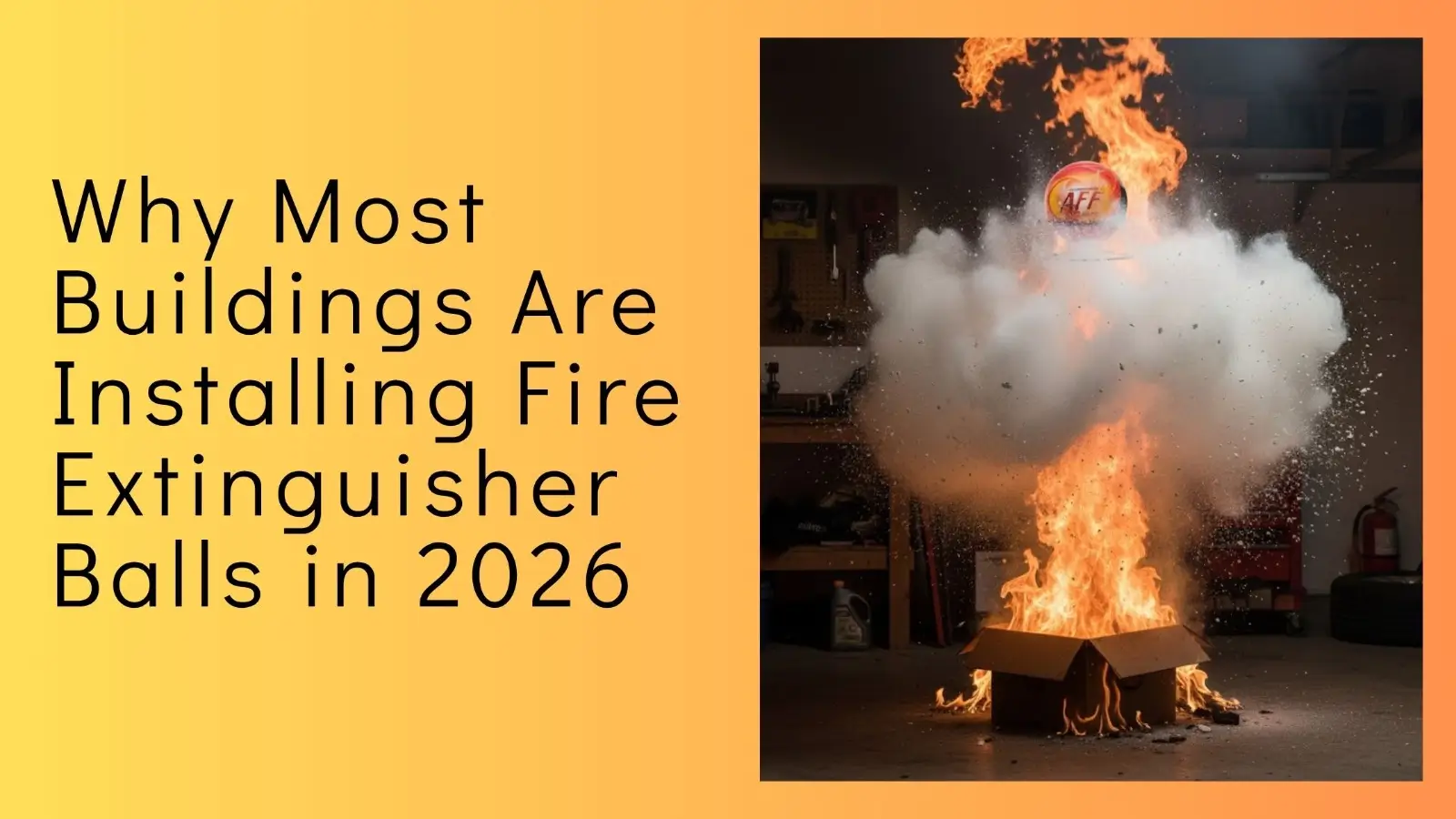
A fire extinguisher ball is a self-activating fire suppression device. It requires no human intervention whatsoever. When it comes into contact with flames, the outer shell heats to a threshold temperature — typically between 60°C and 80°C — and the internal pressure causes the ball to rupture and disperse dry chemical powder (ABC monoammonium phosphate) across a radius of roughly 2 to 4 metres, depending on the model.
The entire discharge happens in under 3 seconds.
This is fundamentally different from every other fire suppression device on the market:
- A traditional fire extinguisher cylinder requires a trained human to operate it.
- A sprinkler system activates with water, which destroys electrical equipment and inventory.
- A smoke detector alerts but does nothing to suppress the fire itself.
Fire extinguisher balls do the one thing none of these do: they act automatically, at the source, the moment fire ignites — with no electricity, no wiring, and no human required.
The 7 Locations Where Fire Extinguisher Balls Deliver Maximum Value
This is where most guides stop short. They tell you fire extinguisher balls are “good for homes and offices.” That’s not helpful. Here is a precise, application-specific breakdown of where fire extinguisher balls perform best — and why.
1. Electrical Distribution Boards and Panel Rooms
This is the single highest-value placement for fire extinguisher balls in any commercial or industrial building.
Electrical panels are the most common ignition source in Indian commercial buildings. They’re also the worst environment for human firefighting — high voltage means you cannot spray water, and most ABC powder cylinders are too large to direct precisely into a panel enclosure.
Fire extinguisher balls placed on the floor directly in front of the distribution board, or mounted just inside a large panel enclosure, will self-activate the moment electrical arcing causes a flame. They discharge ABC powder, which is rated for Class C (electrical) fires.
No staff member needs to approach a live electrical panel. No water damage to wiring. Suppression happens in under 3 seconds.
Placement rule: One ball per panel room. Position it at a height of 1 to 1.5 metres from floor level, directly facing the panel face.
2. Server Rooms and Data Centres (Small to Mid-Scale)
Enterprise data centres use expensive gaseous suppression systems. But small server rooms — the kind that exist in thousands of Indian offices, schools, and hospitals — often have no suppression system at all, just a fire extinguisher hanging on the wall outside the door.
This is a serious gap. A fire in a server rack can destroy irreplaceable data and equipment worth lakhs in under two minutes.
Fire extinguisher balls mounted on a bracket above the server rack or on the ceiling of a small server room give you immediate, automatic suppression without the collateral damage of a sprinkler. The dry powder discharge is far less destructive to equipment than water — though for high-value data centres, a CO2 or clean agent system is still preferable for Tier 3 and above.
Placement rule: One ball per 10 to 15 square metres of server room floor space. Mount at ceiling height directly above the highest-risk equipment.
3. Vehicles — Trucks, Buses, and Construction Equipment
Vehicle fires in India kill hundreds of people annually. The engine bay, fuel lines near the exhaust, and electrical wiring looms are all common ignition points — and they’re all areas where a fire can develop while the vehicle is in motion or parked unattended.
Fire extinguisher balls can be mounted in the engine bay using a heat-resistant bracket. When the engine compartment temperature exceeds the ball’s activation threshold due to fire, it discharges automatically — even with no driver present.
This is a particularly strong application for fleet operators, bus companies, truck logistics firms, and construction equipment contractors. The cost of one fire extinguisher ball per vehicle is negligible compared to the cost of a vehicle fire.
Placement rule: One ball mounted in the engine compartment, away from normal operating heat sources — position near fuel lines or electrical looms, not against the engine block itself.
4. Storage Rooms and Warehouses During Unmonitored Hours
The most dangerous period in any warehouse or storage facility is between 11 PM and 6 AM — when no staff are present, CCTV is running but nobody is watching, and a small fire from an electrical fault or rodent-chewed cable can become a total loss event before the fire brigade arrives.
Fire extinguisher balls do not sleep. They require no monitoring system, no alarm trigger, no staff action. Positioned at the top of shelving units — where heat from a fire rises first — or suspended from the ceiling via cord or bracket, they will self-activate the moment they encounter flame.
For high-value storage — pharma, electronics, textiles, raw materials — fire extinguisher balls at each storage bay are one of the most cost-effective risk management decisions available.
Placement rule: One ball per 20 to 25 square metres. Suspend from ceiling at 2.5 to 3 metres height so it sits in the flame path as fire grows upward.
5. Kitchen Exhaust Hoods and Commercial Cooking Areas
Cooking fires are Class A and Class F fires. Most fire extinguisher balls use ABC dry powder, which covers Class A (ordinary combustibles) but is not ideal for deep-fat fryer fires (Class F). Check your product specification carefully before placing them in a commercial kitchen.
That said, for general commercial kitchens — not dedicated deep-fry operations — fire extinguisher balls placed inside the exhaust hood or near the cooking range provide a meaningful layer of protection for the critical first 30 seconds before staff can respond.
Placement rule: Mount inside or directly above the exhaust canopy. If the kitchen primarily uses deep-fat fryers, pair with a wet chemical extinguisher — the fire extinguisher balls handle ignition suppression, the wet chemical handles the follow-up.
6. Generator Rooms
Generator rooms combine three fire risk factors: fuel (diesel), heat, and electrical ignition. They are also typically installed in basements or external outbuildings — away from regular staff traffic, and often locked during off-hours.
Fire extinguisher balls are tailor-made for this environment. They require no access, no human operation, and activate from the heat of a fuel fire within seconds.
Placement rule: One ball mounted on the wall at 1.5 metres height near the fuel tank or control panel. In large generator rooms above 30 square metres, use two balls placed at opposite ends of the room.
7. Lift Machine Rooms and Utility Shafts
Often overlooked entirely in fire safety planning, lift machine rooms house powerful motors, electrical controls, and hydraulic fluid — all serious fire risks. They are typically accessed by maintenance staff only, meaning a fire can develop completely undetected for extended periods.
Fire extinguisher balls here are a pure passive protection play: mount them, and let them do their job if the worst happens.
How to Choose the Right Fire Extinguisher Balls: 5 Specifications That Actually Matter
Walk into any industrial supply market and you’ll find fire extinguisher balls ranging from ₹800 to ₹8,000. The price difference is not arbitrary — it reflects real differences in specification. Here is what to examine before you buy.
1. Chemical Agent: ABC Powder Concentration
The vast majority of fire extinguisher balls use monoammonium phosphate (MAP) dry chemical powder, rated for Class A, B, and C fires. This covers ordinary combustibles, flammable liquids, and electrical fires — the most common fire scenarios in Indian buildings.
Confirm the MAP concentration is at least 75%. Lower concentrations use cheaper filler powders and deliver noticeably less suppression performance.
2. Activation Temperature
Look for a stated activation temperature between 60°C and 80°C. Fire extinguisher balls with thresholds below 60°C are prone to false activation in hot environments — vehicle engine bays in summer, industrial facilities in Rajasthan or Gujarat, any space with high ambient temperatures. Balls rated above 80°C may activate too late to suppress a developing fire effectively.
3. Discharge Radius
Quality fire extinguisher balls cover a discharge radius of 3 to 4 metres in an enclosed space. Be sceptical of claimed radii above 5 metres — this is often a marketing figure based on open-air discharge testing, not the enclosed room conditions where the powder disperses most usefully.
4. Shell Material
The outer shell should be made from impact-resistant ABS plastic, not cheaper PVC. ABS tolerates wider temperature fluctuations, is less brittle, and provides more consistent activation. Check whether the fire extinguisher balls have been drop-tested from a minimum of 1.5 metres — a quality product will not activate from accidental falls or rough handling during installation.
5. Shelf Life and Certification
Look for a rated shelf life of 3 to 5 years and evidence of third-party testing. In India, BIS certification under IS 15683 is the relevant standard for dry chemical powder extinguishers. Ask your supplier whether their fire extinguisher balls conform to this standard or to an equivalent international standard such as EN 3 or UL 299. Always insist on a test documentation package — activation temperature certificates and chemical composition reports should come standard with any reputable product.
The Compliance Reality in India: What Building Owners Actually Need to Know
This is the section most blogs skip entirely — and it’s the one that matters most if you’re a facility manager, safety officer, or building owner.
The National Building Code of India (NBC 2016) governs fire safety requirements for buildings. Under NBC 2016, fire suppression systems are mandatory for buildings above certain occupancy and height thresholds. However, the code does not specifically categorise fire extinguisher balls as a standalone suppression system — they are currently best understood as a supplementary passive device.
What this means practically:
Fire extinguisher balls cannot substitute for mandatory fire extinguisher cylinders. If NBC 2016 or your state’s fire NOC requirement specifies a certain number of ISI-marked ABC powder cylinders per floor, those remain mandatory. Fire extinguisher balls supplement that provision — they do not replace it.
However, in spaces where mandatory extinguisher placement is not practical — inside electrical panels, inside vehicle engine bays, inside utility shafts — fire extinguisher balls fill the protection gap that no current regulation addresses. Insurance surveyors increasingly view this additional layer positively during risk assessments.
For fire NOC applications: When applying for fire NOC from the relevant state fire department, present your fire extinguisher ball deployment as part of your passive suppression strategy, alongside your mandatory cylinder inventory and sprinkler or alarm system documentation. Frame it as supplementary coverage in unattended high-risk zones.
The 4 Mistakes People Make When Deploying Fire Extinguisher Balls
Mistake 1: Placing Them Too High in Open Spaces
In large open warehouses or high-ceiling spaces, mounting fire extinguisher balls at 5 metres or above means the fire will have grown significantly before enough heat reaches the ball’s activation threshold. In open-ceiling spaces above 4 metres, conventional sprinklers or suppression tubes are more appropriate. Fire extinguisher balls work best in enclosed or semi-enclosed spaces where heat concentrates quickly.
Mistake 2: Ignoring Ambient Temperature When Choosing the Activation Threshold
A fire extinguisher ball rated to activate at 65°C placed in a vehicle engine bay in Rajasthan during peak summer may experience ambient temperatures of 55–60°C during normal operation. This narrows the safety margin dangerously. For high-ambient-temperature environments, always specify fire extinguisher balls with an 80°C activation threshold.
Mistake 3: Not Maintaining a Replacement Schedule
Fire extinguisher balls are passive devices and need no regular servicing — but they do have a shelf life, typically 3 to 5 years. Many buyers install them and simply forget. Mark the expiry date visibly on the ball housing at the time of installation and set a calendar reminder for replacement. An expired fire extinguisher ball may not activate reliably when needed.
Mistake 4: Treating Them as a Complete Fire Safety Solution
Fire extinguisher balls are one layer of a fire safety system. They are not a fire alarm. They do not call the fire brigade. They do not protect an entire building. Use them as the first-response suppression layer in high-risk specific locations, alongside smoke detectors, manual extinguishers, and your building’s broader fire safety plan.
Fire Extinguisher Balls vs. Automatic Suppression Tube: Choosing the Right Device
A question that comes up often in industrial settings: when should you choose fire extinguisher balls over an automatic fire suppression tube system?
The suppression tube is a polymer tube filled with dry powder that runs through a specific enclosure — a CNC machine, server rack, or electrical cabinet — and ruptures at the point of highest heat concentration. It is a more precise, contained system designed for a known, fixed risk location.
Fire extinguisher balls are a room-level device — they discharge across a wide radius into the surrounding space from a single point.
Use a suppression tube when the fire risk is inside a specific enclosed piece of equipment. Use fire extinguisher balls when the fire risk is in a room, space, or vehicle where the ignition source point is variable. In many well-designed industrial facilities, both are deployed together: suppression tubes inside machinery, fire extinguisher balls covering the room around them.
Quick Reference: Fire Extinguisher Ball Deployment Guide
| Location | Recommended Height | Quantity Guide | Key Note |
|---|---|---|---|
| Electrical panel room | 1–1.5 m | 1 per panel | Face toward panel face |
| Server room | Ceiling level | 1 per 12 sq m | Mount above rack height |
| Vehicle engine bay | Inside engine bay | 1 per vehicle | Away from engine block |
| Warehouse / storage | 2.5–3 m | 1 per 20–25 sq m | Suspend from ceiling |
| Generator room | 1.5 m | 1–2 per room | Near fuel or control panel |
| Kitchen exhaust hood | Inside hood | 1 per cooking zone | Pair with wet chemical for fryers |
| Lift machine room | 1.5 m | 1 per room | Near motor controls |
Final Word
Fire extinguisher balls are not a gimmick. They are serious passive suppression tools with a specific, well-defined role in a comprehensive fire safety strategy. When placed correctly, in the right environment, with the right specification, they suppress fires that would otherwise go unchallenged — in the seconds before a human being could ever react.
The key is knowing where they belong and choosing a product built to the specification that your environment demands. Get those two things right, and fire extinguisher balls become one of the most reliable and cost-effective fire safety investments your building, facility, or fleet can make.